Introducing: The Hierophant’s Year.
The information below describes the purpose and structure of the group, along with the material we’ve covered so far. Please contact me if you have any questions.
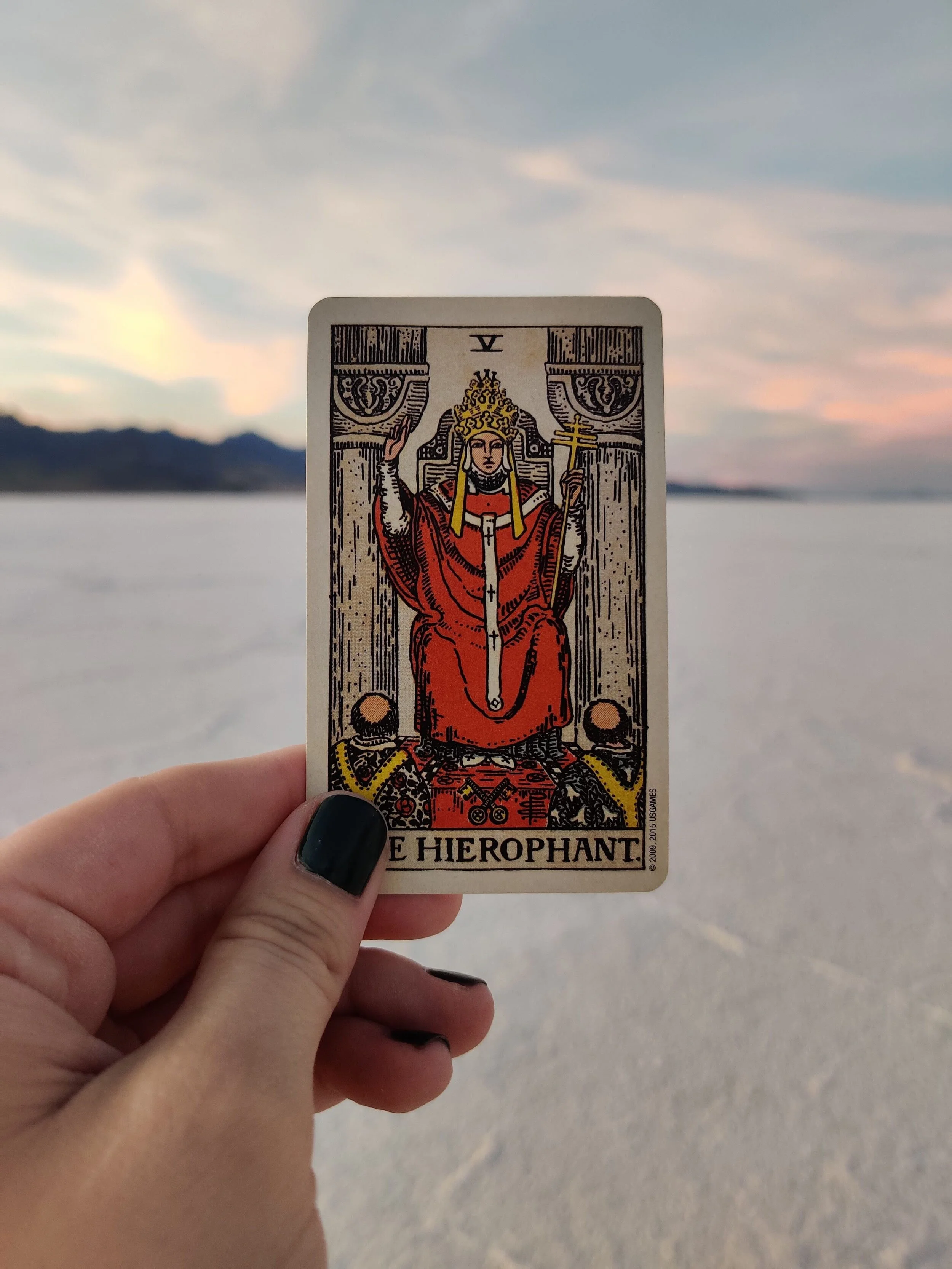
What is The Hierophant’s Year? The Hierophant’s Year is a guided tarot study community for 44 people, officially in session from December 21st, 2020 to December 20th, 2021. We’ll approach tarot as a personal examination tool, allowing each individual to develop their own ideas and techniques in a supportive environment. The community will gather online, and each group member will be supported in their learning with occasional tarot treasures delivered by mail.
How experienced do I need to be with tarot? What if I’m more or less experienced than other people in the group? This study group is planned with the beginner-to-moderately-experienced tarot reader in mind; on a scale of 1-10, with 10 being the most experienced reader, I’m aiming to serve a group of folks between 2 and 5. We’ll cover all the basics and also have ample opportunity to delve deeply, so I think everyone in the group will find conversations that excite them and help them explore aspects of tarot that are new to them. If you find you’re more or less experienced than other people in the group, that might bring up some feelings of self-consciousness or frustration, and I invite you to check in with me on that and see if there are ways I can support you. That said, a range of experience levels is absolutely expected and desired in The Hierophant’s Year. People of all levels have valuable things to both give and receive in our community.
What supplies will I need? Do I need to work with a specific deck? The only absolute requirement is a tarot deck of your choice. A dedicated notebook is recommended as well, though if you prefer to take notes in another format, that’s fine too. Because it’s so widely-used and influential, I’ll refer often to the Rider-Waite Deck, illustrated by Pamela Colman Smith; its images are easily accessible online and in various apps, so owning a physical copy of the deck is purely optional. If you don’t have a tarot deck at the moment or are simply interested in buying another, here are some recommendations:
Any version of the Smith-Rider-Waite (sometimes called the Rider, the Rider-Waite, the Rider-Waite-Smith, etc.)
The Fountain Tarot
Modern Witch Tarot
Fifth Spirit Tarot
The Aquarian Tarot
Linestrider Tarot
What platforms will be used for group discussion and connection? We’ll use four online platforms: Instagram, Patreon, Flock, and Zoom.
A private Instagram account will be used as a central gathering point for lesson materials. This account is only available to community members. Information will be delivered in posts, stories, and live videos, always saved and accessible for future use. Comments and conversation are welcome here.
Patreon will be our payment platform and a way of sending out weekly review emails to community members.
Flock is a community message board app that can be used on desktop, tablet, and mobile. We’ll use Flock for discussions, allowing us to get acquainted and share questions and insights.
Less frequently, we’ll use Zoom for live conversations. I anticipate we’ll have 4-5 Zoom calls over the course of the year. Everyone’s presence is encouraged but certainly not required; recordings of the calls will be available afterwards.
What will we study? Is there a set curriculum? I’ve come up with a schedule based on a different focus for each week. That schedule is included at the bottom of this page. We’ll start with some community-building and tarot theory, followed by dedicating a week to each card in the Major Arcana. After that, we’ll delve into the Minor Arcana (including Court Cards) and spend the final few months of the course exploring additional themes like astrology, ritual, developing your own relationship with tarot, and so forth. This schedule is subject to change according to group needs and consensus, but all the subjects listed will be covered in some way, even if the exact timing needs to be adjusted.
What will I receive in the mail? You’ll receive a brief, personalized 3-card tarot reading from me, by mail, three times over the course of the year (marking the beginning, middle, and end of our journey). The reading will be in written format, and the three actual cards that make up your reading will be included as well. Of the three cards, two will come from the Minor Arcana, and one will come from the Major Arcana. The Major Arcana card you receive will be of particular importance; you’ll have opportunities to explore that card in-depth and serve as its “ambassador” in some of our group discussions and exercises.
How much does it cost? The cost of this class is flexible. Through Patreon, you can choose your level of payment: $5, $10, $15, $20, $25, or $30 per month. Altogether, that will add up to an amount between $60 and $360 over the course of a year. Fees are charged on the first of each month. The amount you pay won’t change your level of access or attention in the study group. Pay what you feel is appropriate according to your resources.
Can I change my payment amount if needed? Yes, you can change your monthly payment at any time, no questions asked. If at any point you’d like to contribute more money as a one-time thing, without changing your regular payment amount, you can do so through Venmo, PayPal, or other means. I’ll post periodic reminders of this in the group discussion.
How much participation is required? What’s the expected time commitment? Am I going to be overwhelmed by the content? I’m definitely aware of the need to strike a good balance between too much content and too little, and I’ll pay close attention to how well we’re finding that balance, especially in the early months as we get the ball rolling. I anticipate that you’ll spend, on average, 1-2 hours on the material each week, broken up into smaller chunks each day (10 minutes here, 30 minutes there, and so forth). There’s no minimum requirement for participation, but my hope is that each group member will contribute to group discussion at least 1-2 times per week, although more is certainly welcome.
Can I leave the group if needed? Is it possible to rejoin if I leave? Can I try it out for a while to see how I feel about it? You’re welcome to leave the group at any time for any reason. If you leave and want to rejoin later on, you’ll need to check in with me first and make sure it will work with the needs and parameters of the group. Please do your best to respect the nature of the group and take your investment in it seriously; I’d rather that people not join the community “on a whim,” if that makes sense, because the idea is to have this experience as a group and support each other along the way. That said, no hard feelings at all if you decide to bow out. I know that we all have to do what feels best for us, and obviously our needs can change unexpectedly. I’m absolutely available to talk if you have any questions.
How much interaction will I have with fellow group members? That’s largely up to you. The group discussion channels on Flock are always available, and I imagine the conversations will ebb and flow according to people’s availability. Group members are welcome to create their own ways of connecting in other spaces as well.
Should I be concerned about privacy? Followers of the group Instagram account will be visible publicly; if you don’t want to risk people knowing about your interest in tarot, I recommend creating an anonymous Instagram account and using it to follow The Hierophant’s Year. Aside from that, the information we share is designed to be private. I expect all community discussions to be held in confidence by each member of the group. To be clear: it’s fine to have a conversation with a friend where you say, “Someone in my tarot study group mentioned this cool idea …” It’s not fine to screenshot and share or copy/paste anything from our community spaces in a way that makes it accessible to others, unless you receive permission from those involved. It’s also not fine to disclose the names of people in the community. Before joining, each group member will agree to this expectation. Breaking that agreement will be cause for removal from the group. With a community this small, I don’t anticipate that there will be a problem with sharing private information or experiences, but I also can’t guarantee every person’s integrity. If you have any concerns about this issue, please let me know.
Will this group work with my spiritual background/beliefs? I want the group to be open enough to welcome many kinds of people, including those who follow particular religions, those who have a less-defined belief system, and those who don’t consider themselves spiritual at all. You might view tarot as a spiritual tool or as something totally secular, and either is fine. I ask each member of the community to be accommodating of those who believe or approach spiritual matters differently from them.
Who’s welcome in the group? The Hierophant’s Year is open to people of all genders, ages, races, ethnicities, sexualities, locations, religions, and abilities, and I expect every member of the group to maintain respect for those who are different from them in these and other areas. I’m happy to make any possible accommodations for those who are blind, hard of hearing, or otherwise in need of support; in the intake form for the group, you’ll be able to express whatever needs you have in this area, and we’ll figure out the best way to make things work. I’m less confident in my ability to make this an accessible community for people who aren’t proficient in English, due to the volume of group discussion and difficulty with translation. If that’s a concern for you, please contact me before deciding whether The Hierophant’s Year is a good fit.
Will group discussion be moderated? Yes. You can find a list of the community expectations below, and if any problems arise, we can revisit those expectations as a group and update them.
Will there be any in-person meetings? No. Our community members live in many different locations, and 2021 will continue to require precautions related to Covid-19, making parties and so forth a risky prospect. If folks who live near each other want to connect and see one another in person, that’s obviously their business, but I won’t organize any official in-person gatherings for the group.
What will this group help me to learn? What will I know at the end of 12 months that I didn’t know at the beginning? Here’s what I envision: At the end of 12 months, you will …
have a working relationship with tarot as a tool for introspection, connection, evolution, and emergence;
know various ways of interacting with the cards, helping you figure out what does and doesn’t work for you;
see tarot as a powerful ally for discovering your own ways of contributing to a liberated and liberating world;
have access to hundreds of resources for deeper investigation;
stand on a foundation of knowledge to support the continuing development of your own unique understanding of the cards.
These measures of success are what I’m aiming for, and I also want to be straight-up about the fact that this is an experiment. I’ve never organized a community centered on tarot or come up with a 12-month course of study, and I’m guessing you’ve never been part of something like this either. So the actual outcomes are dark, as in mysterious, as in unknown. It’s impossible to predict exactly how it will all unfold and what specific benefits you’ll find for yourself, but I’m confident in the possibilities, and I believe we’ll create something wonderful together.
Is there anything else I should know? Yes! Please enjoy this mini-manifesto …
The Hierophant’s Year is a 12-month tarot study community. The 44 people who gather in this community will engage with tarot as a tool for self-reflection, healing, personal evolution, and justice in the broader world. Our community welcomes people of all backgrounds. We commit to honor individuality, practice open and respectful communication, and embody values of inclusivity, anti-racism, interdependence, and responsiveness. This undertaking is organized and steered by Sara Hanks of Cottonwood Tarot.
Community Expectations and Standards
Stand in your own power and honor others as they stand in theirs. This means claiming your own experiences without discrediting the experiences of others; it also means understanding that other people’s choices aren’t a criticism of yours. We can all hold a space where various interpretations and values are celebrated.
By joining The Hierophant’s Year, you agree to respect the privacy of your fellow community members. Unless you have the explicit permission of all participants in a conversation, nothing shared in community spaces is to be quoted or copied to any other forum. This also applies to the names of community members and to lesson materials and any supporting documents; please keep all these things in confidence.
Please don’t delete posts or comments you make in The Hierophant’s Year unless you made the post in error (like accidentally posting in the wrong thread, for example) and deleting will not interfere with group discussion.
Tarot is capable of incorporating the lived, earthly realities of this moment and every moment. Our community approach to tarot education will remain mindful of history and culture. In conversations related to race, sexual orientation, class, neurodiversity, gender, or any other dimension where some communities are advantaged at the expense of others, we will strive to prioritize the needs and thoughts of people who are most directly affected by oppression, and we’ll all do our best to show humility in response to subjects that we don’t intimately understand. We’ll embrace correction and adjust as needed.
We will build a community together. None of us can know beforehand what it will be by year’s end. Our only metrics for success in this area are how faithfully we hold each other’s sacredness and stay true to our values. We’ll support each other however we can while also respecting our own boundaries and needs. We won’t fake a bond that doesn’t exist, but we will show up as authentically as possible. With one another, we’ll practice the world we want to create.
The Hierophant’s Year Weekly Outline
Getting Acquainted in Our Community (week of December 21, 2020)
Building the Framework: Tarot in Real Life (December 28)
Meeting The Fool (January 4)
Meeting The Magician (January 11)
Meeting The High Priestess (January 18)
Meeting The Empress (January 25)
Meeting The Emperor (February 1)
Meeting The Hierophant (February 8)
Meeting The Lovers (February 15)
Meeting The Chariot (February 22)
Meeting Strength (March 1)
Meeting The Hermit (March 8)
Meeting The Wheel of Fortune (March 15)
Meeting Justice (March 22)
Meeting The Hanged Man (March 29)
Meeting Death (April 5)
Meeting Temperance (April 12)
Meeting The Devil (April 19)
Meeting The Tower (April 26)
Meeting The Star (May 3)
Meeting The Moon (May 10)
Meeting The Sun (May 17)
Meeting Judgment (May 24)
Meeting The World (May 31)
Recapping and Relating to The Major Arcana (June 7)
Mid-Year Check-In (June 14)
Exploring The Suits (June 21)
Exploring The Aces (June 28)
Exploring The Twos (July 5)
Exploring The Threes (July 12)
Exploring The Fours (July 19)
Exploring The Fives (July 26)
Exploring The Sixes (August 2)
Exploring The Sevens (August 9)
Exploring The Eights (August 16)
Exploring The Nines (August 23)
Exploring The Tens (August 30)
Embodying The Pages (September 6)
Embodying The Knights (September 13)
Embodying The Queens (September 20)
Embodying The Kings (September 27)
Special Card Relationships (October 4)
Ethical Tarot (October 11)
Using and Creating Tarot Spreads (October 18)
Working with Decks (October 25)
Tarot and Astrology (November 1)
Tarot and Ritual (November 8)
How to Read for Yourself (November 15)
How to Read for Others (November 22)
Claiming Your Sovereignty (November 29)
Messages from the Cards (December 6)
Goodbye Tour (December 13)
Week One: Getting Acquainted
Hello, Hierophants, and welcome to Week One!
🎉🎉🎉
This week, we're getting acquainted, both with each other as community members and with some basic terms of tarot.
∆
Throughout the week, I'll share vocabulary that comes up a lot in discussions of tarot. Covering these terms will help you navigate our conversations and do your own deeper research, should you so choose.
∆
As far as getting acquainted with one another, those of you on the Flock app can go into the Weekly Study channel and share a little about yourselves. You can get deep, be silly, or do whatever feels right! You can also share Getting-To-Know-You style posts here on Instagram, and if you tag @thehierophantsyear or send them to me in a DM, I'll share the posts in stories and let everyone meet you that way.
∆
This is definitely a low-key week—that's on purpose. We're still finding our feet in this community, and I want to make sure we have a solid foundation before diving into the deep end. Thanks for all your support and sharing so far, and I can't wait to see where this goes!
Let's start at the very beginning (a very good place to start): WHAT IS TAROT?
∆
Tarot is a deck of 78 cards said to have magical dimensions or the power to reveal hidden truths.
∆
The origins of tarot are a bit mysterious, as are the origins of any Very Old Thing. Many stories and theories have popped up over the centuries. We know for sure that the cards were used in the 15th century and later gained prominence as a divinatory tool among the Romani people. The 18th and 19th centuries saw heightened interest in the occult, and through secret societies like the Order of the Golden Dawn, tarot reached new audiences. Tarot has seen a few significant resurgences in the public consciousness since then, most notably in the 60s/70s and also in the past 5 years or so.
∆
There are many kinds of card decks out there (more than ever these days). Tarot decks must follow a specific order and include specific cards, but the way those cards are named and portrayed can vary.
∆
To me, a deck qualifies as "tarot" as long as it contains the 22 cards of the Major Arcana and four suits (each including the ace through ten, along with four court cards). The artist might toy with the names and even throw some extra cards into the mix, but as long as those essentials are covered, it's tarot.
Continuing on with our tour through tarot vocabulary: WHAT IS THE MAJOR ARCANA?
∆
From Joan Bunning's book "Learning the Tarot": "The word 'arcana' is the plural of 'arcanum,' which means 'profound secret.' To the alchemists of the Middle Ages, the arcanum was the secret of nature. The tarot cards are therefore a collection of the 'secrets' that underlie and explain our universe. The 22 cards of the major arcana are the heart of the deck."
∆
The Major Arcana is one part of a tarot deck, comprising 22 cards from The Fool to The World. These cards represent the major secrets (or mysteries) of life.
∆
Though they make up less than a third of the deck, the cards of The Major Arcana are the most iconic, recognizable even to people who know nothing about tarot. And in a reading, these cards tend to be the focus whenever they appear. The lessons and themes of the Majors are both broad and deep, and they connect us to the most profound aspects of human existence.
WHAT IS THE MINOR ARCANA?
∆
Yesterday I touched on the Major Arcana (see last post). Its counterpart, the Minor Arcana, makes up the rest of the tarot deck. Its 56 cards are split between four suits, and together, they cover the so-called minor secrets or mysteries of life.
∆
The Minor Arcana is structured a lot like an ordinary deck of playing cards. The four suits (typically called Wands, Cups, Swords, and Pentacles) each contain ten cards, numbered from Ace to Ten. Instead of the traditional Jack, Queen, and King, there are four crowning personalities in each suit, the Court Cards. They most often go by the names Page, Knight, Queen, and King.
∆
Where the Major Arcana is all about big themes, overarching lessons, and powerful turning points, the Minor Arcana reflects on day-to-day concerns. Where the Majors are descriptive ("here's what's happening"), the Minors are prescriptive ("here's something you can do"). The Minors don't necessarily carry the same punch of the Majors, and it can be easy to overlook them in favor of flashier cards. But if you give them a little more credit and time—if you sit by the fire of the Wands, swim in the water of the Cups, breathe the sharp air of the Swords, dig around in the dirt of the Pentacles—the rewards are immense. This is where the conceptual magic of tarot meets the reality of our actual lives.
WHAT ARE COURT CARDS?
∆
Court Cards are the people of the tarot. These sixteen cards are divided equally, with four courts in each suit, most frequently called the Page, Knight, Queen, and King.
∆
Technically, the Court Cards are part of the Minor Arcana, because they're organized by suit. But they kind of have a flavor all their own, and they deserve special consideration.
∆
Many tarot resources, especially old-school ones, view the Court Cards as representatives of actual people in your life. The Knight of Cups might symbolize a charming romantic, the Queen of Swords an icy older woman. I respect the traditional significance of those interpretations, but it doesn't resonate with my experience of Court Cards.
∆
Don't get me wrong: the Court Cards (and all cards in the tarot, really) *can* show up as stand-ins for actual people in your life. This happens most often when you seek out a reading specifically to sort through an important relationship or interpersonal dynamic.
∆
But at their core, I think the Court Cards represent parts of *us.* Parts of you. Parts of whomever is receiving the reading. We're all such complex creatures, with many sides that become more and less dominant depending on the situation. The Court Cards correspond with those different selves, inviting us to embrace the skills and spirits that will be in our best interest at any given time.
WHAT IS A SPREAD?
∆
In tarot, "spread" refers to an arrangement of cards, typically meant to explore a theme, answer specific questions, or represent different options.
∆
There are entire books full of tarot spread examples, along with countless content creators out there coming up with their own spreads and sharing them with the world. The simplest spreads involve just two or three cards, and at the other end of the spectrum, I've seen spreads that use every last card in the deck, all 78 of them laid out in the shape of a spiral or a star.
∆
Whether you're using a tarot spread that originated with someone else or one that comes from you and you alone, you're usually looking at a series of questions and tarot cards that serve as the answers. A simple three-card spread might ask:
1. What is happening now?
2. Why is it happening?
3. What can I do about it?
Once the questions are defined, you can draw a card for each one. The three cards together serve as a basis for investigation and clarity.
∆
Not everyone works with pre-planned or strictly-defined spreads. If there's another way of approaching tarot that works better for you, huzzah! Still, spreads are a useful component of a tarot practice for most people, and playing around with them can help deepen your familiarity with the cards and the relationships between them.
WHAT IS A REVERSAL?
∆
In tarot, a reversal refers to any card that appears upside-down in a reading, potentially shifting its meaning.
∆
When I started out with tarot, I never read reversals. 78 cards felt like enough of an undertaking, so if a card happened to be reversed when I was reading, I'd just flip it around. Once I got more experience and confidence, I started to incorporate reversals, but even now, I don't see them all that much; the way I shuffle my cards doesn't allow for them to go upside-down all that often. And for what it's worth, I know of several well-respected, professional readers who have been working for years and don't do reversals, so it's definitely not a requirement in order to be a "real" tarot reader. It's all about what feels right for you.
∆
If you do want to work with reversals, my suggestion is to think of them as "twists" on the traditional card interpretations. It helps to start out by thinking through what the upright version of the card might be saying, then investigate what "twist" the reversal brings to that default meaning.
∆
Reversals are a highly-individual part of any tarot practice, and there's no one-size-fits-all way of approaching them. A reversal can soften a card's intrinsic message, making it less urgent or intense. A reversal can caution you against taking the course of action that the upright card might suggest. Reversals can also indicate that a card's energy is being resisted, that there's some block to be addressed. These are just a few examples; the "twists" are many and multi-layered. Context and intuition will be your greatest allies in determining what each reversal is saying to you in every unique moment.
WHAT IS A CLARIFYING CARD?
∆
Sometimes you do a reading and you see a certain card and you're like, "... what?" You can't sort out what it's saying, just a big fat question mark of irrelevance or a piled-up mess of possible interpretations. What do you do in those moments?
∆
There are a few options. You can walk away confused, hoping some ideas will come to you throughout the day. You can consult outside resources, like guidebooks, teachers, or friends (this is happening in our Interpretations channel on Flock, and it's so so cool!). You can also utilize clarifying cards.
∆
A clarifying card is an extra card that's meant to give you a little more insight in a reading. Most often, clarifiers are drawn after a reading is complete in order to give additional information.
∆
Clarifying cards can be used in a general sort of way, such as in instances where you're done with a reading but feel like there's still a little more to be said. In that case, you might shuffle the cards and ask "Is there anything else to know?" You can also draw them as addendums to particular cards that are puzzling you. If you do a five-card reading and The Emperor is making you go 🤨🧐🤔, you can draw another card specifically as a clarifier for The Emperor. The two cards can then work together to highlight certain themes.
WHAT IS A QUERENT?
∆
In any tarot reading situation, there are two factions: a reader and a querent. The reader is the one who shows up to translate the language of the cards. The querent sits on the other side of the table (literally or metaphorically). The querent is the person seeking a tarot reading, the one for whom the cards are drawn and interpreted.
∆
Querents come in all forms. Some are familiar with tarot, and others have no context for the cards. Some are believers, and some are skeptical, and many are a little of both. Sometimes querents seek out a reading because they're curious. Sometimes they're motivated by boredom. Sometimes they're deeply hurting, confused about what they're experiencing or what they're supposed to do. Being a querent is inherently vulnerable, because you are trusting someone or something outside of yourself to weigh in on your life. That willingness to invite an outsider's perspective must always be honored.
∆
Not every tarot reader goes into professional work or offers their services to other people; reading only for yourself is a perfectly valid way of working with tarot, and in fact, it's beautiful. Whether or not you ever pull cards for another person, the querent/reader dynamic is still present even in readings you do for yourself. In those encounters, you claim dual roles. Both/and. You are the reader, consulting your intuition and education to convey the cards' messages, and you are also the querent, approaching with some amount of trepidation and hope. Remember to hold space for yourself as a tender seeker of help.
WHAT IS DIVINATION?
∆
Divination is the supernatural practice of reading or predicting the future.
∆
Many methods and tools of divination exist. Some people read runes or tea leaves or shapes in melted wax. Others use pendulums. Osteomancy is divination using bones. Lithomancy is divination using stones. Numerology, astrology, water scrying, automatic writing, bibliomancy, gazing into a crystal ball, vivid dreams ... the list goes on and on (seriously, look up "methods of divination" on Wikipedia and marvel at what you see).
∆
Cartomancy is the use of cards to see or "divine" the future. Tarot has historically fallen under this umbrella. There are numerous examples of books, movies, and TV shows where a character visits a tarot reader and receives some news about what awaits them in the future (spoiler: the news is usually bad), and the notion of using tarot for purposes of divination has its roots in centuries of cultural tradition among the Romani people of Europe and Central Asia.
∆
In my experience, the current generation of renewed interest in tarot has seen less emphasis on tarot as a divinatory tool and greater emphasis on the way tarot can serve a therapeutic function. In other words, it's more about healing the past and understanding the present than predicting the future. Of course, there's huge variation on that front; many tarot readers have divinatory gifts and find that tarot supports their work in that way.
∆
That said, I gravitate to a more open-ended view of the future, a belief that there are many possible ways for things to unfold and that we're not locked into a defined outcome. This is the tarot philosophy that I'm bringing into our study group.
WHAT IS THE SMITH-RIDER-WAITE?
∆
The Smith-Rider-Waite is a highly-influential tarot deck, named for its illustrator (Smith), publisher (Rider), and creator (Waite). The deck goes by many names, including the Rider, the Rider-Waite, the Rider-Waite-Smith, or some combination of the initials (SRW, RWS, etc.).
∆
The Smith-Rider-Waite was first published in 1909 and has since been rereleased in a variety of sizes and forms. It was conceptualized by poet and mystic A.E. Waite, influenced by the Hermetic Order of the Golden Dawn, a secret society devoted to study of the occult and metaphysical.
∆
Traditionally, prior to the SRW, tarot decks featured Minor Arcana cards that were represented only with a certain number of the suit's emblem (for example, the Two of Cups would be a card with two cups, the Five of Swords would be a card with five swords, etc.). Pamela Colman Smith took an innovative approach by creating pictorial scenes for the Minor Arcana, giving each one more interpretive potential.
∆
The Smith-Rider-Waite is iconic. Its visual style is timeless, and it has formed the basic inspiration for hundreds (if not thousands) of subsequent tarot decks.
WHAT IS THE THOTH?
∆
The Thoth is another influential tarot deck from the 20th century, created by Aleister Crowley and painted by Lady Frieda Harris. Sometimes called The Book of Thoth, this deck differs from the Smith-Rider-Waite in some key ways and relies upon complex systems of symbolic meaning.
∆
The Thoth was published in 1969, though the artwork and accompanying guidebook were created in the 1930s and 40s.
∆
I'm gonna level with you: The Book of Thoth is ca-ray-zy, but in such a good way. The art feels like it came from another dimension. The symbolic correspondences are mind-boggling. And given that my personal tarot study comes from decks and books based on the Smith-Rider-Waite, I am not qualified to teach anyone anything about Thoth.
∆
So why'd I bring it up? Well, in all the cross-pollination of the tarot world, it's very likely that some of you are working with decks that have some Thoth DNA mixed in. Some notable markers are the switching of Strength and Justice (the SRW has Strength as card 8 and Justice as card 11, while the Thoth flip-flops those and actually renames "Strength" as "Lust") and a different naming/ranking system for the Court Cards (instead of Page-Knight-Queen-King, the Thoth has Princess-Prince-Queen-Knight). If you notice any disparities between the decks you use and the information I'm describing or the discussions that are taking place, it might be a Thoth/SRW thing, and if needed, you can turn to the internet or dozens of books to help you sort it out.
∆
As always, no matter the specifics of the deck(s) you use, your most reliable education will come from practice and intuition. Feel into what your cards are telling you, evaluate outside information, and you'll develop ways of understanding tarot that fit whatever you need, wherever you go.
Week Two: Building Our Framework
Hello, Hierophants, and welcome to Week Two!
🎉🎉🎉
This week, we're building our framework. We'll explore some concepts and values that are central to my personal understanding of tarot and that I want to pass along for your consideration.
∆
Throughout the week, I'll share posts that sum up some big ideas, and as I do, I want to be clear that my understanding of tarot is still evolving (and probably will be for decades to come!). My views don't have to be yours, and you don't have to take anything I say as the gospel truth. You all decided to trust me to play some role in your tarot education, so I want to show up with everything I have to offer, but it's always yours to evaluate and incorporate as you see fit.
∆
Feel free to share thoughts and questions in the comments or in the Weekly Study channel on Flock.
∆
Here's to a great week, the last few days of 2020, and the beginning of 2021! 🥂
Core Concept 1: WE LEARN TAROT BY OBSERVING LIFE.
∆
Once you have a little familiarity with tarot cards, whether it comes from guidebooks or classes or a study group like this one, your best education will come from the world around you.
∆
You can know intellectually that the Five of Cups stands for loss and disappointment, but your understanding becomes a lot more intimate when you experience devastation in one of your most precious relationships and have three friends reach out in the week afterwards and tell you they pulled a card for you and got the Five of Cups. (This happened to me.)
∆
You can have a basic understanding of The Empress's complex earthy power, but watching "Moana" and seeing Te Fiti and Te Ka on the screen somehow makes it much more real.
∆
You can read a description of the Queen of Wands and process the words intellectually, but your connection to her energy is much stronger when you realize this card is embodied in the daring, charismatic friend you've known since middle school.
∆
Real life is the teacher. Real relationships and goals and moments of crisis. Real experiences with the world of film, literature, music, and politics. Real observations of natural processes in the animal and botanical realms.
∆
As much as possible this year, notice the world around you and ask yourself, "How does this teach me about tarot?" You might not have any answers at first, and that's absolutely okay—take your time and give yourself all the room. But when you do come up with an idea that means something to you, make a note of it. This is how you build a catalog of tarot meaning that's beautifully intertwined with your own life.
Core Concept 2: TAROT IS MAGIC BECAUSE YOU ARE MAGIC.
∆
Many people who work with tarot consistently will tell you that it's magical -- not in a figurative or metaphorical way, but literally magical. I believe the same thing, but I'll level with you: I don't know what "magic" really is, and when I say that tarot is magic, I'm not sure what that means. Does it mean that there are supernatural forces and lingering spirits guiding your fingers to shuffle the cards in a certain way and cut the deck in a specific place, all so you'll see the exact right cards?
∆
... hey, maybe. (I don't know how the universe works. I'm not ruling anything out.)
∆
My guess, though, is that the magic of tarot is less mysterious than that. The magic comes from our interaction with these cards, and ultimately, the magic isn't found in the cards themselves; the magic is located within us.
∆
Tarot is magic because we are magic.
∆
Maybe an example will help: Have you ever had a song come on the radio at the exact moment when you needed to hear it? Have you thought, "Whoa, that is some bizarre timing"? It can feel kind of magical, kind of meant-to-be. Does it mean that the radio station itself is mystically led, or that the guitars and pianos and drums that made the song years before were charmed with spells and potions? Probably not. A more likely explanation is that we live in a magical world where strange, unlikely, beautiful things happen all the time, and we are magical people who take part in those strange, unlikely, beautiful things and have the ability to notice them when they occur. That's the kind of magic tarot taps into. The magic of existence.
∆
I think tarot harnesses magic in a really special way, for reasons I don't understand, but ultimately, harnessing is all it's doing. It doesn't create magic; it doesn't possess magic. It's just a handy way to access magic.
∆
So here's my bottom line answer to this question: Yes, tarot is magic. It's magic because of the magic we bring to the table.
Core Concept 3: YOU HOLD THE WISDOM YOU SEEK. TAROT IS A KEY TO UNLOCK IT.
∆
Let's imagine for a moment that you're in a really happy, healthy romantic relationship, and you're approaching your first anniversary. Things are going well with this person. You feel supported, and you're in love, and the life you're starting to build with them is satisfying to you both. You decide to draw a tarot card that represents what you need to know about your relationship in this moment, and the card that shows up is The Devil.
∆
"Yikes!" you say to yourself. "The Devil brings up themes of imprisonment and being so accustomed to your own lack of freedom that you barely even notice it anymore. What does this say about my relationship? Am I trapped without realizing it? Do I only *think* I'm happy with this person? Is our partnership a prison?"
∆
Okay, slow down, brain. This kind of reaction is very common in tarot readings where thorny cards show up unexpectedly. But if it's not helpful to your soul or state of mind, dig deeper. The Devil card brings up those themes, and perhaps the recognition that you *don't* feel trapped in this relationship is the most valuable gift the tarot can give you in this moment.
∆
We can really psych ourselves out by thinking of tarot as a source of wisdom that's outside of us. In the hypothetical situation we're looking at, you could conclude that something big must be amiss in their relationship, and that even though you don't know what that big thing is, the relationship is doomed. But if that idea doesn't square with what you know and feel, and more importantly, *if you can only accept that assessment by denying your intuition*, it's time to take a deep breath and start again.
∆
Here's the deal: Tarot doesn't know more about your life than you do. It's not the expert on you. It's not the ultimate holder of wisdom. You are.
Core Concept 4: YOUR METHODS AND INTERPRETATIONS ARE THEIR OWN JUSTIFICATION.
∆
This is something I'll say over and over again in different ways throughout our time together. I don't want there to be any confusion as we talk about the cards or various ways of approaching tarot that, yes, this is the way I do things, but if you have a different way, that's GREAT. There is no problem to resolve and nothing to explain.
∆
Allow room for evolution in your practice. You'll very likely find that your understanding of certain cards will change over the months or years. You might hear an idea from a fellow reader that makes you look at The Emperor or the Knight of Swords or the Five of Wands with new eyes. You might be introduced to a new way of reading that's more or less rigid than you've done before and discover that you really like the change. And that's fantastic! Just as it should be!
∆
It doesn't mean that your previous way of interpreting that card, or your previous way of reading, was wrong. It doesn't mean you need some elaborate, well-researched explanation for why you like the new way better. Think about the change, of course, and see what it might be teaching you, in tarot or in life. But remember that your interpretations and methods are their own justification. No apologies necessary. The way tarot shows up for you in this season of your life is exactly right, and if it's time for a shift, you can trust that the way forward will show up in good time and you'll recognize it when it does.
Core Concept 5: THERE ARE MANY POSSIBLE FUTURES.
∆
Last week, we talked briefly about divination, ie the practice of using magical tools or extrasensory powers to learn something about the future. Many people use tarot cards in a divinatory way.
∆
The question of divination leads us down a winding path to some of the most enduring questions of human existence: is the future predetermined? Are we predestined for certain experiences? If so, who or what is dictating that fate? If not, does that mean there's no rhyme or reason to anything? Do things "happen for a reason"? What is the reason? Supposing we *could* get a peek into the future, would we want to? Does knowing the future change who we are in the present?
∆
These questions are above my pay grade, folks.
∆
For our purposes, I'll tell you what makes sense to me 90% of the time, the belief that most consistently informs my own work with tarot: there are many possible futures. Lots of things could happen. We don't know which ones *will* happen. Tiny clues give us some good guesses, but truly, the future is non-existent until it actually happens, and then it's not even the future anymore.
∆
Sometimes, a reading will help you identify an intuitive sense of what your future holds. That can be very real. Don't discount those moments. But is this the primary function of tarot? I don't think so. I think tarot is more useful when it helps you reflect on the present and make sense of the past. And doing that helps you enter your days with more clarity around which future you want to bring into being.
Core Concept 6: SWEET AND BITTER ARE FOUND IN EVERY CARD.
∆
Some tarot cards tend to get an immediate positive reaction. People are happy to see them; their names and imagery bring up thoughts of pleasure, peace, or good fortune. Some examples: The Sun, the Ten of Cups, the Nine and Ten of Pentacles, the Four of Wands.
∆
Some tarot cards tend to get an immediate negative reaction. People are sad to see them; their names and imagery bring up thoughts of pain, suffering, and doom. Some examples: The Devil, The Tower, the Five of ... well, anything, the Ten of Wands, several cards from the suit of Swords.
∆
Any kind of emotional response to a particular card, whether fearful, hopeful, or neutral, is valid and worthy of attention. One thing I want to emphasize in our community is how every card is complex, bringing both gifts and challenges. This might complicate our initial reactions, and I think that's a good thing.
∆
When talking about the complexity of every card, I like to use the words "sweet" and "bitter." Other sources sometimes use words like "light/dark" or "high-vibe/low-vibe," but I've intentionally chosen not to follow in their footsteps because I want to be mindful of how my language choices might reinforce a cultural habit of associating "light" and "high" with GOOD and "dark" and "low" with BAD. We can't fully appreciate some of tarot's most beautiful teachings if we're negatively-disposed to darkness and shadow or anything that's in close proximity to the ground.
∆
I also like the "sweet/bitter" dyad because it's not a strict binary (there's a huge spectrum between 100% sweet and 100% bitter) and because, as we all know, there are foods that are too sweet, so sweet they make us sick, and there are other foods we'd describe as bitter, but in a way we crave and enjoy. Neither sweet nor bitter is a synonym for GOOD or BAD. Our tastes change. Our cravings change. Both sweet and bitter are vital, and every card has some delicate, singular ratio of the two.
Core Concept 7: TAROT IS CAPABLE OF ADDRESSING THE COMPLEX REALITY OF THIS MOMENT AND EVERY MOMENT.
∆
I first came to see tarot as a tool for personal reflection. I looked for my own story in the cards, my own emotions and fears and goals and relationships and memories. I still believe this is a valuable way of engaging with tarot.
∆
When George Floyd was killed in May of 2020 and the nation responded with Black Lives Matter protests and conversations around police brutality, I was caught up in a desire for change and the need to educate myself more thoroughly, as I'm sure many of you were. This was a moment of clarity for me in regards to my tarot practice. In those Spring and Summer months, living amidst an uprising for justice against the backdrop of a global pandemic that was highlighting our dependence on one another more starkly than ever before ... I couldn't think the same way about tarot. If it was *only* about me and my little life and my little concerns, I didn't want it. I couldn't make myself care about something that didn't involve the best interests and the deepest healing of every being on Earth.
∆
So here's where I very quickly landed: tarot contains the micro and the macro. It addresses both, or at least it can. Tarot is strong enough and big enough to say something about your fight with your sister and about economic disaster. It might even say the same thing about both.
∆
And as hard as it may be to understand (especially if you're a binary thinker like I am), tarot is actually able to dissolve the boundaries between micro and macro, between you and them, between personal and political. Non-duality. These are not separate spheres. As adrienne maree brown says in the book "Emergent Strategy": "What we practice at the small scale sets the pattern for the whole system." So when tarot tells you something about you, it's still talking about the big stuff. And vice versa.
∆
Point being: in this community, we're not divorcing tarot from the most pressing questions and issues of our world. I don't think doing so would be responsible, and I'm also straight-up uninterested in having conversations about tarot that don't incorporate what's going on all around us.
∆
So let's make ample room for the complex reality of this moment and every moment, joy and uncertainty and justified anger and lighthearted observations. All of it. Let's talk about how to "see our own lives and work and relationships as a front line, a first place we can practice justice, liberation, and alignment with each other and the planet" (quoting AMB again). Let's talk about the ways tarot lines up with our understandings of gender, race, class, education, bodies, families, communities, love, and power. From the decks we use to the interpretations we favor, from the way we make space to the way we hold boundaries, how are we practicing our values? It's a work in progress. Let's see what we learn. ❤️
Core Concept 8: TAROT INVITES BUT DOESN'T COMMAND, REFLECTS BUT DOESN'T JUDGE.
∆
I watched a sitcom when I was a kid (no idea what it was) with a running joke about a guy who only answered questions by asking another question. Something like this:
"Do you happen to know the time?"
"Do you see me wearing a watch?"
... or ...
"Did you really mean what you said earlier?"
"Have you ever known me to say something I didn't mean?"
∆
I think tarot cards behave a lot like that. We go to them with questions, and instead of giving a straightforward response, they ask questions in return.
∆
"Well, have you ever thought of it this way?"
"Would it make a difference if what you're fearing actually happened?"
"Is there something deeper going on here?"
"When did you start feeling this way?"
"How much energy are you giving to this problem?"
∆
Tarot can help you find your own answers, or find your way to better questions, by inviting you to contemplate something from a new perspective and reflecting your own knowledge back to you. What tarot *doesn't* do is order you around or try to make you feel like a dumbass. It's not some stern nun or intimidating drill sergeant or gossipy popular kid trying to shame or reform you.
∆
Insofar as tarot has any kind of motivating desire (which I know may be a stretch depending on what you believe about tarot, but go with me for a second) ... tarot is motivated by a desire to see you claim sovereignty in your own life. It wants you to know what you are and aren't responsible for, and it wants to help you make kind, wise decisions that come from a deeply-honest place inside of you. Those goals aren't met if tarot tries to force, guilt, or pressure you into any course of action.
∆
Tarot is here to help. It's here to support. It's not here to be the boss of you. Because YOU are the boss of you. If tarot knows anything, it surely knows that. Make sure you do too.
Week Three: Meeting The Fool
The Fool is the beginning. As Card 0, it stands somewhat apart from the rest of the Major Arcana, able to be inserted anywhere along the way without changing the essential nature of the other cards; add zero to any number, and the number stays the same. There’s a little bit of The Fool in every other tarot archetype.
∆
The tarot itself is often called The Fool’s Journey, and throughout the rest of our time in the Major Arcana, you can imagine this naive, trusting figure stumbling forward into a quest they never imagined, meeting each of the other archetypes and eventually mastering their lessons.
∆
The Fool moves from feeling and desire, not intellect, the way a baby moves its limbs and makes noises without any thought or restraint, just going on instinct. Instinct is all The Fool has, really; any other way of moving through the world hasn’t had a chance to develop.
∆
In a reading, The Fool often stands for fresh starts, limitless potential, and not knowing what the hell you’re in for. It’s a beautiful energy to channel when you need to follow your gut, because as someone with no experience or understanding of what it’s like when things go wrong, The Fool simply moves forward without hesitation. The Fool doesn’t doubt, fidget, or stutter. It’s all heart, all faith, all the time. This method of travel has its downsides, of course; that's part of The Fool's nature as well.
∆
In Pamela Colman Smith’s iconic illustration of The Fool, we see a joyful young man, dressed colorfully, eyes in the sky, mere seconds before diving head-first off a rocky cliff. He didn’t know he needed to watch his step. The Fool is in for a hard fall and a harsh awakening. That said, life's grandest leap is the one that brings you home to yourself. The leap can be a huge risk, but it doesn't have to be. It can be an irrevocable turning point, but it doesn't have to be. Trusting your heart can show up in the tiniest ways, and that’s what The Fool encourages.
∆
THE SWEET: trust, bliss, pure presence in the moment, following your heart, a willingness to risk
∆
THE BITTER: lack of preparation, inexperience, biting off more than you can chew, a privileged assumption that everything will work out
I posted a video on Instagram that takes you through some of the common symbols of The Fool as seen in a variety of decks.
∆
- The Fool originated as a figure of madness, punishment following error, folly, being on the fringes of society, the eccentric.
- Rooted in the traditions of HOLY FOOL (humble person touched by divinity, not bound by society’s constraints) and COURT JESTER (able to say the outrageous or too-honest thing, outside the court hierarchy
- the dog (a voice of warning; may stand for protective primal instincts that are alert to danger; The Fool is instinctively motivated, but on the side of pursuing pleasure rather than avoiding pain, and does not notice the dog’s warning)
- the sun (symbol of life and light; astrologically, represents the self; sun is behind The Fool, shining brightly, illuminating the entire landscape; Fool is not self-aware but entirely self-contained)
- the staff and bundle (staff is like the wand, bundle is said to contain a sword, cup, and coin)
- the mountain and the cliff (mountains represent challenges and needed growth, and in this card, they show up both above and below The Fool’s current location; The Fool is falling into challenge; the cliff is a sudden turn, a sheer drop into awareness)
- the rose (white rose indicates purity of heart)
Continuing on with our discussion of The Fool, I want to offer a handful of questions related to this card's energy. These are questions you can journal about, discuss with fellow Hierophants, think about when you pull The Fool in a reading, etc.
∆
- Is there any area of your life where you’re feeling the need to take a leap of faith? Do you feel fear or hesitation? Where are those feelings rooted, and how can you respond to them?
- What does it look like to move forward from the body and the gut rather than the mind?
- What motivates your risktaking behaviors motivated? Ego? Intuition? A desire to numb? A desire to grow? What’s the difference? What helps you distinguish?
- You might know this saying: “What would you try if you knew you could not fail?” Those words come straight from The Fool, in my opinion! Can you identify the risks you’d take if you weren’t afraid of failing, or succeeding, or being seen, or being thought foolish?
- Tarot scholar Rachel Pollack says, “The Fool follows a path of delight, of fascination that is as natural as eating.” Where does the path of delight show up in your life, and where does it lead? When do you remember following the path of delight in earlier years?
- The Fool’s spontaneity, impulsivity, and lack of concern for the outcome can be harmful. How do we understand the bitter side of this card? If we feel that Fool energy is showing up in a destructive way or is overemphasized, how can we wisely respond?
- Are there any parts of life where you see the energy of The Fool being used to sidestep responsibility?
- Is there anyone in the world whom you might call “a fool” in a negative or insulting way? What do they tell you about the energy of this card? Is there anyone who embodies The Fool in a more empowered and admirable way? What comes to mind when you think of them?
We're coming to the end of our dedicated week of The Fool, and I'd love to know where you see this card in real life.
∆
Hierophant Jessa posted in Flock earlier this week and asked me if the Sara Hanks she saw listed on the cover of one of her books was actually me, and it was! I forget sometimes about this passion project of mine, but it really does exist.
∆
Years ago, I wrote for a popular and influential blog called Feminist Mormon Housewives. The blog began in 2004 and featured literally thousands of posts by the time I joined the group of writers in 2012, and when the tenth anniversary rolled around in 2014, I had the bright idea to compile a book to mark the occasion. This was a moment of absolute Fool energy in my life. I had no idea what it took to make a book, but somehow, I just felt it needed to happen, that I may as well be the one to do it, and that I’d figure it out along the way. My heart was clear and motivated by pure desire, pure delight and love for the Mormon feminist community and the part this blog played in the Mormon feminist story. I fell off a proverbial cliff into a project that took four years, multiple failed attempts, strained friendships, stops and starts and stops and starts again. Honestly, it was The Fool’s Journey, all the way through! And it began with a bright-eyed leap of faith, a naive fall into the unknown.
∆
That's my story of The Fool in my real life. What's yours?
Week Four: Meeting The Magician
Hello, Hierophants, and welcome to Week Four!
🎉🎉🎉
This week, we're continuing our study of the Major Arcana. Card 1, The Magician, will be our focus
∆
Throughout the week, we'll spend time with this one specific card and see how we connect to its lessons. I'll share my thoughts on its energy and signature symbols. We'll take a look at how different artists have portrayed The Magician over a number of decks. You'll be given a few key questions to journal about, if you so choose, and we'll also have a chance to swap Tarot In Real Life experiences related to The Magician. That's all coming up throughout the week ahead.
∆
To begin, I'd love to know: What words, characteristics, images, or memories come to mind when you hear "The Magician"? These can be related to your understanding of tarot or not. Feel free to share thoughts in the comments or in the Weekly Study channel on Flock. I'm excited to learn from you all!
If The Fool is our stand-in throughout this journey, The Magician is the first mentor we encounter. This wizardly figure has access to all the tools of the tarot (wand, cup, sword, and pentacle in a traditional deck) on the altar in front of him and is therefore able to combine them to cast spells and make pretty much anything happen. This is the card of the conduit; with one hand pointed up to the heavenly realms and the other pointed down towards the ground, The Magician channels divine power and brings it into the world in a tangible way.
∆
I imagine The Fool, still dusty and bruised from falling off the cliff, encountering The Magician unexpectedly and falling into something like a trance at the sight of this otherworldly master of the elements. Because The Fool is so new to the world, so uneducated and open, The Magician has exaggerated influence; The Fool still possesses an instinctive, bodily preference for delight, but in terms of education, they literally don’t know anything other than what The Magician tells them. This gives The Magician a unique place in the tarot, the ability to speak boldly with no one there to contradict or balance.
∆
And here is where we meet The Magician’s bitter side. Seeing all the trappings of magical ability, placing this larger-than-life figure in a position of trust, The Fool (again, that’s you and me) is vulnerable to deception and manipulation. The Magician might buy their own press and live in a land of their own specialness, eventually leading to a situation where they’re less interested in reminding The Fool of their own power and free will and more interested in claiming the role of The Only One You Can Believe. Think con artist or cult leader, and you have The Magician’s worst iterations.
∆
As for the sweet side of this tarot archetype? In its most aligned form, The Magician says, “I’m here to help you find your own power to create. I know some things, but you can know them too, independent of me. I’m here as a guide until you find The Magician within, and then I’ll hit the road and leave you to your own discoveries.” This card expresses confidence in your power to make things happen and emphasizes the importance of evaluating your tools and making good use of them, rather than rushing out to accumulate whatever you don’t already have. The Magician invites manifestation, action, and recognition of your ability to make meaningful choices. It reminds you to take what’s inside of you and bring it outward, to take what’s available and create something true.
∆∆∆
THE SWEET: competence, belief in your abilities, finding solutions, partnering with creation
∆∆∆
THE BITTER: arrogance, self-aggrandizing, an overblown ego, mistaking yourself for the source rather than the channel
I posted a video on Instagram that takes you through some of the common symbols of The Magician as seen in a variety of decks.
∆
- The Marseille version of this card features the French name “Bateleur,” often translated as juggler. “Juggler” comes up repeatedly in other early decks and as well. Think street entertainers, buskers, someone who does magic tricks on the corner. Skill, subtlety, hustling. “Mountebank” is another word that was used frequently, meaning charlatan, someone who tricks others out of their money.
- Starting in the mid-1800s, tarot guidebooks talk about The Magician at times as though he’s literally God.
- One hand up, one hand down (a two-way channel from above to below and vice versa; acts as a lightning rod, the most direct path from the sky to the ground; we can really only hold on to power by constantly discharging it; when we release creative power, we open ourselves up to receive a further flow) -- AS ABOVE, SO BELOW (opening of the Emerald Tablet, literal cornerstone of the Hermetic teachings: “That which is below is like that which is above, and that which is above is like that which is below, to accomplish the miracles of the one thing.”)
- Lemniscate (symbol of infinity, takes us out of ordinary time, ordinary rules, and the finite; represents something boundless and endless; reminiscent of the number 8, the ouroboros, the DNA helix, eternity with a twist; participating in creation)
- Tools of the tarot (access to all the elements, able to connect with all the suits; is The Magician the one dispensing the tools in the suits, the hand coming from the cloud? Is he the one receiving them?)
Some thoughts on how our understandings of cards can evolve:
- You don’t have to connect to the positive or the negative side of every card. It’s okay to have uncomplicated love or uncomplicated distaste for any card.
- Is it possible to see The Magician as another face of myself? What if all the tarot cards are other faces of myself? This is another dimension of the Tarot in Real Life approach, teaching us that if we assume certain things about the cards and distance ourselves from them, we can also revisit our assumptions, dig deeper, look for complexity, and eventually start to see them as other faces of ourselves. And if we can do that with the cards, why not with actual people?
- Three questions to ask: What is it like when I’m The Fool and I encounter The Magician? What is it like when I embody The Magician? What is it like when The Magician is influencing a situation or environment?
- Quote from “The Uses of Anger” by Audre Lorde: “I am a lesbian woman of Color whose children eat regularly because I work in a university. If their full bellies make me fail to recognize my commonality with a woman of Color whose children do not eat because she cannot find work, or who has no children because her insides are rotted from home abortions and sterilization; if I fail to recognize the lesbian who chooses not to have children, the woman who remains closeted because her homophobic community is her only life support, the woman who chooses silence instead of another death, the woman who is terrified lest my anger trigger the explosion of hers; if I fail to recognize them as other faces of myself, then I am contributing not only to each of their oppressions but also to my own …”
Continuing on with our discussion of The Magician, I want to offer a handful of questions related to this card's energy. These are questions you can journal about, discuss with fellow Hierophants, think about when you pull The Magician in a reading, etc.
∆
- What is magic for you?
- What resources do you have available? Are you allowing yourself to work with those resources, or are there any that feel off-limits to you?
- Do you remember any times in your life when you’ve felt like you were working with something divine or otherworldly, when you were channeling energy rather than creating it?
- If your will or creative work is blocked in some way, what resources can you draw from to soften that difficulty?
- Stand in the way you see The Magician standing in the traditional Smith-Rider-Waite, with open body language, one arm up and one arm down. What does this feel like for you? (You can also play around with mimicking the body language you see in other Magician cards, if you work with multiple decks.)
- The Magician’s charm, position of trust, and ability to make things happen can be used for selfish or unwise purposes. How do we understand the bitter side of this card? If we feel that Magician energy is showing up in a destructive way or is overemphasized, how can we wisely respond?
- Do you know anybody who embodies The Magician, for better or for worse? What have you learned from them?
We're coming to the end of our dedicated week of The Magician, and I'd love to know where you see this card in real life.
∆
Some pop culture examples that resonate for me:
- In the movie "An American Tail," an adorable little immigrant mouse named Fievel gets swept off a transatlantic ship and separated from his family on the way to America. Fool much? Fievel meets The Magician in the form of Henri, an encouraging French pigeon who lives and works in the Statue of Liberty. (Omg, just realizing the 🗽 is somewhat reminiscent of The Magician as well!) Henri reminds Fievel that anything is possible. 🎵"Never say never, whatever you do. Never say never, my friend."
- I recently read Roald Dahl's "Matilda" with my seven-year-old, and we watched the film version as well. Matilda is 100% The Magician, creating her own future with the resources available to her: superglue, a talking parrot, chalk, her brilliant mind, and actual magical powers.
- If you've seen the show "Devs," you might see the sweet and bitter sides of The Magician in the characters of Forest and Lily. The entire show revolves around Magician themes, foremost our ability (or inability) to exercise free will. I won't spoil anything, but I do think it's worth mentioning that in her final scene, Lily is wearing a lemniscate necklace. ♾️🤯
- The Genie from "Aladdin" is another classic Magician-as-mentor figure.
- Improv comedy (anyone else watching "Middleditch and Schwartz"?)
- Regina Spektor's song "Ghost of Corporate Future" — such a favorite
∆
That's where I see The Magician in real life. What about you?
Week Five: Meeting The High Priestess
Hello, Hierophants, and welcome to Week Five!
🎉🎉🎉
This week, we're continuing our study of the Major Arcana. Card 2, The High Priestess, will be our focus
∆
Throughout the week, we'll spend time with this one specific card and see how we connect to its lessons. I'll share my thoughts on its energy and signature symbols. We'll take a look at how different artists have portrayed The High Priestess over a number of decks. You'll be given a few key questions to journal about, if you so choose, and we'll also have a chance to swap Tarot In Real Life experiences related to The High Priestess. That's all coming up throughout the week ahead.
∆
To begin, I'd love to know: What words, characteristics, images, or memories come to mind when you hear "The High Priestess"? These can be related to your understanding of tarot or not. Feel free to share thoughts in the comments or in the Weekly Study channel on Flock. I'm excited to learn from you all!
If we continue to see the Major Arcana as a series of encounters for The Fool, here we meet The High Priestess, a veiled stranger who invites The Fool to go within. This is the ancient oracle, separated from the daily concerns most of us can’t avoid, enclosed within sacred walls. Carrying symbols of Judaism, Christianity, and the Triple Goddess, The High Priestess is situated between two pillars (one light, one dark) and possesses an unparalleled ability to navigate mystery and live in the gray.
∆
A direct and personal connection to divine source is central with this archetype; there is no intermediary to a higher power for The High Priestess, nor does this wise soul aim to serve as that intermediary for anyone else. Though this figure possesses great wisdom, they don’t care to convert anyone else to their way of thinking. Testifying is not the point. Teaching is not the point. The High Priestess sits in this sanctuary, whatever form it takes, and communes with something greater. That one-on-one bond is primary. Anyone is welcome to approach and ask for insight, but The High Priestess literally could not care less what anyone does once they exit the temple doors.
∆
This indifference can be part of the High Priestess’s bitter side, carrying some antisocial and passive vibes. The High Priestess is not one to agitate or enact change, choosing instead to inhabit the world as recipient and observer. Are there limits to this approach, situations where it’s not the ideal? Absolutely. High Priestess energy can also carry such a singular focus on the otherworldly that there’s a lack of curiosity about anything “frivolous,” “earthly,” or “temporary” … in other words, most of the things that are on most people’s minds most of the time. This indifference can get in the way of meaningful connections with others. But after all, The High Priestess is self-contained, and other people were never part of the plan.
∆
This card holds the tension of the inner and outer world, of existing as a spiritual being in a material realm. In a reading, it calls forth gifts of intuition, a deep well of sovereign belonging, and the ability to listen for what's moving inside the silence. Withdrawal from the outer world is a key part of this archetype’s magic; if The High Priestess is showing up for you repeatedly or in a particularly assertive way, consider if it’s time to step back from external advice and rely on your own divine understanding. You are wiser than you may believe.
∆∆∆
THE SWEET: intuitive gifts, receptivity, openness to wisdom, deep listening
∆∆∆
THE BITTER: withholding, out-of-touch with the world, unaware of the need to take action, lack of humility or willingness to question one’s conclusions
I shared a video on Instagram that goes through some of the common symbols of The High Priestess as seen in a variety of decks.
∆
- Card 2; duality of the pillars, roman numeral brings to mind the number 11, which reduces to 2, and card 11 Justice is visually very similar to the High Priestess
- The Papesse, The Female Pope -- legend of Pope Joan (woman who disguised herself as a man to become a priest, eventually rising to pope); woman named Manfreda Visconti elected Pope among radical movement that believed Christ would return as a woman and usher in an era of female popes (first known tarot deck is the Visconti); connections to Mother Mary (wearing blue and white; Mary was often envisioned holding a book in early artwork, early tarot showed High Priestess holding a book, symbol lingers in the scroll)
- Religious symbols: cross, tora (the law), triple goddess crown/crown of Isis (earlier versions show The Papesse wearing the Pope’s crown), the moon
- Twin pillars (Boaz: passive mystery) (Jakin: active conscious) (names of the black and white pillars at the entrance to Solomon’s temple in Jerusalem)
- Veil (pomegranates, connection to myth of Persephone in the underworld; connection to medieval Kabbala idea of Pardes Rimmonim, paradise as the “orchard of pomegranates”)
- Water beyond the veil (quote from Rachel Pollack: “The curtain represents the veil over the occult secrets of existence. But look carefully at the Rider image. We actually can see between the pillars and the curtain, and when we do, we discover no great temple, no ancient documents, no opening to the other world. Instead we just find water--formless, serene, fathomless. The ultimate mystery.”)
- twilight/nighttime as the setting, showing a familiarity with darkness
Continuing on with our discussion of The High Priestess, I want to offer a handful of questions related to this card's energy. I've divided them roughly into questions you can ask when The High Priestess appears in a reading and questions you can journal about or reflect on in other ways, but of course, you can use these ideas however you see fit.
∆
IN A READING
- Have you checked in with your intuition? Does it feel like a trustworthy guide?
- What would happen if you decided to do nothing, at least for now? Is that a viable option?
- Have you had any dreams lately? What are they telling you?
- Are you wrapped up in things happening outside of you? Return to what’s happening within.
- Sit quietly for 5-10 minutes (or as long as feels right to you). If possible, lie down and elevate your feet so they’re above the level of your head and heart. This calms the nervous system, quieting the brain so intuition can come through more clearly. What information crosses your mind? What wise words come to you?
∆
JOURNALING/REFLECTION
- What is intuition for you? Do you think of yourself as an intuitive person? Do you know how to connect with your intuitive voice?
- Are you feeling obligated to share what you know or talk about what you’re going through? Is there a need to adjust on that, to keep some things for yourself and let that be enough?
- What distracts you from deep listening? Think particularly about technology, constant outer influences, to-do lists, and those who give you advice. Do you feel any desire to set some boundaries in those areas?
- Sometimes, people do harmful or irresponsible things in the name of intuition, saying “it just feels right," “I have to follow my heart," etc. This can also come up when people buy into false narratives and baseless conspiracy theories; the intuitive sense that something is “true" can be intoxicating. Do you see this tendency in yourself? Do you have any ideas on how to differentiate between moments when your intuition is guiding you in a direction you want to go vs. when it’s faulty or even being used as an excuse?
∆
If The High Priestess inspires any other questions for you, please share! ❤️
We're coming to the end of our dedicated week of The High Priestess, and I'd love to know where you see this card in real life.
∆
Some pop culture examples that resonate for me:
- This line from the choreopoem "For Colored Girls Who Have Considered Suicide / When the Rainbow Is Enuf" by Ntozake Shange: "I was cold, I was burnin' up, a child. And endlessly weavin' garments for the moon with my tears. I found God in myself and I loved her. I loved her fiercely." The idea of finding God in myself and loving her fiercely has captivated me for years, and I keep the words on my wall as a reminder of this High Priestess magic: the ability to connect oneself with the divine and find no difference between the two.
- Grandmother Willow from "Pocahontas"
- Some music: "Dance to Another Tune" by First Aid Kit ("with each secret revealed, there's another to be told"), "Waidalal Waidalal" by Khalifa Ould Eide and Dimi Mint Abba, and pretty much anything by AURORA
- Years ago, I spent a weekend with a group of girlfriends in a cabin near Park City, Utah. We gave each other blessings under the full moon one night, and in the midst of that experience, I felt some kind of intuitive prompt to tell one of my friends to stop worrying, that she would be pregnant and have a baby soon. I was very hesitant to say those words out loud, with fertility and motherhood being the complicated, loaded subjects they are. But eventually, I said it. Even if I hadn't, I knew very deeply in that moment that she would be pregnant soon. My intuition was crystal clear. And two months later, she was. (We actually ended up being pregnant together and having our daughters a month apart, which is a fun little detail.)
∆
That's where I see The High Priestess in real life. What about you?
Let's talk a bit about gender in tarot! Feels like a good time, as we're heading into back-to-back weeks on The Empress and The Emperor.
∆
Some thoughts:
- tarot is capable of holding the complex reality of this moment and every moment *for every person who interacts with it.* tarot is capable of holding every trans person's reality, every gender-fluid or gender non-conforming or gender non-binary person's reality, every cisgender person's reality. if gender is not an essential ingredient of existence, it's not an essential ingredient of tarot, and also, if gender plays a part in your life, wisdom about gender can be found in tarot.
- as a woman who was born and raised in a patriarchal religion and who built my life around patriarchy for 30 out of 33 years, I've found significant comfort and empowerment in tarot cards that show women as sovereign, gifted, dynamic beings. I would never want to take away that experience from my younger self or even from my current self. it's important to me, and I treasure it. AND I also feel excited and challenged and inspired by visions of the world, including tarot, that question the gender binary completely. I think that's an important part of the next stage of my tarot education, and I'm sure my stumbling efforts in that area will be on display as we learn together.
- our understanding of gender can change, both in general and in relation to tarot. I wrote an IG post a little over a year ago that talked about the divine feminine as the ability to withdraw into creative/destructive space and the divine masculine as the ability to hold that space for others. I look at that post now, and while there are pieces of it that I identify with, there are other parts I don't think I would say now. for example, the ideas of inhabiting sacred space and holding sacred space for others are still very resonant for me, but the idea of naming them "feminine" or "masculine" no longer feels useful or accurate. my understanding changes all the time, and I bet yours does too. one beautiful part of tarot is how it can both reflect and facilitate deep growth.
Week Six: Meeting The Empress
Hello, Hierophants, and welcome to Week Six!
🎉🎉🎉
This week, we're continuing our study of the Major Arcana. Card 3, The High Empress, will be our focus
∆
Throughout the week, we'll spend time with this one specific card and see how we connect to its lessons. I'll share my thoughts on its energy and signature symbols. We'll take a look at how different artists have portrayed The Empress over a number of decks. You'll be given a some key questions to consider when this card comes up in readings, and we'll also have a chance to swap Tarot In Real Life experiences related to The High Empress. That's all coming up throughout the week ahead.
∆
To begin, I'd love to know: What words, characteristics, images, or memories come to mind when you hear "The Empress"? These can be related to your understanding of tarot or not. Feel free to share thoughts in the comments or in the Weekly Study channel on Flock. I'm excited to learn from you all!
The Empress is deeply identified with the Earth. Seeing this card as a representation of the natural world is perhaps the most instructive way to understand the Empress archetype, which is traditionally considered the archetypal “Mother” of the tarot. There’s a key shift from the cultural ideal of a human mother who tends her children with care to the larger, more complicated Earth, holder of us all. The Earth sustains life, and yet no creature is shielded from meteorological forces, cycles of change, freezing cold, withering heat. Rain falls on the good and on the evil. The Empress carries this same acceptance. The Earth doesn’t distinguish or discriminate, and The Empress likewise shows no interest in determining who’s most worthy. The Empress embodies a kind of love that doesn’t care if you’re a dandelion or an elm tree or a cactus or a blackberry bush — it just wants you to grow and feel the sun, to reach your full, unique potential. A love truly without condition. The Earth brings things to life when they’re ready and likewise allows other things to die in their due time. Whatever you see in the Earth’s processes can be taken as a lesson on The Empress.
∆
As a creative force, we might see some similarities between Empress and Magician, but where The Magician is primarily focused on combining and organizing the elements into new forms, The Empress understands that making something new requires something else to be dismantled. Empress energy holds creation and destruction in equal measure. Additionally, while The Magician creates from designated tools, The Empress is perpetually in a state of receiving whatever’s given and creating from that basis. Think of the Earth’s ability to take in whatever rain, sludge, snow, sunlight, toxic substance, solid matter gets sent its way. The Empress tells us when we’re in states of intense receptivity and asks us to reflect on whether we’re existing in places that will nourish us through that dynamic of give and take.
∆
Think of pouring a liquid onto a patch of soil; whatever liquid you’re dealing with (fresh water, salt water, juice, poison, acid) will be enveloped and integrated into the soil, and any plants that grow from that ground will be influenced by what the Earth received. The Empress reminds us that we are similarly sponge-like in our tendency to absorb what’s given to us, and we can use this knowledge to be more intentional in our own receiving.
∆
In a reading, The Empress might invite you to connect with the Earth and understand its medicine, to stand barefoot on the grass, walk through a snowy field, wade in a river, talk to your houseplants. This card is also a call to embodiment and sensual pleasure as you relate to your physical body as the piece of Earth you carry with you. The Empress’s emphasis on receptivity, creation, and destruction are reminders of the need to be aware of your own surroundings (physical, emotional, spiritual, psychological, and otherwise) and what you’re making of them. At the foundation of all those interpretations is a call to feel yourself as beloved, cherished, deserving of pleasure, exactly as you are.
∆
THE SWEET: physical delights, acceptance, welcoming, beauty, change
∆
THE BITTER: lack of boundaries, over-identification with the physical or material, impatience, resentment towards the body, nihilism
I posted a video on Instagram that goes through some of the common symbols of The Empress as seen in a variety of decks.
∆
- Card 3; numerological connection to The Magician + The High Priestess, The Hanged Man, and The World
- Wheat (connects to Demeter)
- Shield with Venus symbol (connects to Aphrodite; decks from the Tarot de Marseille era and prior often feature a shield with an eagle)
- Pomegranates on dress (connects to High Priestess and Persephone)
- Crown of 12 stars, representing signs of the zodiac ("In his compendium of western esotericism, Transcendental Magic, the nineteenth-century occultist Eliphas Levi based his description of the Empress on the Apocalypse of St. John [Book of Revelations, chapter 12]: 'And there appeared a great wonder in heaven; a woman clothed with the sun, and the moon under her feet, and upon her head a crown of twelve stars' … Oswald Wirth [in an 1887 deck] based his card on the Tarot de Marseille while following Levi’s description closely. The Empress’s foot rests on a crescent moon and twelve stars encircle her head." -from tarot-heritage.com)
- Natural environment (landscape with trees and river)
Continuing on with our discussion of The Empress, I want to offer a handful of questions related to this card's energy. I've divided them roughly into questions you can ask when The Empress appears in a reading and questions you can journal about or reflect on in other ways, but of course, you can use these ideas however you see fit.
∆
IN A READING
- The Empress is a reminder that we’re deeply influenced by our surroundings and that all the stuff we receive will inevitably show up in whatever we produce. What are you surrounded by lately? What input are you receiving? How is it affecting you?
- Do you recognize any part of life or any recent experiences where you’ve been especially open to receiving or when receiving has been particularly difficult?
- When’s the last time you made mindful, physical contact with the Earth?
- How friendly are you with your body these days? Is there anything you’d like to adjust in your relationship with your body? What are you learning from or through your body?
- What can you do today to cultivate sensory experiences and pleasure?
- Is there any part of your life where you feel a greater need for acceptance and non-judgment? How can you offer that gift, to others as well as to yourself?
- Think of something you’re trying to create right now. What has to be destroyed in the process of creating that thing?
∆
JOURNALING/REFLECTION
- What do you love? What would it look like to receive love more fully?
- What can you do to serve the Earth? Does the idea of serving the Earth bring up any unexpected or uncomfortable feelings for you?
- Think about your attitude towards change. Do you welcome it, chase it, celebrate it? Do you avoid it? Does it scare or invigorate you? What are your earliest memories of this attitude towards change?
- From wherever you are right at this moment, what does the Earth look like? What examples of creation and destruction can you observe? What will this same spot look like in three months? What will be destroyed and created between now and then?
∆
If The Empress inspires any other questions for you, please share! ❤️
We're coming to the end of our dedicated week of The Empress, and I'd love to know where you see this card in real life.
∆
Pop culture wise, I often think of the songs "Good as Hell" by Lizzo and "Video" by India.Arie as portals into this card's energy. The movie "Moana" features maybe my favorite manifestation of The Empress in the form of Te Ka and Te Fiti. I've also been thinking lately that maybe the huge number of shows and even entire channels dedicated to food and cooking are messengers of The Empress—any thoughts on that? Yay? Nay?
∆
More lasting and influential than any of those, of course, is our mighty Earth. The dried-up leaves caught in my daughter’s hair. Stunning sunset colors. Rivers, dirt paths, wildflowers. And also earthquakes, cyclones, tsunamis, volcanic ash. And also: my body, my piece of Earth taking human form as long as I'm here.
∆
That's where I see The Empress in real life. What about you?
Week Seven: Meeting The Emperor
Hello, Hierophants, and welcome to Week Seven!
🎉🎉🎉
This week, we're continuing our study of the Major Arcana. Card 4, The Emperor, will be our focus
∆
Throughout the week, we'll spend time with this one specific card and see how we connect to its lessons. I'll share my thoughts on its energy and signature symbols. We'll take a look at how different artists have portrayed The Emperor over a number of decks. You'll be given a some key questions to consider when this card comes up in readings, and we'll also have a chance to swap Tarot In Real Life experiences related to The Emperor. That's all coming up throughout the week ahead.
∆
To begin, I'd love to know: What words, characteristics, images, or memories come to mind when you hear "The Emperor"? These can be related to your understanding of tarot or not. Feel free to share thoughts in the comments or in the Weekly Study channel on Flock. I'm excited to learn from you all!
As partner to The Empress, The Emperor shows up in a supportive role during times of creation and destruction. This card’s inherent genius comes in the form of protection, preservation, maintenance, and holding of sacred space. The ability to do so comes from a deep sense of worthiness, which means that even when The Emperor isn’t directly focused on holding space for someone else, they’re still holding space for themselves. They don’t shrink down in order to fit into some convenient box or narrative. They move, stand, sit, and speak with confidence.
∆
Almost every time I see The Emperor, I think of a story I read years ago. A documentary film crew watched from a distance as a mother elephant gave birth to her calf. Threatening hyenas were on the perimeter, ready to attack when the mother and calf were most vulnerable, but the space was held and kept safe by other members of the elephant herd. They stood guard in a circle and let the creative process of birth unfold behind the walls of their fierce love. The elephants surrounding mother and baby were enacting Emperor energy in that moment. If you’ve ever shown up for a loved one in need, ever been a shoulder to cry on, organized a meal train, or made sure your friend got home safe after a rough night, you’ve embodied The Emperor.
∆
An elephant herd is called a “memory,” as in “a memory of elephants.” This ties in so beautifully to The Emperor’s emphasis on tradition and history. Think of The Emperor as Card 4 and the fact that time is considered the fourth dimension. The Emperor is not one to dismantle what’s already built or abandon what’s been done in the past, and this firm loyalty to the past speaks to The Emperor’s bitter side. There’s little desire for experimentation or flexibility here; instead, when we’re under Emperor influence, we usually want to stick with the program, and efforts to convince us to do otherwise can be met with fury. The Emperor can take rule-following to an unhealthy extreme.
∆
This card is often seen as the standard-bearer of patriarchy, which can make it difficult to welcome for many people. My personal encounters with The Emperor have shown me its sweetness in beautiful, memorable ways, yet I also think it’s important to honor our feelings when any card triggers anger, fear, or suspicion. The bitter side is very real. If that’s your response to The Emperor, there’s room for that. Trust that any necessary changes will come in their own due time and that you can work with this card exactly as you are, exactly as you see it. ∆
The Emperor stands for rigidity, not giving an inch, holding fast to goals and plans, and showing up fully, both in service to others and in your own brilliance. The downsides are many, and the gifts are as well.
∆
THE SWEET: dependable, well-boundaried, supportive structures, ability to guard and protect, respect for the past, desire to help others in intense moments
∆
THE BITTER: frustration, over-reliance on hierarchy, binary thinking, refusal to change, confusing legality with morality
I posted a video on Instagram that goes through some of the common symbols of The Emperor as seen in a variety of decks.
∆
- Card 4 (suggests squares, stability, symmetry, four directions, four elements, four seasons, four suits)
- rams, symbol of Aries
- scepter and orb (changed in Smith-Rider-Waite to an ankh and an orb without a cross; connects to Egyptian symbolism)
- armor (brings up thoughts of war and battle); absence of sword or any other explicit weapon is interesting and suggests an emphasis on protection without desire to cause injury
- physical environment characterized by harsh, barren mountains and small river
Continuing on with our discussion of The Emperor, I want to offer a handful of questions related to this card's energy. I've divided them roughly into questions you can ask when The Emperor appears in a reading and questions you can journal about or reflect on in other ways, but of course, you can use these ideas however you see fit.
∆
IN A READING
- Does the thought of giving support feel relevant for you right now? Is there anyone in your life, or any cause you care about, that could use your support, particularly as they work with the creation/destruction process?
- What structures, routines, rhythms can you implement right now to help you feel more creative?
- When it comes to the focal point of your reading, the issue that drove you to the cards, are there any systems or traditions involved? Are you feeling stressed by the need to follow rules (or break them)? Do the rules you’re working with stand up to scrutiny?
- What Emperor characteristics do you see in yourself? What areas of life tend to bring out this side of you, or alternately, what areas put you at the greatest distance from Emperor energy?
- What are you most anxious to protect in this moment?
∆
JOURNALING/REFLECTION
- The Emperor has some obvious connections with rulers and powerful leaders. Are there any real-life figures in that category who’ve had a big impact on you? What do they teach you about The Emperor and your feelings towards this card?
- Emperor energy stripped of virtue and service becomes tyrannical. Following some kind of code can help The Emperor harness their gifts with purpose and compassion. What codes are important in your life? What oaths, principles, ethics, and values help form the structure of your moral judgment?
- How do you tend to react to rules and/or people in authority? Do you see yourself as an authority figure, or have you at any time in the past?
- Does the number 4 remind you of anything or hold any special significance? Grab a pen or pencil and a piece of paper. How many shapes can you make with four lines and four corners? Does this suggest anything about the nature of The Emperor?
∆
If The Emperor inspires any other questions for you, please share! ❤️
We're coming to the end of our dedicated week of The Emperor, and I'd love to know where you see this card in real life.
∆
Nobody embodies my beloved Emperor more fully to me than Maya Angelou. What a legend. An Aries Queen, lighting up the world with poetry and justice and love. The Emperor takes up space, and Angelou most certainly did that, with her six foot frame and clear voice. Look up her poems "Still I Rise" and "Phenomenal Woman" for some powerful Emperor goodness. I have this picture of Angelou next to my bed and love the spirit of it.
∆
A few other examples that have come to mind this week:
- Remember The Emperor from "Mulan"? Well, this might seem like a HUGE leap, but I'm telling you, The Emperor = The Emperor. 😁 This line in particular: "No matter how the wind howls, the mountain cannot bow to it."
- I'm doing a rewatch of "Breaking Bad" right now, and it has so much bitter Emperor energy on display, most noticeable for me in the way Walter White plays into very limited, stereotypical, and dangerous narratives around what it means to be a man. An episode I watched this week featured Walter's cold and tyrannical boss, Gus, telling him, "And a man, a man provides. And he does it even when he's not appreciated, or respected, or even loved. He simply bears up and he does it. Because he's a man." This version of manliness is supposed to justify all manner of evil. The Emperor is often associated with ideas of male leadership and patriarchal power, and right now, we're asking important questions about the gender binary, notions of masculine/feminine, and what roles these things play in our tarot work. It's valuable to look at what The Emperor represents, both personally and in the larger tarot community, and what it's supposed to mean that those characteristics, gifts, and challenges have been culturally assigned based on gender or biology.
- On a lighter note ... Rachel Pollack notes that listmaking is Emperor energy (implementing structure to aid in creative processes). So every time I've made a mental or written list this week, I've thought to myself, "I see you, inner Emperor." 👑
∆
That's where I see The Emperor in real life. What about you?
Week Eight: Meeting The Hierophant
Hello, Hierophants, and welcome to Week Eight!
🎉🎉🎉
This week, we're continuing our study of the Major Arcana. Card 5, The Hierophant, will be our focus
∆
Throughout the week, we'll spend time with this one specific card and see how we connect to its lessons. I'll share my thoughts on its energy and signature symbols. We'll take a look at how different artists have portrayed The Hierophant over a number of decks. You'll be given some key questions to consider when this card comes up in readings, and we'll also have a chance to swap Tarot In Real Life experiences related to The Hierophant. That's all coming up throughout the week ahead.
∆
To begin, I'd love to know: What words, characteristics, images, or memories come to mind when you hear "The Hierophant"? These can be related to your understanding of tarot or not. Feel free to share thoughts in the comments or in the Weekly Study channel on Flock. I'm excited to learn from you all!
Of all the card names you find in a traditional tarot deck, The Hierophant is least familiar to our modern ears. The word is Greek in origin, a mashup of hieros meaning “sacred” and phainein meaning “to show or reveal.” The Hierophant is a channel, a resource for divine wisdom, deeply-grounded in the physical world, committed to honoring the past. If this all sounds a little familiar, it should; The Hierophant synthesizes many valuable aspects of The Magician, The High Priestess, The Empress, and The Emperor, then delivers them to the masses in their crowning role as teacher. The Hierophant reveals the sacred. They are The Fool’s final mentor.
∆
Card 5 in the Major Arcana spent many years under the name “The Pope,” and though that title has largely been abandoned in modern decks, the likeness remains. We often think of The Hierophant as a priest or guru, a religious figure who, like our friend The High Priestess, holds mysteries and ancient knowledge. Where High Priestess and Hierophant part ways is over what to do with that knowledge; The High Priestess largely holds understanding within, while The Hierophant offers it up with zeal and seeks an audience. Is this impulse motivated by generosity or ego, by genuine care or a desire to be seen as superior? When we’re feeling The Hierophant’s influence, we must be brutally honest in answering these questions. Archetypally, the role of The Hierophant is valuable but risky; the desire to share precious treasures can be loving and sincere, but in time, few if any can resist the temptation to set oneself up as the powerful source, forgetting it was the truth that first drew people in.
∆
In a reading, The Hierophant asks for reflection around learning, tradition, and conformity. So much of the learning we do in our adult lives is really unlearning, the painstaking, repeating process of locating beliefs or views we’ve picked up along the way and asking whether we’ll maintain or chip away at them. Two options call to us like sirens: to follow the path that’s laid out for us by society, church, family, overarching systems, never doubting or straying, vs. rejecting that path entirely. Adhere to the traditions or throw them in the dumpster. With either of these two options, our path ends up being dictated by what has come before and by the expectations of others. A third option, trickier to find, requires self-awareness and decisions rooted in our own authority to choose each step of our path. Somewhere between “whatever you say” and “you can’t tell me what to do,” The Hierophant advises us to consider traditions, to be open to their value, while also knowing we’re not obligated to do the traditional thing. We become our own teachers on this path; we ask the hard questions, run the experiments, consult reliable texts, and refine our understanding.
∆
THE SWEET: curiosity, learning how to learn, seeing every being (including yourself) as your teacher, building on the wisdom of your predecessors
∆
THE BITTER: dictating what others are and aren’t allowed to know, harmful hierarchy, refusal to change, appropriating ancestral knowledge, misrepresenting information for one’s one purposes
I shared a video on Instagram that goes through some of the common symbols of The Hierophant as seen in a variety of decks.
∆
- Card 5 (known as "The Pope" until the late 19th/early 20th centuries)
- final mentor for The Fool, combining aspects of previous mentor figures and teaching The Fool in a more purposeful way.
- Connection to Magician (red clothing, upheld hand, fingers pointing up and down); The Hierophant’s right hand held up in such a manner is a sign of benediction. This position (mudra) symbolizes a blessing of love and spiritual well-being. Can also represent the power to both share and withhold knowledge.
- Connection to High Priestess (pillars, special spiritual wisdom)
- Connection to Empress (triple cross, triple crown, Venus/Taurus)
- Connection to Emperor (red clothing, holding a staff)
- followers/community -- The Hierophant’s task is to bring the two initiates into the church. The Hierophant’s body language and positioning in relation to the two other figures suggest pronouncing some kind of blessing or performing a sacrament. Development of group identity is prominent in this first appearance of multiple people.
- keys, symbolizing the keys to spiritual knowledge and wisdom. The ancient Greeks depicted keys as symbols for knowledge and life.
Continuing on with our discussion of The Hierophant, I want to offer a handful of questions related to this card's energy. I've divided them roughly into questions you can ask when The Hierophant appears in a reading and questions you can journal about or reflect on in other ways, but of course, you can use these ideas however you see fit.
∆
IN A READING
- What traditions are on your mind right now? These might be actual events and behaviors or simply traditional ways of living, choices that carry on patterns from previous generations. Do you feel drawn to implementing certain traditions? Are you bristling against the uncomfortable constraints of traditions you’re ready to outgrow?
- When you think about your current situation, are there any teacher/student dynamics that stand out? What is being taught? Is there a need for greater humility on either side?
- The Hierophant card often features keys. Do you feel like a metaphorical door is locked to you right now? What’s on the other side of that door? Take a moment to breathe deeply, still your mind, and intuitively finish the following sentence: “The key to unlocking this door is ___________________.”
- What sacred understanding are you in the process of revealing, to yourself or to the world?
- What meaning do you find in community? What role does community have to play in your current predicament, if any?
∆
JOURNALING/REFLECTION
- When you think of any challenges you’re facing right now, are there underlying beliefs at play? Beliefs about your own worthiness? About what constitutes right and wrong? About the way things are supposed to be? Think about whether it’s time to interrogate those beliefs. Think about where you learned them in the first place and whether you still trust those teachers.
- What comes to mind when you hear the word “authority”?
- Are there any traditions you’ve intentionally rejected in your life? Are there any you want to reclaim or reimagine for yourself now?
- What are you qualified to teach? What do you feel called to teach? How can you prepare yourself? What constitutes a good teacher, in your experience?
∆
If The Hierophant inspires any other questions for you, please share! ❤️
We're coming to the end of our dedicated week of The Hierophant, and I'd love to know where you see this card in real life.
∆
I feel like I may as well have just hosted a watch party for "Moana" and called it good this week. Moana's struggle between respecting tradition and following the call of her heart is quintessential Hierophant territory.
∆
Lyrics from the film's soundtrack highlight the dilemma so perfectly, along with the way Hierophant energy shows up not just in Moana but also in her father and grandmother.
∆
First, her father, the chief ...
"Moana, it's time you knew
The village of Motunui is
All you need.
The dancers are practicing.
They dance to an ancient song.
(Who needs a new song? This old one's all we need.)
This tradition is our mission
And Moana, there's so much to do ...
Don't walk away.
Moana, stay on the ground now.
Our people will need a chief
And there you are."
∆
Then, her grandmother, "the village crazy lady" ...
"You are your father's daughter,
Stubbornness and pride.
Mind what he says but remember
You may hear a voice inside.
And if the voice starts to whisper
To follow the farthest star
Moana, that voice inside is
Who you are."
∆
At first, Moana is persuaded by the wisdom of tradition ...
"So here I'll stay
My home, my people beside me.
And when I think of tomorrow
There we are.
I'll lead the way.
I'll have my people to guide me."
∆
... but she can't quite deny her cosmic connection to the ocean or her desire to explore it ...
"I know everybody on this island, seems so happy on this island.
Everything is by design.
I know everybody on this island has a role on this island
So maybe I can roll with mine.
I can lead with pride, I can make us strong.
I'll be satisfied if I play along.
But the voice inside sings a different song.
What is wrong with me?"
∆
Moana soon learns that her pull towards the sea isn't wrong at all, that it's actually in keeping with an older, forgotten tradition of her people ("We were voyagers!"). This revelation, along with a commitment to her village's safety, motivates her to do the forbidden thing, to follow her own authority.
∆
That's where I see The Hierophant in real life. What about you?
Week Nine: Meeting The Lovers
Hello, Hierophants, and welcome to Week Nine!
🎉🎉🎉
This week, we're continuing our study of the Major Arcana. Card 6, The Lovers, will be our focus
∆
Throughout the week, we'll spend time with this one specific card and see how we connect to its lessons. I'll share my thoughts on its energy and signature symbols. We'll take a look at how different artists have portrayed The Lovers over a number of decks. You'll be given some key questions to consider when this card comes up in readings, and we'll also have a chance to swap Tarot In Real Life experiences related to The Lovers. That's all coming up throughout the week ahead.
∆
To begin, I'd love to know: What words, characteristics, images, or memories come to mind when you hear "The Lovers"? These can be related to your understanding of tarot or not. Feel free to share thoughts in the comments or in the Weekly Study channel on Flock. I'm excited to learn from you all!
o identify the spirit of The Lovers card, let’s return to the concept of The Fool’s Journey. The Fool (our protagonist and avatar) falls from the cliff and encounters personified energies in cards 1-5, learning and emulating along the way. The Lovers is a powerful turning point in this journey. The Fool is suddenly presented with the choice to leave the role of observant, willing student, always anxious to learn from the masters, and enter into compacts that place them on equal footing with other human beings. We move away from the hierarchical dynamic of the previous cards to looking at another person and finally seeing oneself reflected in their eyes.
∆
When The Lovers card appears, I take it as the tarot inviting me to learn more about myself through my relationships. How is my husband mirroring me back to myself? How are my children mirroring me back to myself? My friends, my parents, my neighbors, even strangers? When I look in their eyes, what of myself do I see?
∆
With The Lovers, we feel a distinct shift in card imagery from prominent central figures to a trio of beings who all attract attention. In the most iconic Lovers card, illustrated by Pamela Colman Smith, we see an angel hovering over Adam and Eve, biblical symbols of the choice between innocence and knowledge. The concept of choice is echoed in the energy of this card, which offers the first prompting to begin a journey of your own conscious making, a prompting that will be realized fully in subsequent cards. Developmentally, a person’s first experience with sexuality and/or falling in love can allow them to feel their own desire as a motivating force, to see themselves as an individual who can make their own decisions for their own reasons. Adam and Eve symbolize the idea of “first love” in a deeply resonant, mythical way.
∆
Perhaps unexpectedly, The Lovers brings us into authentic, caring relationship with ourselves. The card’s name might make us think about passionate romantic connection, but that aspect of its meaning can only come from love and understanding of self.
∆
In the iconic words of RuPaul, “If you can’t love yourself, how in the hell you gonna love somebody else?” The Lovers checks in on the first part of that equation and reminds us of our primary commitment, the one that predates, outlasts, and undergirds all the others.
∆
THE SWEET: personal development, knowing who you are and what you want, connection, choice, care for both self and others
∆
THE BITTER: codependency, over-identification, unhealthy attachment styles, looking to others for your worth
I shared a video on Instagram that goes through some of the common symbols of The Lovers as seen in a variety of decks. *special interrupt-y appearances by my daughter Freya 🙂*
∆
- Decks in the Tarot de Marseilles tradition show a man choosing between two women (mother and sweetheart, suggesting the move to maturity? The temptress and the virgin, suggesting moral choice [and misogyny, while we’re at it]?). Cupid is hovering above with an arrow; ties in with the theme of choice, but being struck with cupid’s arrow means that the choice of lover is no longer ours.
- Waite and Smith worked backward from The Devil card to create The Lovers; the visual similarities are striking.
- At the center of the SRW version of the Lovers is an angel with flaming hair. Questions to ask if the angel is present on a card: Where is the angel looking? What is their body language? What do these things suggest? In the SRW, the angel’s hands are outstretched -- are they performing a marriage? giving a blessing? Some interpret this scene as a culmination of previous cards, with The Hierophant performing a marriage between Empress (the land) and Emperor (social order).
- Where are the Lovers looking? At each other? At the angel? What is their body language? Are they touching? Lovers are often shown nude, clearly as an echo of the Adam and Eve story, but also representing freedom, innocence, and the natural state.
- The setting brings to mind the biblical story of the Garden of Eden (Adam and Eve, trees, snake). Suggests a protective environment (Eden could correspond with the parents’ home, educational systems, churches, etc.) that can also be confining as you grow. Serpent can represent temptation and the devil, but also change, rebirth, fertility, older goddess religions that saw the snake as the goddess. Notice that this isn’t a moment of punishment or sin in the Eden narrative.
Continuing on with our discussion of The Lovers, I want to offer a handful of questions related to this card's energy. I've divided them roughly into questions you can ask when The Lovers card appears in a reading and questions you can journal about or reflect on in other ways, but of course, you can use these ideas however you see fit. (Side note: this week has been such a chore for my inner grammar perfectionist. Should I say "The Lovers HAVE" because lovers is a plural noun or "The Lovers HAS" because it's the title of a card, ie a singular noun??? I am torn. 😬)
∆
IN A READING
- How do you feel about yourself? Would you be happy in a relationship with someone who loved you exactly as much as you love you?
- Where in your life are you leaving the role of student or follower? What mentors are you outgrowing? What have they taught you, and what learning are you hoping for as you journey beyond their reach?
- Do memories of first love, first sexual experiences, or coming-of-age moments feel relevant to what you’re facing now? What wisdom might your maturing-but-younger self have for you?
- Is there anyone in your life who seems to be teaching you a lot about yourself right now, for better or for worse? What do your responses to that person tell you?
∆
JOURNALING/REFLECTION
- Look at multiple versions of The Lovers card (from different decks you own, from #TheLovers hashtag on Instagram, etc.). Are there any that stand out to you as especially powerful, appealing, surprising? If you were looking at these images without any context, simply as a piece of art, what titles would you give them? What do the different titles you’ve come up with teach you about this card?
- The self-help classic “If Life is a Game, These Are the Rules” by Cherie Carter-Scott lists ten rules for “being human.” One of those rules goes as follows: “Others are only mirrors of you.” Does this rule speak truly of your own life or worldview? Are others mirrors of you? What are some potential benefits of seeing people in this way? What are some potential drawbacks?
- What is love? Who or what do you love? How do you know?
∆
If The Lovers inspire(s) any other questions for you, please share! ❤️
We're coming to the end of our dedicated week of The Lovers, and I'd love to know where you see this card in real life.
∆
There are so many love songs out there that could fit, but I gravitate to “I’ll Be Your Mirror” by The Velvet Underground (though I also love the cover by Lowland Hum). The lyrics go like this ...
I'll be your mirror
Reflect what you are, in case you don't know
I'll be the wind, the rain and the sunset
The light on your door to show that you're home
When you think the night has seen your mind
That inside you're twisted and unkind
Let me stand to show that you are blind
Please put down your hands
'Cause I see you
I find it hard to believe you don't know
The beauty that you are
But if you don't let me be your eyes
A hand in your darkness, so you won't be afraid
When you think the night has seen your mind
That inside you're twisted and unkind
Let me stand to show that you are blind
Please put down your hands
'Cause I see you
I'll be your mirror
∆
That's where I see The Lovers in real life. What about you?
Week Ten: The Chariot
Hello, Hierophants, and welcome to Week Ten!
🎉🎉🎉
This week, we're continuing our study of the Major Arcana. Card 7, The Chariot, will be our focus
∆
Throughout the week, we'll spend time with this one specific card and see how we connect to its lessons. I'll share my thoughts on its energy and signature symbols. We'll take a look at how different artists have portrayed The Chariot over a number of decks. You'll be given some key questions to consider when this card comes up in readings, and we'll also have a chance to swap Tarot In Real Life experiences related to The Chariot. That's all coming up throughout the week ahead.
∆
To begin, I'd love to know: What words, characteristics, images, or memories come to mind when you hear "The Chariot"? These can be related to your understanding of tarot or not. Feel free to share thoughts in the comments or in the Weekly Study channel on Flock. I'm excited to learn from you all!
The Lovers card offered a choice: remain childlike in Edenic splendor, always subject to those who know more than you, or venture forward and see what you’re made of in the wilderness. In The Chariot, that choice is made. It’s time to leave the supposed-safety of following others’ orders and suspending all responsibility. Here, you learn to harness will and determination to move towards your own chosen destiny (even if you’re not totally sure what it looks like).
∆
In a sense, The Chariot mimics The Fool; both cards teach us about moving forward into the unknown, but whereas The Fool makes that move ignorantly, almost involuntarily, The Chariot suggests a point of conscious decision, a calculated risk to leave what’s familiar and enter something undefined. It will probably be beautiful. It will probably knock the wind out of you. It might leave you desperate. It might change you in ways you can’t even fathom. However the journey twists and turns, The Chariot is willing to try. This archetype is most definitely a turning point in the trajectory of the Major Arcana, and it reflects a similar turning point in the life of each person: the moment (or multiple moments) at which one begins to live life on their own terms. In the best-case scenario, a healthy ego and self-concept are able to develop.
∆
It’s interesting to note that every card up until this point has been named for the person or people involved. With card 7, that pattern changes, and instead of a name like The Driver or The Charioteer, we’re looking at The Chariot itself. This suggests an emphasis on your means and mode of travel. How well have you prepared for the journey ahead? What are you taking with you? Will you prioritize speed, comfort, efficiency, a dependable chariot over a flashy one? Many tarot decks, including the Smith-Rider-Waite, show a chariot that, upon closer examination, may not be equipped to move at all. This invites questions about whether we’re “putting on a show,” playing a part for other people’s amusement or praise rather than actually putting in the work. When you see this card, ask yourself if you’re ready to move in the direction of your necessary growth, no matter how foggy the path. Recognize drive, vision, movement, and self-motivation as key ingredients for this phase of your journey.
∆
THE SWEET: execution, independence, progress, figuring out the way forward, faith in oneself, knowing your goals are worthy
∆
THE BITTER: pretense, arrogance, self-obsession, trying to force an experience before its time, refusal to stop even for the best reasons
I shared a video on Instagram that takes you through some of the common symbols of The Chariot as seen in a variety of decks.
∆
- Numerous reminders of previous cards (canopy for The Magician, crescent moons and black/white pair for The High Priestess, 8-pointed star on the head for The Empress, 4 posts for The Emperor, placement of the charioteer in relation to the sphinxes for The Hierophant, wings for The Lovers)
- For centuries, the chariot was attached to two horses, one black and one white. The colors represent duality and opposition, and in particular, the two horses bring to mind a story by Plato, where the human soul is likened to a chariot pulled by two horses, one black and one white. The imagery changed a bit with the Oswald Wirth tarot, created in 1889; the two horses became two sphinxes, still in a dark and a light color. A sphinx – a lion’s body with a woman’s head – represents control over the animal drives.
- The charioteer in the SRW seems to be part of the chariot itself, not simply standing in it but merged with it. In previous iterations, the sphinxes were the ones that seemed to be merged with the chariot. Pay attention in any decks you use whether The Chariot depicts someone or something in motion or at rest, along with whether or not any “chariots” you see can actually take you anywhere.
- Charioteer wears a laurel wreath, which stands for victory. Belt is engraved with symbols (probably the signs of the zodiac), and the skirt below bears geomantic symbols, which were used for magic rituals by members of the occult group The Golden Dawn, of which Arthur E. Waite and Pamela Colman-Smith were members.
- The two sphinxes hold the tips of their tails between their front legs. This is a reference to the ouroboros (the serpent that bites its own tail) a symbol from alchemy that refers to the oneness of everything.
Continuing on with our discussion of The Chariot, I want to offer a handful of questions related to this card's energy. I've divided them roughly into questions you can ask when The Chariot appears in a reading and questions you can journal about or reflect on in other ways, but of course, you can use these ideas however you see fit.
∆
IN A READING
- How are you harnessing your energy at this time?
- Are you at a point of decision? What are you leaving (literally or figuratively), and for what purpose? What alternative path or destination are you choosing?
- What would it look like to put your independence first in this situation?
- Are you giving enough attention to your actual work right now, as opposed to the *appearance* of that work? How much thought are you giving to the way others perceive you, and is that taking away from your ability to actually do what you want to do or go where you want to go?
- If you think of yourself as the charioteer in this card, what is your chariot? What are you counting on to move you from Point A to Point B?
∆
JOURNALING/REFLECTION
- Are there any times in your life when you felt an abundance of Chariot energy? These would be times when you moved with purpose towards a goal, changed course in a confident way, or began to trust yourself enough to make your own choices. What did it feel like? Is this a common or uncommon thing for you?
- In regards to the two sphinxes on this card (and the two horses that appear in earlier versions of The Chariot, which were likely inspired by Plato’s Chariot of the Soul analogy), Charlie Claire Burgess, creator of The Fifth Spirit Tarot, writes this: “... we cannot move forward with only one horse, only one side of ourselves. We move forward with all of us, with our whole soul, or we do not move at all.” Do you find yourself thinking that you can only move forward without some part of yourself? What part or parts of yourself have you tried to disown, and how do you relate to those parts at this moment?
- What stories do you have about yourself in terms of being a motivated, driven, or determined person? Are they true?
∆
If The Chariot inspires any other questions for you, please share! ❤️
We're coming to the end of our dedicated week of The Chariot, and I'd love to know where you see this card in real life.
∆
There are several pop culture references I could describe for their Chariot-ness. Benny "The Jet" Rodriguez, anyone? From "The Sandlot"? His sudden deep knowing, thanks to a dream of Babe Ruth, that he needed to be the one to retrieve a priceless baseball from the jaws of The Beast is a quintessential Chariot moment. Further evidence: his new PF Flyers and the speedy way he tears through town.
∆
But classic films of childhood aside ...
The Chariot operates on a number of levels. In addition to being a card of speed, directing your own life, and claiming independence, The Chariot also invites contemplation around our means of transport, the things we rely on to get us where we want to go.
∆
From the age of 22, Mormon Feminism was my most trusted chariot. The history, the theory, the worldview, the goals, the community—everything Mormon Feminist (or MoFem for short) was of ultimate importance to me. I counted on it, identified with it, organized my brain and heart around its tenets.
∆
This week, through a series of not-too-interesting events and conversations, I've realized something: I don't think of myself as a Mormon Feminist anymore.
∆
I don't have the words at this point to describe all the reasons why I've left Mormon Feminism behind. I didn't necessarily mean to. But what a surprise to realize what's happened while I wasn't paying attention.
∆
Part of The Chariot is recognizing that a certain "vehicle" (be it a relationship, a job, a way of living, a project) can be valuable and cherished, and yet it might only get you so far. You might need to leave it by the side of the road at some point, your soul full of gratitude and fond memories and greater understanding. You can know what it meant to you and also that you need something different for the next phase of your journey.
∆
That's where I see The Chariot in real life. What about you?
Week Eleven: Strength
Hello, Hierophants, and welcome to Week Eleven!
🎉🎉🎉
This week, we're continuing our study of the Major Arcana. Card 8, Strength, will be our focus.
∆
Throughout the week, we'll spend time with this one specific card and see how we connect to its lessons. I'll share my thoughts on its energy and signature symbols. We'll take a look at how different artists have portrayed Strength over a number of decks. You'll be given some key questions to consider when this card comes up in readings, and we'll also have a chance to swap Tarot In Real Life experiences related to the Strength card. That's all coming up throughout the week ahead.
∆
To begin, I'd love to know: What words, characteristics, images, or memories come to mind when you hear "Strength"? These can be related to your understanding of tarot or not. Feel free to share thoughts in the comments or in the Weekly Study channel on Flock. I'm excited to learn from you all!
Following the decisive exit of The Chariot, we come to Strength. This card offers a valuable lesson in befriending the things we fear, particularly the things we fear inside ourselves.
∆
The Smith-Rider-Waite Strength version of this card shows an almost angelic figure, dressed in white robes with a flower garland around the waist, a flower crown up top, and an infinity loop floating above like a halo. They’re in close contact with a lion, petting its head and placing a hand near (or even inside) its mouth. There seems to be love and trust between these two beings, shown in how they gaze into one another’s eyes and seem so at ease even though each one potentially represents a threat to the other. Both are taking a risk to be at each other’s side.
∆
The Strength card encourages that most difficult and buzzed-about quality of our time: vulnerability. This is not the strength of domination, military might, physical prowess, or how much you can bench, but rather of respect for the parts of life, the parts of ourselves, that might inspire loathing or distaste. The strength of acknowledging weakness. The strength of apology. The strength of experiencing grief. The strength of asking for help. These are acts of courage.
∆
Some tarot guides hypothesize that the duo on the Strength card symbolizes aspects of one united self; we all have within us divine kindness and presence alongside our wild instincts, and neither can be sacrificed. These contrasting aspects can be reconciled, not through shameful secrecy or forced submission, not through attack, but through love and acceptance. Here, we meet all the sides of ourselves in any given moment and find that each one has a home within us.
∆
THE SWEET: an open heart, willingness to learn and understand, gentleness, claiming all the parts of oneself as worthy of love
∆
THE BITTER: naivete, trust where it's not warranted, oversharing, excessive navel-gazing
I shared a video on Instagram that takes you through some of the common symbols of Strength as seen in a variety of decks.
∆
- Card 8. There's some disagreement over whether Strength should be card 8 or whether it should swap places with Justice to become card 11. The older tradition from Tarot de Marseilles days is for Strength to be 11 and Justice to be 8, but the Order of the Golden Dawn saw fit to switch the two and line them up with the astrological signs of Leo and Libra. I see more decks these days that follow the Golden Dawn approach, but there are plenty that stick with the Marseilles numbering. Both ways have merit, and I don't personally feel that the numbering impacts interpretations in any significant way.
- Lemniscate (infinity symbol) reminds us of The Magician and brings out themes of being connected to something eternal, something beyond what we can sense in this life.
- Human/animal partnership. Most versions of the Strength card feature a human and an animal interacting in some way. This meeting of competing/complementary natures highlights themes of self-control, wildness, being "civilized," etc.
Continuing on with our discussion of Strength, I want to offer a handful of questions related to this card's energy. I've divided them roughly into questions you can ask when Strength appears in a reading and questions you can journal about or reflect on in other ways, but of course, you can use these ideas however you see fit.
∆
IN A READING
- What roles do vulnerability and tenderness play in the situation you're currently facing?
- Carl Jung says we achieve wholeness not by cutting off parts of ourselves, but through "integration of the contraries." What contraries are you aware of in this moment? If you're doing a larger reading, do you notice any contraries in other cards? Is it possible for the contraries to be integrated and reconciled?
- In the deck you're using, does the Strength card feature a human figure and an animal being? What sort of relationship is suggested in the artwork?
- Are there any aspects of your current self or your present situation that you're tempted to ignore or suppress? What would it look/feel like to meet those aspects with acceptance?
∆
JOURNALING/REFLECTION
- Who is the strongest person you know? When have you seen their strength on display?
- Maya Angelou calls courage the most important virtue, "because without courage you can't practice any other virtue consistently." What virtue do you practice most consistently? Do you see courage underneath that virtue? How does it feel to look in the mirror and say "I am courageous"?
- I read a post from a style blogger years ago in which she said, "Orange shoes don't make me mighty, but they remind me that I'm mighty." Are there any external factors, like orange shoes, that help you remember your own strength? Any clothes, songs, activities, foods, places, people?
∆
If Strength inspires any other questions for you, please share! ❤️
As Strength week draws to a close, I want to share my most powerful real life education on this card. It has been unfolding since December through a woman named Annie.
∆
One December day, I was driving through an area not too far from where I live, past the natural majestic beauty of Mt. Timpanogos. Annie loves Mt. Timp. I know this because she is very open with her love—she writes about it all the time. Annie is a painter, and she has painted Mt. Timp in a thousand iterations.
∆
As I'm driving past Mt. Timp, I'm also listening to a podcast. Brené Brown is interviewing Dolly Parton and shares a quote from Dolly's new book, "Songteller": "As a songwriter, and as a person, I have to leave myself wide open. I suffer a lot because I am open so much. I hurt a lot, and when I hurt, I hurt all over, because I cannot harden my heart to protect myself. I always say that I strengthen the muscles around my heart, but I can't harden it."
∆
"That sounds like Strength," I think to myself. "That sounds like the code of the artist. That sounds like Annie."
∆
Annie dies the next day. She's been sick since September, and her death is not a surprise. It's a devastation.
∆
That was almost three months ago now. The time since has been a gradual apprenticeship in the spirit of Strength. I've learned mostly from Annie's closest friends what it looks like to hurt all over and to share the truth of that. No suppressed grief, no demands for silver linings or bright sides, no wallowing, just honesty.
∆
I've learned from Annie too, even in her absence. She left words and images by the hundreds. She's become my teacher in Strength, in being open with one's anger and dread and confusion and unabashed joy.
∆
Last night, Mt. Timp showed up in a dream. I stopped to climb a tree and take pictures of the mountain, the way Annie so often did. I remember thinking in the dream that the clouds around the peaks were so dynamic and amazing; I wasn't sure if the camera on my phone would be able to do them justice. But I took the pictures all the same. There was no resisting this fierce beauty.
Week Twelve: The Hermit
Hello, Hierophants, and welcome to Week Twelve!
🎉🎉🎉
This week, we're continuing our study of the Major Arcana. Card 9, The Hermit, will be our focus.
∆
Throughout the week, we'll spend time with this one specific card and see how we connect to its lessons. I'll share my thoughts on its energy and signature symbols. We'll take a look at how different artists have portrayed The Hermit over a number of decks. You'll be given some key questions to consider when this card comes up in readings, and we'll also have a chance to swap Tarot In Real Life experiences related to the The Hermit card. That's all coming up throughout the week ahead.
∆
To begin, I'd love to know: What words, characteristics, images, or memories come to mind when you hear "The Hermit"? These can be related to your understanding of tarot or not. Feel free to share thoughts in the comments or in the Weekly Study channel on Flock. I'm excited to learn from you all!
In comparison to most Major Arcana cards, The Hermit is very uncomplicated on a visual level; there aren’t a lot of background details to contextualize or enrich the main figure in the foreground. We’re looking at an old, bearded person in a gray robe. They hold a lantern in one hand, a staff in the other, and stand on snow-covered ground. The overall spareness of the scene reflects the way in which The Hermit has retreated from life’s distractions. No external noise or hustle or jingle-jangle is competing for attention. The Hermit is a card of relying on oneself and separating from ordinary life in order to hear your own voice and discern your own path.
∆
In the Smith-Rider-Waite, the winter scene in The Hermit is unique in the Major Arcana, and actually, only one other winter card appears in the entire tarot (the Five of Pentacles). A factor like this one invites questions: why the snow? Why this cold moment? Why winter? After all, there’s no special reason a hermit must be shown in winter; people go on solo quests and pilgrimages at all times of the year, and those who live on their own in a more long-term way will naturally experience their solitude in all weather conditions. To me, the choice to show The Hermit in snow adds to an overall sense of quiet with this card, the way the world is a bit more hushed with snow on the ground. Winter also implies a time of less daylight and greater darkness, making The Hermit’s lantern all the more important. There’s no other light source to rely upon. Perhaps the scene also brings a sense of fear and loneliness, of being literally “left out in the cold.”
∆
Being on your own in such an extreme way makes it difficult to hide from the truth of who you really are; there are no relationships to stress about, no loved ones to fix, no projects to obsess over, no comfort from the substances or behaviors you might normally use to numb yourself. Instead, you have the quiet companionship of nature and the daily tasks of survival. You have your wits and your instincts. Whether the isolation is chosen or imposed, this card reminds you to look for what is uniquely, authentically you when no one else is watching.
∆
THE SWEET: calm, lack of complication, seeing what you’re made of, time to yourself, a chance to discover with what matters
∆
THE BITTER: self-doubt, fear of being unwanted, choosing to isolate yourself in an unhealthy way, resisting meaningful connections, a “no one understands me” complex
I posted a video on Instagram that takes you through some of the common symbols of The Hermit as seen in a variety of decks.
∆
- The word hermit comes from the Greek eremites, meaning “person of the desert.”
- The Hermit in the Marseilles tradition holds a lantern that’s closed, but the SRW version has an open lantern, revealing a six-pointed star or hexagram.
- The Hermit can suggest one who sets out on a spiritual quest of some kind and also the unexpected helper who shows up to guide another person on their spiritual quest.
- The image of the mysterious stranger, the wise elder, is archetypally significant. It appears repeatedly in myths, fairy tales, dreams, etc. Some tarot decks call card 9 the Crone, the Sage, the Wise Woman, etc. The age of the figure on the card, along with the fact that this is card 9, can suggest maturity and experience. The Visconti tarot shows The Hermit holding an hourglass again, suggesting the passage of time.
- Hermit on a mountaintop! I am only just now seeing this! The Fool is also shown on top of a mountain, which brings up possible connections/complementary energies between the two.
Continuing on with our discussion of The Hermit, I want to offer a handful of questions related to this card's energy. I've divided them roughly into questions you can ask when The Hermit appears in a reading and questions you can journal about or reflect on in other ways, but of course, you can use these ideas however you see fit.
∆
IN A READING
- If you’re approaching tarot to get help with a particular situation, does it seem like getting a little distance would help at all? Taking a break or some time away?
What’s distracting you at the moment? How can you realistically find some peace and quiet?
- Do age or maturity play any role in what you’re experiencing now? Do you feel there’s an inner “wise elder” you can consult?
- Are there certain things you feel you need to do on your own, without external help or input? Where does that feeling come from?
- Think of a time in your life when you set out on a solo journey, literal or metaphorical. What lessons from that journey are calling out to you now, waiting to be revisited?
∆
JOURNALING/REFLECTION
- What’s your relationship to solitude? Is it comfortable? Does it make you anxious? Is it something you crave?
- What guides you in times of uncertainty? What is your hermit’s lantern?
- What role have elders or guides played for you? Does this archetype resonate as an important one in your life so far? Do you see yourself as The Hermit in any particular relationships or settings?
∆
If The Hermit inspires any other questions for you, please share! ❤️
We're coming to the end of our dedicated week of The Hermit, and I'd love to know where you see this card in real life.
∆
I've been thinking a lot about a solo trip I took in September 2019. One of my goals at the beginning of the year was to travel by myself, and I decided New York City would be a great destination. Not necessarily the most Hermit-y spot in the world (population: 8,000,000+), but I knew from a previous visit that NYC could feed my soul in profound ways. Time away from my regular life, without anyone else to entertain or accommodate, felt like such an escape.
∆
The trip ended up not being that great, and I think the reasons why actually have a lot to do with The Hermit. I needed quiet. I needed peace, room to hear my own thoughts. Originally, my entire itinerary revolved around those goals; I was going to spend entire days reading and relaxing in parks, with occasional breaks for meals with friends who lived in the city and maybe a little shopping. But the allure of the Big Apple was too much for this western witch to resist! I started cramming in more and more activities, packing my schedule as tightly as possible, and before long, the trip I'd originally envisioned as restorative became noisy, crowded, chaotic, and exhausting.
∆
Even when we most deeply need Hermit energy, creating an environment that welcomes it can be really difficult; FOMO gets the best of us, or we feel guilty about taking time away, or we just get straight-up bored. But this particular experience taught me how important it is to stay true to that need. We sacrifice quiet at our own peril.
∆
That's where I see The Hermit in real life. What about you?
Week Thirteen: Meeting The Wheel of Fortune
Hello, Hierophants, and welcome to Week Thirteen!
🎉🎉🎉
This week, we're continuing our study of the Major Arcana. Card 10, The Wheel of Fortune, will be our focus.
∆
Throughout the week, we'll spend time with this one specific card and see how we connect to its lessons. I'll share my thoughts on its energy and signature symbols. We'll take a look at how different artists have portrayed The Wheel of Fortune over a number of decks. You'll be given some key questions to consider when this card comes up in readings, and we'll also have a chance to swap Tarot In Real Life experiences related to the The Wheel of Fortune card. That's all coming up throughout the week ahead.
∆
To begin, I'd love to know: What words, characteristics, images, or memories come to mind when you hear "The Wheel of Fortune"? These can be related to your understanding of tarot or not. Feel free to share thoughts in the comments or in the Weekly Study channel on Flock. I'm excited to learn from you all!
In the Smith-Rider-Waite version of The Wheel of Fortune, we see four figures in the corners: an angel, an eagle, a bull, and a lion, all with wings, all holding a book. These watchful beings correspond to the fixed signs of the zodiac (Aquarius, Scorpio, Taurus, and Leo, respectively). An orange wheel is located at the center and is surrounded by a sphinx, a snake, and an anubis. The symbolism on this card is complex and layered, to say the least, and a thorough examination of all its elements requires knowledge of astrology, Jewish mythology, alchemy, and more. We’ll get to that tomorrow. For now, let’s focus on the message at the heart of it all: for better or worse, we are not solely responsible for what happens next.
∆
Life changes. It turns in ways we can’t predict or explain. The Wheel of Fortune reminds us that, while we are indeed responsible for huge swaths of our life experiences, not everything is in our control. Larger systems, whether divine or manmade, are always influencing our paths, showing up with a hopeful opportunity, a discouraging obstacle or some pain-in-the-ass development; we have no choice but to navigate the twists and turns as they come. The patterns we enact and the systems we inhabit are bigger than we are. We feed into them even without meaning to (and even when consciously trying not to). We are impacted by them constantly. This card brings to mind oppressive constructs that smother some and uplift others for no good reason, a reminder to those who’ve gotten the short end of the stick that self-blame is ridiculous and to those who’ve had an easier time that they may want to pause before patting themselves on the back and chalking it all up to their own hard work. Call it fate, call it luck, call it kyriarchy. Whatever the name: we are not solely responsible.
∆
The Wheel of Fortune speaks through its roundness. Themes of revolving, turning, spinning, and repeating are readily seen. Remember the old proverb, applicable in every situation? “This too shall pass.” Every good day will end. Every bad day will end. Nothing is permanent or unchanging.
∆
And just as seasons pass, we pass through them. At times we may feel like we’re going backwards, spinning our tires, repeating on a loop, and maybe we wonder how in the world we ended up back in the same old tired mess. Just because you’re treading the old paths doesn’t mean this walk will be like the ones that came before; you are a different person than you were then, and the situation is unique, and the time is new.
∆
Paradoxically, even as we are reminded of the powerful forces outside our control, The Wheel of Fortune helps us gain clarity on the one little realm of destiny we can control: our own choices. Fate gives you the circumstances; what will you do next? How will you adapt to the wheel’s turning? Where will you put your weight?
∆
THE SWEET: adaptability, flexibility, understanding larger forces, taking action
∆
THE BITTER: absolving yourself of responsibility OR taking on an excessive amount of responsibility, lack of hope for the future, simplistic ideas of success and happiness
I posted a video on Instagram that takes you through some of the common symbols of The Wheel of Fortune as seen in a variety of decks.
∆
- Roundness brings up cycles, turning motions, clocks, time, repetition
- Angel, eagle, lion, bull, relating to the fixed signs of the zodiac. These figures don’t appear on the Wheel of Fortune in earlier decks; this was an innovation from Smith and Waite, based on The World card. Why the books and wings? Supposedly this indicates the “four evangelists” from the Bible (Matthew, Mark, Luke, and John).
- Snake, sphinx, anubis from Egyptian myth of Osiris’s death and resurrection.
- Alternating Hebrew and Roman letters
- Hebrew spells the Tetragrammaton: Yod-Heh-Vav-Heh, often translated as Yahweh or Lord
- Roman letters can be read many ways. MacGregor Mathers, co-founder of the Golden Dawn, gave this sentence as an example: ROTA TARO ORAT TORA ATOR. “Rota” means “wheel” in Latin. “Taro” means tarot. “Orat” means “speaks” in Latin. “Tora” is Hebrew for “the law.” “Ator” is the Egyptian goddess of love. Rough translation: The wheel of tarot speaks the law of love. (Note also that the same letters appear on The High Priestess’s scroll, spelling “tora.”)
- Compass points with alchemical signs for salt (body; physical matter), water (intuition), sulfur (soul; expansion and dissolution), and mercury (the mind; transcending death).
- Excerpt from “Tarot Wisdom” by Rachel Pollack: “One final symbol, the central symbol, that is the literal center of a wheel--everything on a wheel turns constantly up or down, nothing ever stays the same, except the hub. Our true center remains constant. Juliet Sharman-Burke, designer of the Sharman-Caselli Tarot, calls the center of the Wheel ‘the core of our being.’ A wheel mounts on an axle, and in order to do that, the center must be empty. Lao-tzu writes in the Tao Te Ching. ‘Thirty spokes unite in the hub of a wheel. A wheel is useful because its center is empty.’ The events of our lives, the many turns of the Wheel, radiate from a center that is not any *thing* but has all that Fool possibility of Nothingness.”
Continuing on with our discussion of The Wheel of Fortune, I want to offer a handful of questions related to this card's energy. I've divided them roughly into questions you can ask when The Wheel of Fortune appears in a reading and questions you can journal about or reflect on in other ways, but of course, you can use these ideas however you see fit.
∆
IN A READING
- Where do you feel the wheel of life moving right now? Is the movement fast? Painfully slow?
- Do you notice any larger forces influencing this moment? Can you name and describe them? How do you relate to these forces?
- What choices are available to you? How can your own will, values, and life experience interact with the circumstances in front of you?
- Does whatever you’re facing right now feel like an echo of some preexisting pattern in your life? Do you feel like you’re exactly where you were a year or five years ago, having to learn the same lesson all over again? What do you know now that you didn’t know then? Do you feel like you’re being invited to break or change that pattern?
- In her poem “Evidence,” Mary Oliver gives this advice: “Keep some room in your heart for the unimaginable.” This reminds me of The Wheel of Fortune and how we can neither control nor predict everything. Are you keeping room in your heart for the unimaginable?
∆
JOURNALING/REFLECTION
- How do you feel about concepts like fate, destiny, or luck?
- Do any of the symbols or characters on The Wheel of Fortune have special meaning for you?
- What stories about wheels or cycles have been formative for you? What have you been taught about the symbolism of circles?
- People sometimes say, “Everything happens for a reason.” Does this ring true for you? Why or why not?
∆
If The Wheel of Fortune inspires any other questions for you, please share! ❤️
We're coming to the end of our dedicated week of The Wheel of Fortune, and I'd love to know where you see this card in real life.
∆
The tarot might just be messing with me at this point. Every week, it feels like the card we're focusing on shows up in some forceful way. Our Wheel of Fortune week was quite topsy-turvy for me on a personal level, throwing a wrench in the works almost every day. The interruptions were relatively mundane, nothing earth-shattering, but each one felt like a messenger of the same theme: "No matter how solid your plans or thorough your thinking, there are some things you just can't control. Get used to it."
∆
One little center of calm came when I stopped in at a local shop to pick something up and found the chunkiest, most loving cat waiting to give me some affection. This is the only picture on my phone from this week, the only moment where I took enough conscious pleasure in something to think, "I want to remember this." Things are peaceful at the center of the wheel. Locating that center can be difficult when we're in Wheel of Fortune energy, but it's the exact medicine we need.
∆
That's where I see The Wheel of Fortune in real life. What about you?
Week Fourteen: Meeting Justice
Hello, Hierophants, and welcome to Week Fourteen!
🎉🎉🎉
This week, we're continuing our study of the Major Arcana. Card 11, Justice, will be our focus.
∆
Throughout the week, we'll spend time with this one specific card and see how we connect to its lessons. I'll share my thoughts on its energy and signature symbols. We'll take a look at how different artists have portrayed Justice over a number of decks. You'll be given some key questions to consider when this card comes up in readings, and we'll also have a chance to swap Tarot In Real Life experiences related to the Justice card. That's all coming up throughout the week ahead.
∆
To begin, I'd love to know: What words, characteristics, images, or memories come to mind when you hear "Justice"? These can be related to your understanding of tarot or not. Feel free to share thoughts in the comments or in the Weekly Study channel on Flock. I'm excited to learn from you all!
After the destabilizing turns of The Wheel of Fortune, it can be hard to know which way is up. Enter Justice. The figure at the center of this card holds a sword at a sharp angle in one hand, and in the other, we see a scale in perfect balance. These two symbols communicate Justice’s most defining characteristics: clarity and equity. Justice encourages us to see things for what they are, then strive for fairness. The energy of this card is highly logical and pragmatic. It countenances no illusions, no hedging, no stubborn ignorance. Under the influence of this archetype, we grasp truth and falseness as simple realities.
∆
You may notice some similarities between this card and some others we saw earlier in the Major Arcana, particularly The High Priestess; our Justice-bringer is seated between pillars with a veil behind them, though this one is plain and ragged in comparison to the one on The High Priestess card. Justice doesn’t exist in some distant, protected temple; the territory is real life, with all its mess and corrosive elements. In a reading, this card emphasizes the analytical faculties and encourages making decisions with the head rather than the heart, though of course, balance is needed. Justice discourages any extreme that takes you away from truth.
∆
Many movement-leaders of our day speak from the fringes, from liminal spaces where many truths co-exist, and this intimacy with complex realities can make them powerful beacons of Justice. You and I can be those beacons as well. Getting there means recognizing of what is; we have to comprehend the factual and choose it over whatever illusions we're more comfortable accepting. From there, the scales help us shift from a concept of Justice that’s punitive and hierarchical to one that’s restorative, bringing us to reconciliation, accountability, a wholeness that holds us all.
∆
THE SWEET: objectivity, knowing what’s needed, responsibility, moral uprightness, peace with reality
∆
THE BITTER: lack of sympathy, shame, pride, resistance to critique
I shared a video on Instagram that takes you through some of the common symbols of Justice as seen in a variety of decks.
∆
- While Justice is card 11 in most modern decks, it also has a history as card 8 in the days prior to the Order of the Golden Dawn. If we see it as card 11, it falls exactly in the middle of the Fool’s Journey (10 cards come before it, 10 cards come after it). This balancing point echoes the balanced scales held in Justice’s hand. This midpoint can also call up a need to reconcile past and future.
- The person at the center of the Justice card looks similar to many statues/paintings we see in courthouse or legal settings: a seated figure holding a sword and scales. This tradition is inspired by the Greek goddess Themis (also called Astraea, as in “astral”). The specifics vary, but it’s common to see Justice wearing a blindfold, suggesting impartiality, and holding scales that are tipped to one side, suggesting the need for the court to decide one way or the other. These markers are removed in the Justice card; there is no blindfold, and the scales are exactly even. Clear sight and harmony are achieved.
- The sword in Justice’s hand is held at a perfect right angle, straight up and down, which symbolizes moral uprightness and a commitment to truth and honor. In the entire tarot, Justice is one of only three cards that shows a sword grasped in this way rather than tilted at an angle (the other two are the Ace of Swords and the Queen of Swords).
- Similar to The High Priestess, Justice shows a seated figure between two pillars with a veil behind, but the setting of card 11 feels more gritty. Justice is not detached or distant the way The High Priestess can be; Justice is in the thick of it, getting dirty and damaged, showing up on the frontlines.
- Some decks will incorporate imagery from Egyptian myth. Here’s how Rachel Pollack describes the myth in “Tarot Wisdom”: “When a person dies, the god Anubis (see the previous card, Wheel of Fortune) leads the soul to the goddess Ma’at, with our old friend Thoth standing alongside to write down what happens. The goddess, whose name means ‘truth,’ takes the person’s heart and places it on one side of a scale; on the other side lies an ostrich feather. If the scales balance, the person moves on to the next life, in a higher spiritual realm … If, however, the heart weighs down the scales, a monster named Ammit devours it … [an ostrich feather] weighs next to nothing. A human heart weighs about half a kilo. Clearly, we have entered the realm of symbol … the Egyptians, and later the Sufis, understood in detail that the heart is more than a pump; it is the center of our being, the place of knowing and truth. The heart chakra stands at the midpoint of our bodies, with three chakras of physicality below and three of awareness above, just as Justice stands at the midpoint of the Major Arcana. The heart forms the border, the place where Above and Below join together. What weighs down the heart … is guilt, and fear, and shame. What opens the heart, makes it weightless, is Justice.”
Continuing on with our discussion of Justice, I want to offer a handful of questions related to this card's energy. I've divided them roughly into questions you can ask when Justice appears in a reading and questions you can journal about or reflect on in other ways, but of course, you can use these ideas however you see fit.
∆
IN A READING
- Can you list out the solid facts of the situation you’re facing? Emotion is not an enemy, and at the same time, it might help to dedicate a moment to looking at things for what they are, not for what you assume or want them to be.
- What biases might be clouding your judgment?
- What opposing forces need to be reconciled in order to find peace and healing?
- Are there any boundaries or needs that must be communicated? What is the clearest, most exact way of expressing yourself?
- Is your heart weighed down? Justice invites you to lighten your load, not by abandoning responsibility or pretending you don’t care, but by engaging with the matter at hand. What is one step you can take today to get positively involved with what’s troubling you?
∆
JOURNALING/REFLECTION
- If a five-year-old asked you what justice means, what would you tell them? How would you explain it to a ten-year-old? To a college student?
- What have you been taught about justice, at various times and in various settings? What does the word bring up for you?
- How do you know if something is just or unjust? What makes the difference?
- The word “balance” is often associated with this card. How do you feel about the idea of balance? Is it something you strive for? Is it an unrealistic ideal? How do you know if you’ve achieved it? What does balance look or feel like?
- Where do you feel a lack of justice most acutely? How and when did you come to recognize that injustice, and what avenues do you have to help make a change?
- Who exemplifies the energy of Justice to you?
∆
If Justice inspires any other questions for you, please share! ❤️
Our week of focusing on the Justice card is officially over, but it's taken me a few days to know what I wanted to say about it.
∆
I've been thinking a lot about what the word has brought up for me in previous years vs what it brings up for me now. Growing up Mormon, I heard "justice" and thought "scary," "harsh." Justice was God punishing sinners in the scriptures (or the people with the bad luck to be descended from sinners) or Jesus having to die an excruciating death because the cosmic plan of salvation required that someone suffer in that way in order to save everyone else. Justice was the sinister twin of Mercy. It was a necessary requirement we tried to escape with any possible loophole.
∆
Education from friends and modern luminaries has been so influential for me that now, when I hear the word "justice," my reaction is very different. It doesn't seem separate from kindness, but a generous realization of it; as Dr. Cornel West says, "Justice is what love looks like in public, just like tenderness is what love feels like in private." The tarot card never feels angry or vengeful to me, just serious and clear.
∆
I attended LDS church services yesterday while visiting family. The song that opened the meeting was "Praise to the Man," a tribute to church founder Joseph Smith, and it contains the words, "Wake up the world for the conflict of justice." Seeing that line made me wonder what other hymns mentioned justice, so I flipped to the back of the book to a section that lists hymns by topic. Under "Justice," no hymns were listed, only a suggestion to "See also: Jesus Christ—Savior; Jesus Christ—Second Coming." It occurred to me then that if a church felt really right for me, it would likely have hymns about justice as something *we* work for, something *we* value, not something we assign to Jesus alone.
∆
Maybe without knowing it, the biggest change in how I see Justice has to do with my own relationship to it. Justice isn't distant or inaccessible; it's up close, unfolding in every corner of my life and myself and the world we're creating together. And I have a responsibility to be part of it.
∆
That's where I see Justice in real life. What about you?
Week Fifteen: Meeting The Hanged Man
Hello, Hierophants, and welcome to Week Fifteen!
🎉🎉🎉
This week, we're continuing our study of the Major Arcana. Card 12, The Hanged Man, will be our focus.
∆
Throughout the week, we'll spend time with this one specific card and see how we connect to its lessons. I'll share my thoughts on its energy and signature symbols. We'll take a look at how different artists have portrayed The Hanged Man over a number of decks. You'll be given some key questions to consider when this card comes up in readings, and we'll also have a chance to swap Tarot In Real Life experiences related to The Hanged Man card. That's all coming up throughout the week ahead.
∆
To begin, I'd love to know: What words, characteristics, images, or memories come to mind when you hear "The Hanged Man"? These can be related to your understanding of tarot or not. Feel free to share thoughts in the comments or in the Weekly Study channel on Flock. I'm excited to learn from you all!
The scene we witness in The Hanged Man card invites questions. Who is this person? Why are they upside down? Did other people tie them up to this tree by the ankle, and if so, why? Did they enter this experience willingly, and again, why? How is it that they look so serene, emitting an honest-to-goodness glow, while in this precarious situation? There are no obvious answers to these questions, no clues hiding in the corners, but cultural context gives some possibilities. In Italy (a pivotal place of origin for the tarot), there is a history of hanging traitors by the ankle as punishment for their crimes. Some see echoes in The Hanged Man of the Norse god Odin, who gained wisdom while suspended from a tree. Closer to the present, the name of this card can’t help but call up memories of the lynching tree and its 21st century equivalents.
∆
The Hanged Man, at least in this snapshot of a moment, is at ease; having learned the lessons of Justice, we accept the reality of the moment and look for what it can teach us, even as we’re intensely uncomfortable. This image of suffering can inspire our own survival, but do we expect ourselves (or others) to simply endure mistreatment, abuse, torture, violence and put on a saintly face? The Hanged Man is the card of the criminal, the outsider who’s punished in full view of the public. What do we understand about those social locations? What do we assume about the metaphorical hanged ones we see in our communities? What is our relationship to these labels?
∆
Despite the ambiguity of what led to this scene, right now, The Hanged Man is in a state of initiation. This card can’t be understood without recognizing that it immediately precedes the Death card; The Hanged Man, then, becomes the place where all the preparatory work takes place before entering the transformational rite of passage that is Death. What does that work entail? A radical change in perspective, a shedding of ego, and a surrender to adverse circumstances.
∆
THE SWEET: seeing the world with new eyes, humility, preparing for desired change, profound presence
∆
THE BITTER: undeserved blame, loss of freedom, embarrassment, being pushed aside
I shared a video on Instagram that takes you through some of the common symbols of Justice as seen in a variety of decks.
∆
- Note the name of the card. It’s not “The Hung Man” (lol, let’s get sexual I guess) or “The Hanging Man,” but The Hanged Man. This version of the past tense for “hang” tends to be associated with punishment and execution. A 1393 Italian decree for the punishment for traitors reads as follows: “Let him be drug [dragged] on a [wooden] plank at a horse’s tail to the place of execution, and there be suspended by one foot to the gallows, and be left there until he is dead. As long as he lives let him be given food and drink.” Being punished in this way, in full view of the public, was intensely shaming. An entire genre of painting is dedicated to the portrayal of people in this position; it’s called “pittura infamante” (“defaming portrait”). The fact that it was a punishment reserved for treason is significant, and many Italian decks call card 12 “The Traitor.”
- Features a person hanging upside down by the ankle. That upside-down quality suggests seeing everything in a different way from how you’ve seen it in the past and/or in a way that other people don’t, very much in the spirit of nonconformity. “Mundus inversus,” meaning “world upside down,” is both a rhetorical method for developing arguments and a literary motif.
- The Hanged Man’s look tends to be quite relaxed, both when it comes to facial expression and body tension. There are similarities between the shape of their body and the Tree of Life from Kabbalah texts, sometimes described as a tree that grows upside down. Typically, you’ll see one of The Hanged Man’s legs bent behind the other, creating something like an upside-down 4; this characteristic connects The Hanged Man with The World, where we see an upright figure with legs held in the same way.
Continuing on with our discussion of The Hanged Man, I want to offer a handful of questions related to this card's energy. I've divided them roughly into questions you can ask when The Hanged Man appears in a reading and questions you can journal about or reflect on in other ways, but of course, you can use these ideas however you see fit.
∆
IN A READING
- Are there any areas of your life where you feel like an outsider?
- What is your current perspective? Has it flipped at some point? Does it need to flip? What if you flipped your viewpoint temporarily to see what you might learn?
Does anything in your current situation feel like punishment?
- If suffering or discomfort are part of your current situation, how are you enduring it? Are you putting on a brave face? Are you resisting unnecessarily? Do you feel genuine moments of serenity? Is there any need for surrender?
- What might you learn from the discomfort you’re experiencing now?
- Does this feel chapter like a preparation for anything to come, particularly an ending or a transformation? What is ready to be released as you anticipate what comes next?
- Is betrayal involved in what you’re facing now? Who or what has been betrayed, and what stories do you have about the punishment that has to follow the betrayal?
∆
REFLECTION/JOURNALING
- What do you see in a different way from the people around you, and how does that make you feel? Do you feel punished for the stances you take or the way you look at things? Do you feel on display or humiliated?
- What is your response to seeing other people punished, hurt, or portrayed in a defamatory way?
- Have previous seasons of discomfort helped you evolve? How have you approached those seasons of discomfort?
∆
If The Hanged Man inspires any other questions for you, please share! ❤️
Our week of focusing on The Hanged Man is drawing to a close, and I'd love to know where you see this card in real life.
∆
"Cranes in the Sky" by Solange has always given me Hanged Man vibes. I decided to take a deep dive into why this week. The song describes the lengths a person will go to in the hopes of suppressing deep pain. The narrator tries to drink it away, spend it away, work it away, sleep it away, sex it away, dance it away, but it's there nevertheless. In a podcast called Song Exploder, Solange talks about the development of "Cranes in the Sky," which she wrote at a highly transitional moment in her life. She visited Miami, previously a peaceful haven for her, and saw cranes everywhere (thanks to a burst of real estate development in the area), disrupting her line of sight and mirroring some things she had going on internally. It's not hard to imagine The Hanged Man dangling perilously from one of those cranes, and the narrative structure of trying to escape an inescapable reality feels a lot like what we might do when we're literally or figuratively upside down.
∆
Solange reveals in the podcast that the song's meditative energy is due in large part to the fact that some music files from the track's creation were misplaced, requiring her to use the remaining files in a repetitive way; the way it repeats on a loop kind of quiets the mind. Additionally, when it came time to record her vocals for the entire album at home, Solange was dealing with a cockroach infestation, and all the vocal recordings ended up sounding terrible—except for "Cranes in the Sky." This beautiful song emerged from technology glitches and a house full of squirmy discomfort, the epitome of The Hanged Man's emphasis on seeing what can be made out of the worst or most frustrating moments.
∆
As a special bonus for my Tarot in Real Life heart: the music video for "Cranes in the Sky" features a brief shot of Solange mimicking The Hanged Man's shape.
∆
That's where I see The Hanged Man in real life. What about you?
Week Sixteen: Meeting Death
Hello, Hierophants, and welcome to Week Sixteen!
🎉🎉🎉
This week, we're continuing our study of the Major Arcana. Card 13, Death, will be our focus.
∆
Throughout the week, we'll spend time with this one specific card and see how we connect to its lessons. I'll share my thoughts on its energy and signature symbols. We'll take a look at how different artists have portrayed Death over a number of decks. You'll be given some key questions to consider when this card comes up in readings, and we'll also have a chance to swap Tarot In Real Life experiences related to the Death card. That's all coming up throughout the week ahead.
∆
To begin, I'd love to know: What words, characteristics, images, or memories come to mind when you hear "Death"? These can be related to your understanding of tarot or not. Feel free to share thoughts in the comments or in the Weekly Study channel on Flock. I'm excited to learn from you all!
In card 13, our inner Fool comes face-to-face with Death. This card is all the ways we metaphorically die and are reborn a million times over. It’s the way a coyote meets its end in the desert, violently or peacefully, and the way crows feast on the remains, the way the bones bleach for years, the way all the atoms that were once the coyote become the sand and sagebrush and hares and crickets and other coyotes. The Death card is the way the coyote’s example applies to every part of us, every part of everything.
∆
Card 13 isn’t a bad omen, but it also isn’t easy. We call it DEATH for a reason; the card isn’t called CHANGE or TRANSFORMATION, even though those words are more neutral terms for what it represents. We call this card DEATH because death, as natural and universal as it is, is scary as hell. It’s the great mystery of existence, the one we can’t escape and so often do our best to ignore.
∆
Death forces us to let go of things we can’t imagine being without. There’s a certain beauty in that. What dies can be broken down to such a level that it feeds the soil and enriches new life. This is just as true in our personal journeys as it is in nature, and when the Death card appears in a reading, it can be an invitation to think about what is dying within us, what we are shedding as a snake sheds its too-small skin, and how it might become fertile ground for something else to grow. This card is also a validation of how hard and awful the process can be. It reminds you to honor grief and let it do its work. Whatever you’re going through feels like a big deal because it *is* a big deal. You are dying. You are being reborn into death.
∆
THE SWEET: release, reaching a natural ending, closure, entering a stage of deep learning and transformation, being set free
∆
THE BITTER: grief, loss, uncertainty about what comes next, the pain of inevitable growth
I shared a video on Instagram that takes you through some of the common symbols of Death as seen in a variety of decks.
∆
- 13 is an infamously “unlucky” number (think Friday the 13th or the way hotel buildings skip the 13th floor), associated in many people’s minds with evil or the occult. Is this because of the fact that there are 13 moon cycles in a year and moon = witchy? Is it because the French king destroyed the Knights Templar on Friday the 13th in the year 1307? Because Judas was the 13th guest at the last supper? It’s tough to say how these things develop. (Side note: I feel like a lot of people are flipping the script and declaring 13 a lucky number instead!)
Early tarot decks often didn’t name this card at all, instead numbering it card 13, illustrating it with some version of a skeletal grim reaper, and simply calling it “the unnamed card” or “the card with no name,” perhaps because of superstitions around inviting death.
- The SRW version of Death differs significantly from earlier versions. Death no longer carries a scythe or wanders the country looking for souls, but is instead seen on a white horse, calling up visions of the horsemen of the apocalypse, where Death is said to ride a pale horse. Death also carries a rose flag, likely representing the Rosicrucian mystery tradition, which promises spiritual transformation. The Order of the Golden Dawn (which Waite and Smith followed) claims to derive from Rosicrucian origins.
- People in the foreground suggest Emperor, Hierophant, Empress, and Fool; each responds to Death in a different way. The king is the one who appears dead in this scene, and the crown has fallen, symbolizing death of ego or identity. The variety of people in Death’s path can indicate the inevitability and universal equality of death, which comes for everyone.
- Details that connect Death to other cards: red feather (Sun, Fool), white rose (Fool), towers (Moon), river with boat (Six of Swords)
Continuing on with our discussion of Death, I want to offer a handful of questions related to this card's energy. I've divided them roughly into questions you can ask when Death appears in a reading and questions you can journal about or reflect on in other ways, but of course, you can use these ideas however you see fit.
∆
IN A READING
- Do you feel you’re on a threshold of some kind? What does it feel like here? What do you sense is on the other side?
- Is anything in your life coming to its natural end? Can you tap into the rightness of that ending?
- Are you giving yourself room to feel uncomfortable feelings, especially grief, fear, or regret?
- What are you afraid to name?
- What part of your identity are you being called to shed? What has it meant to you in times past, and what does it mean to you now? Is it scary to let that part of you go? Does it give you a feeling of liberation?
∆
JOURNALING/REFLECTION
- How were you raised to think or feel about death? Do you subscribe to any particular religious or spiritual beliefs about what happens after death? What would you like to believe happens when we die?
- What deaths (real or metaphorical) have you witnessed in your life? What impressions have they left with you?
- Are there any myths, fables, movies, songs, books that have taught you about death? What do you notice about death in the art and media you consume?
∆
If Death inspires any other questions for you, please share! ❤️
Our week of focusing on Death is drawing to a close, and I'd love to know where you see this card in real life.
∆
I've fallen down a bit of a rabbit hole with this card, thanks to my favorite tv show of all time, "The Leftovers." This show is ... weird. It's not for everyone. But it's definitely for me.
∆
Imagine a world where one day, with no warning at all, 2% of the Earth's population vanishes into thin air. And imagine that in the aftermath, no one can find a single particle of reason in who was taken (who "departed," as the lingo becomes). Old, young, good, evil, famous, unknown ... the phenomenon doesn't seem to discriminate along any observable lines. 2% of everyone is simply gone, and the remaining 98% have to come to some kind of peace with that. They have to try, at least. That's what "The Leftovers" is about, and in every unsettling scene and inscrutable character, it's impossible not to recognize humanity's attempted reckoning with our own never-fully-understood reality: that people die, and we don't know exactly when, and we don't know what happens next.
∆
There's really no summarizing the plot or the themes of "The Leftovers," certainly not in the space of an Instagram caption. So instead, I'll lean on the lyrics to the show's theme song as a meditation on Death ...
∆
"Let the Mystery Be" by Iris Dement
Everybody's wonderin' what and where they all came from
Everybody's worryin' 'bout where they're gonna go
When the whole thing's done
But no one knows for certain
And so it's all the same to me
I think I'll just let the mystery be
Some say once you're gone you're gone forever
And some say you're gonna come back
Some say you rest in the arms of the Saviour
If in sinful ways you lack
Some say that they're comin' back in a garden
Bunch of carrots and little sweet peas
I think I'll just let the mystery be ...
Some say they're goin' to a place called Glory
And I ain't saying it ain't a fact
But I've heard that I'm on the road to purgatory
And I don't like the sound of that
I believe in love and I live my life accordingly
But I choose to let the mystery be ...
∆
That's where I see Death in real life. What about you?
Week Seventeen: Meeting Temperance
Hello, Hierophants, and welcome to Week Seventeen!
🎉🎉🎉
This week, we're continuing our study of the Major Arcana. Card 14, Temperance, will be our focus.
∆
Throughout the week, we'll spend time with this one specific card and see how we connect to its lessons. I'll share my thoughts on its energy and signature symbols. We'll take a look at how different artists have portrayed Temperance over a number of decks. You'll be given some key questions to consider when this card comes up in readings, and we'll also have a chance to swap Tarot In Real Life experiences related to the Temperance card. That's all coming up throughout the week ahead.
∆
To begin, I'd love to know: What words, characteristics, images, or memories come to mind when you hear "Temperance"? These can be related to your understanding of tarot or not. Feel free to share thoughts in the comments or in the Weekly Study channel on Flock. I'm excited to learn from you all!
Death is a startling transition. We're going to feel its ripples for a while. If Death is the portal to the shadowlands, Temperance is the first step in its dimly-lit paths. As you cross over from one realm to another, a powerful angel is there to say hello. This heavenly figure blends energies like water between cups, helping you make sense of what you’ve just experienced. This card is an education in the slow alchemy of adjusting to your new reality.
∆
You’d be well within your rights to feel lost in this unfamiliar landscape, but you know what? That’s kind of okay. Temperance gives you all the time you need to remember who you were before you died, then helps you gather your strength so you can move into who you’ll be next. Temperance is about finding the center, taking deep breaths, and understanding that you’ve been through something big and will need a moment (or several) to find your bearings. This gentle introduction to the underworld offers a central message: You Are Not Alone. And we’re going to need that mantra to face what lies ahead.
∆
The Smith-Rider-Waite version of this card features a pathway leading to the horizon, where the sun is halfway visible over mountain peaks. Is the sun setting, or is it rising? Perhaps it’s doing both at the same time, as impossible as that sounds. This angel welcomes you into a land of both/and, where contradictory things can still be true, where the clear distinctions get fuzzy. In Temperance, we come to find the richness in uncertainty, because whatever unknowns lie ahead, we know we’re held by something infinite.
∆
THE SWEET: finding a still point in chaos, synthesis, creative combinations, nurturing, welcome
∆
THE BITTER: stuck in a middle ground or a foolish compromise, blandness, timidity around engaging hard lessons
I shared a video on Instagram that takes you through some of the common symbols of Temperance as seen in a variety of decks.
∆
- Meaning of “temperance” (from the latin temperare, meaning “to mix, to combine”); temperance can bring to mind moderation, the temperance movement to eliminate alcohol from society, the idea of keeping/losing one’s temper, etc.
- Sun on the horizon, rising and/or setting, similar to the sun seen on the Death card (though that one appears between two tower-like structures and this one is seen between mountain peaks). The sun is further emphasized through its astrological symbol, a circle with a dot in the middle, which appears on the angel’s forehead.
- Temperance shows an angel in glorious array. There are different traditions around who the angel is: possibly Michael, the one who casts out Lucifer/Satan, or possibly Gabriel, known as a frequent messenger. The letters of the tetragrammaton (Hebrew name of God) appear in the collar of the angel’s robe. The upward-facing triangle on the angel’s robe is the alchemical symbol for fire, which connects with spirit, passion, and the suit of wands. The square around the triangle might bring to mind The Emperor and firm, structured boundaries around the inner fire.
- One foot in the water, one foot on land ties into this card’s theme of blending opposites, finding a middle way. Water in the tarot is connected with emotion, intuition, and the suit of cups, a correspondence that’s further echoed in the angel’s two cups. Water is poured between them at an impossible angle, a common characteristic of the Temperance card back to the earliest versions. This is a reminder that, after the transition of the Death card, we inhabit a world where the typical rules no longer apply.
- Two other Major Arcana cards, The Lovers and Judgment, also feature winged angels. In all three, the angel’s wings are bigger than the frame of the image.
Continuing on with our discussion of Temperance, I want to offer a handful of questions related to this card's energy. I've divided them roughly into questions you can ask when Temperance appears in a reading and questions you can journal about or reflect on in other ways, but of course, you can use these ideas however you see fit.
∆
IN A READING
- What needs to be combined? Is there a creative compromise or middle way that might serve you?
- As a verb, “temper” has multiple meanings, including: “temper” as in dilute or soften with the addition of something else, or “temper” as in toughen, make stronger and more resilient. Do either of these meanings sound important for your current state? What needs to be tempered?
- What death have you experienced, and how does it feel in the aftermath?
- Do you feel support from unseen forces? How would you describe your beliefs or hopes when it comes to things like angels, guides, and spirit forces?
Is there a need for greater stillness or time to process?
- Do you sense a need to step out of moderation and into a more definitive position, possibly even going to extremes in a certain area?
∆
REFLECTION/JOURNALING
- As a noun, “temper” often refers to anger that’s either kept in check or allowed to run free. How do you relate to this meaning of the word “temper”? Do you have one? Do you lose it? Do you keep it? Do you derive any sense of identity from how you handle your temper?
- What opposites (or seeming opposites) are you observing right now, and where do they blend?
- Where do you find support? What non-human beings (think animals, plants, habits, books, shows, songs, practices, spirits, ancestors) help you find yourself and regain some serenity when things are in upheaval?
∆
If Temperance inspires any other questions for you, please share! ❤️
Our week of focusing on Temperance is drawing to a close, and I'd love to know where you see this card in real life.
∆
A poem called "The Opposites Game" by Brendan Constantine crossed my path this week, and its central question—what is the opposite of a gun?—felt both inspiring and terrible. The Temperance card brings up a theme of blending opposites, but maybe we reach a point where we have to question our assumptions about what the opposites even *are* before we worry about blending them.
∆
I talked more about the poem in this week's live chat, which I saved in the post before this one. You can check that out if you're interested. To be honest, the subject of guns and their opposites is too tender right now for me to know how to say more.
∆
That's where I see Temperance in real life. What about you?
Week Eighteen: Meeting The Devil
Hello, Hierophants, and welcome to Week Eighteen!
🎉🎉🎉
This week, we're continuing our study of the Major Arcana. Card 15, The Devil, will be our focus.
∆
Throughout the week, we'll spend time with this one specific card and see how we connect to its lessons. I'll share my thoughts on its energy and signature symbols. We'll take a look at how different artists have portrayed The Devil over a number of decks. You'll be given some key questions to consider when this card comes up in readings, and we'll also have a chance to swap Tarot In Real Life experiences related to the The Devil card. That's all coming up throughout the week ahead.
∆
To begin, I'd love to know: What words, characteristics, images, or memories come to mind when you hear "The Devil"? These can be related to your understanding of tarot or not. Feel free to share thoughts in the comments or in the Weekly Study channel on Flock. I'm excited to learn from you all!
There’s probably no other tarot card that sets people’s teeth on edge quite like The Devil. The name alone is enough to make folks cower in the corner, and when you look at the actual imagery on the card, things seem even more dire. An off-putting character known as Baphomet sits front and center, lording over a naked pair of humans who are seemingly held prisoner. We feel echoes in this scene of The Magician card (notice the way Baphomet holds one hand up and the other down) and The Lovers card as well (Adam and Eve seem to have left the garden and ended up in chains, even taking on horns to become part-devil themselves).
∆
For obvious reasons, The Devil card is traditionally associated with vice and sin. It contains the long-held human fear of evil forces that seek to drag us down into the pit of temptation. We can look at this archetype and think of all that’s wrong with us, all our weaknesses, all the ways we fall short of glory. But sin, like so much else we discuss in our study of tarot, is at least partly constructed. At first blush, The Devil comes across as an accusation, and we might jump to the most familiar source of guilt we can think of. But do you really know what’s going on? Or have you received an invitation to look more closely and with fewer preconceived notions? Are you open to the idea that there’s nothing wrong with you at all? That the so-called sins you commit don’t answer to the name? Are you willing to consider other potential sins, ones that have escaped your notice because they masquerade as “no big deal” and “just how we do things”? The Devil is where we reckon with our wrongdoing ... after getting clear on what we’ve actually done wrong.
∆
The challenge faced in The Devil card is one of recognizing where you are trapped and deciding what you’re willing to do to break free. Finding that inner desire to escape could be the biggest challenge of all; we often become so cozy in our cages. You may be held captive by substances, by unhealthy relationship patterns, by your own beliefs about whether anything better exists outside this dungeon, or by lies you’ve been told so frequently that they now seem like incontrovertible truth. Whatever the case, coming face-to-face with The Devil is a promising sign; it means you’re ready to deal with your demons, frightening as they may be. The chains won’t evaporate in one climactic moment, but if just one link is weakened, and if enough force is exerted, liberation is possible.
∆
THE SWEET: courage to address your bullshit, accountability, a birthright of freedom, rethinking guilt and shame
∆
THE BITTER: fear of change, choosing captivity, giving up, overindulgence
I shared a video on Instagram that takes you through some of the common symbols of The Devil as seen in a variety of decks.
∆
- The Devil is card 15; 1+5=6, the number of The Lovers. The Devil card is visually very similar to The Lovers. The human figures (Adam and Eve, if you prefer) are standing in the same spots, still naked, and the winged demon between them echoes the angel. Remember that this similarity between the cards was an innovation with the SRW deck; AE Waite reverse engineered The Lovers card to resemble The Devil, which has had a consistent look even in pre-SRW days.
- The actual devil on card 15 is often called Baphomet and combines bat wings, goat horns (and head possibly? It’s honestly hard for me to be sure what’s going on with the face), a human torso, hairy legs, and chicken feet. Baphomet was supposedly worshipped by the Knights Templar and seems to have its roots in the Greek god Pan, who was also part-goat. Pan was all about the party scene, and the implications of wild behavior, sexual indulgence, flowing wine, etc. definitely fits with this card’s history, and in fact, some tarot decks rename card 15 to “Pan.”
- If you subscribe to the Three Lines of the Major Arcana model, The Devil is the first card in the third and final line. The two cards above it, The Magician and Strength, each feature a lemniscate (infinity symbol) above the main person’s head. The Devil shows an upside-down pentagram (five-pointed star) instead. The pentagram is said to evoke the human body with points that correspond to the head, hands, and feet. When the pentagram is turned upside-down (note how this connects to The Hanged Man), it indicates the genitals being placed above the head, ie desire/physical pleasure being prioritized over reason.
- The Devil is perched on a half-cube, which looks like a rectangle from our vantage point. We learned with The Emperor that the cube is a symbol of order, truth, existence, so this half-cube basically cuts those things apart.
∆
We have two human figures in chains on this card. They each have horns on their heads and tails as well, which might indicate that they themselves are demons or simply that they’ve acclimated/taken on some characteristics of their environment. The chains that hold them are quite loose, and they don’t look especially bothered or concerned at their situation. Their imprisonment is so familiar, so ordinary, that they don’t really think about it anymore. Their tails end with flames and grapes, bringing to mind inner passion and earthly pleasures.
Continuing on with our discussion of The Devil, I want to offer a handful of questions related to this card's energy. I've divided them roughly into questions you can ask when The Devil appears in a reading and questions you can journal about or reflect on in other ways, but of course, you can use these ideas however you see fit.
∆
IN A READING
- Where do you feel imprisoned? Are there certain patterns or obligations keeping you stuck in place, maybe giving you a sense of safety in what’s familiar, even if it’s hurting you?
- What freedom are you seeking? What would change in your behavior or thinking if you were truly free of whatever constraints you’re dealing with? What value are you gaining from those constraints? Is there a healthier way to integrate them?
- Are there any parts of your current situation that feel sinful in some way? Can you interrogate your ideas of sin, possibly the ideas you absorbed when you were younger, and see if they align with the values and understanding you claim today?
- Do you feel any suppression at play in whatever you’re going through, interests that you’re not allowing yourself to explore? Are you essentially being your own devil in this way, imprisoning an aspect of yourself rather than exploring or honoring it?
∆
JOURNALING/REFLECTION
- What stories about the devil are you carrying? These can often come from religious traditions. Do these stories teach some lasting truths that you still value, whether or not you consider them factual? Do these stories represent views that you’re ready to outgrow?
- Have any fictional devil figures (from books, movies, etc.) had a particular impact on you? Who are the villains that stand out in your mind? What do they have to say about the nature of captivity and freedom?
- If you’re aware of some metaphorical chains that are holding you back, are you open to doing any kind of personal ritual to break them? Research “cord cutting ritual” or “cutting energy cords” for ideas.
- How do you define freedom? What does it look, smell, taste, sound like? When have you felt the most free?
∆
If The Devil inspires any other questions for you, please share! ❤️
Our week of focusing on The Devil is drawing to a close, and I'd love to know where you see this card in real life.
∆
If I haven't made it clear yet, to me, The Devil is all about freedom. It's about realizing where you're not free, and what your chains are made of, and how to take even one tiny step towards getting out of them.
∆
This week, a Mormon therapist named Natasha was excommunicated from the church. It's caused a lot of pain for a lot of people who appreciate Natasha's work and feel like the outcome for her is very personal to them.
∆
Seven years ago, another Mormon woman, Kate, was excommunicated in the same very-public way. I decided to dig out my old journal, the one that documented that time. It's blue with an orange fish on the cover, and inside are all these relics of the person I was in 2014. A person who wasn't free. A person who was just starting to see her chains. The blue book with the orange fish is full of back-and-forth attempts to do something about them, powerful epiphanies followed by efforts to forget they'd happened.
∆
I'm not saying there are no more chains around my limbs. There are. There's more work to be done, in so many areas. But what a trip—and a gift—to look into the past and find concrete proof of chains I've left behind. The Devil I knew is now The Devil I don't.
∆
That's where I see The Devil in real life. What about you?
Week Nineteen: Meeting The Tower
Hello, Hierophants, and welcome to Week Nineteen!
🎉🎉🎉
This week, we're continuing our study of the Major Arcana. Card 16, The Tower, will be our focus.
∆
Throughout the week, we'll spend time with this one specific card and see how we connect to its lessons. I'll share my thoughts on its energy and signature symbols. We'll take a look at how different artists have portrayed The Tower over a number of decks. You'll be given some key questions to consider when this card comes up in readings, and we'll also have a chance to swap Tarot In Real Life experiences related to the The Tower card. That's all coming up throughout the week ahead.
∆
To begin, I'd love to know: What words, characteristics, images, or memories come to mind when you hear "The Tower"? These can be related to your understanding of tarot or not. Feel free to share thoughts in the comments or in the Weekly Study channel on Flock. I'm excited to learn from you all!
Of all the turning points and game-changers you find in tarot, none is more shocking than The Tower. Everything is crumbling before your eyes, even the things you thought were too sturdy and stable to fall.
∆
In the Smith-Rider-Waite version of this card, we see a mighty medieval tower struck by lightning. The top, in the form of a crown, is blown off completely. Fire leaps out of the windows. Two people are thrown to almost certain death.
∆
The Tower represents moments of profound unraveling. Where Death stands for natural endings, The Tower seems to come from out of nowhere, a lightning strike you couldn’t have predicted. It burns away everything that has outgrown its usefulness, and you’re left to start over, tending your own wounds and shock in the process.
∆
While the destruction is overwhelming, it can also be liberating. Think of our previous card, The Devil. Is it possible that the terrible lair we just discovered was housed somewhere inside The Tower? If The Tower falls apart, nothing stands between us and our next self anymore. We are required to walk away and build anew.
∆
THE SWEET: removal of obstacles, needed destruction, a clear and total end
∆
THE BITTER: disorientation, violence, a crash landing, having to face realities you've avoided for too long
I shared a video on Instagram that takes you through some of the common symbols of The Tower as seen in a variety of decks.
∆
- Some early tarot decks call this card “La Maison de Dieu,” or The House of God, and initially, tarot texts tended to describe The Tower moreso as a divine place from which people were being expelled rather than the modern interpretation, which places more emphasis on The Tower as a corrupt structure that’s being destroyed.
- The lightning striking the tower suggests a sudden and unpredictable source of upheaval.
- The crown at the top of the tower is thrown off, indicating an upending of hierarchy, authority, and ego.
- People thrown out of the tower are upside down, reminiscent of The Hanged Man. One is wearing a crown that looks a bit rumpled and bent, possibly suggesting a court jester or a deposed royal.
- The teardrop/raindrop shaped spots in the sky on either side of the tower are actually called “yods.” Yod is the 10th letter of the Hebrew alphabet, and in the tarot, it represents the presence of the divine. You also see yods on The Moon and on the Aces of Wands, Cups, and Swords.
Continuing on with our discussion of The Tower, I want to offer a handful of questions related to this card's energy. I've divided them roughly into questions you can ask when The Tower appears in a reading and questions you can journal about or reflect on in other ways, but of course, you can use these ideas however you see fit.
∆
IN A READING
- Does The Tower resonate with what you’re going through right now? Are you witnessing destruction, whether large or small, personal or impersonal? Are you giving yourself (or anyone who’s in the thick of it) as much love and grace as you can muster?
- What is falling apart? (There might be more than one answer.) If you imagined the thing that’s falling apart and saw it in the form of an actual building, what would it look like? What feelings come up for you as you meditate on the image of that building burning to the ground?
- What is the lightning, the immediate cause of any destruction you’re witnessing now?
- What false narratives or self-sabotaging habits might be consumed in this destruction? What do you want to protect from destruction and carry with you as you rebuild?
- Think about some of the most significant Tower moments in your life. Are any of them playing some part in what you’re experiencing now? (Note: I often find that The Tower card is an invitation to think about *previous* “Tower Times.” These are times of significant change or upheaval, particularly if they were surprising or if they revealed previously unseen cracks or defects in something I totally trusted. Basically, The Tower can let me know that I’m still feeling the aftershocks and sifting through the wreckage of those earlier times in whatever situation I’m dealing with right now.)
∆
JOURNALING/REFLECTION
- The Tower card almost always includes fire imagery. What is the nature of fire? What deeper wisdom does fire suggest about The Tower?
- When faced with injustice or corruption, are you a “figure out a practical solution” type or a “burn it all down” type? Maybe both, depending on the situation? How do you feel about your own tendencies around destruction?
∆
If The Tower inspires any other questions for you, please share! ❤️
Our week of focusing on The Tower is drawing to a close, and I'd love to know where you see this card in real life.
∆
I remember watching this documentary, "Abducted in Plain Sight," a few years ago and being positively dumbstruck at how insidious and cruel some people can be. The film tells the story of an Idaho family that was terrorized for years by someone considered a friend. The harm came mostly by way of the man's pedophilic obsession with one of the daughters in the family (seen speaking on this clip), whom he kidnapped two separate times. When she was returned home after the second kidnapping, the man set fire to her father's business. The vision of a traumatized family huddled in the light of the flames, with the words "let it burn" as their battle cry, is so moving, even as this young girl's belief that she herself is the lightning strike devastates me all over again.
∆
That's where I see The Tower in real life. What about you?
Week Twenty: Meeting The Star
Hello, Hierophants, and welcome to Week Twenty!
🎉🎉🎉
This week, we're continuing our study of the Major Arcana. Card 17, The Star, will be our focus.
∆
Throughout the week, we'll spend time with this one specific card and see how we connect to its lessons. I'll share my thoughts on its energy and signature symbols. We'll take a look at how different artists have portrayed The Star over a number of decks. You'll be given some key questions to consider when this card comes up in readings, and we'll also have a chance to swap Tarot In Real Life experiences related to the The Star card. That's all coming up throughout the week ahead.
∆
To begin, I'd love to know: What words, characteristics, images, or memories come to mind when you hear "The Star"? These can be related to your understanding of tarot or not. Feel free to share thoughts in the comments or in the Weekly Study channel on Flock. I'm excited to learn from you all!
The Star is a moment of recovery after the upheaval of The Tower. It brings peace in a world you’ve just seen blown to smithereens. A nymph-like figure lovingly returns water to the pond and generously tends to the earth. Here, we are reminded of goodness, simplicity, and stability, given a chance to catch our breath and realize we made it out alive.
∆
Stars themselves bear an interesting duality. They are quiet, twinkling beacons in the night, a source of stillness in a hectic world. If you’ve ever retreated from city lights and seen the Milky Way above you, you know the awe-inspiring humility that stars can bring. At the same time, stars are fiery, dynamic balls of energy burning with unmatched intensity.
∆
From far away, stars are gentle; up close, they are fierce. The Star card contains both ends of this spectrum, allowing you a safe, serene environment in which to recuperate while also lighting a spark within you, assuring you that your path is far from over.
∆
I took an astronomy class in college, and lab hours took place past midnight at a small observatory way out west of the already-small college town. We needed absolute dark, no ambient light from the neighborhoods. And I remember how the professor would tell us to locate individual stars: "If you try to look right where I'm pointing, you won't see it. Look a little to the side." And for some reason that always worked.
∆
You know you're in Star territory because, despite the wreckage, you're still standing. A fire burning light years away is watching over you. And if you look directly at yourself, the situation might seem bleak, but when you look a little to the side, your survival emerges for the blinking lighthouse of hope it always was.
∆
THE SWEET: hope, survival instinct, knowing your strength in new ways
∆
THE BITTER: survivor's guilt, the pressure of having to go on, post-traumatic stress
I shared a video on Instagram that takes you through some of the common symbols of The Star as seen in a variety of decks.
∆
- The Star has historically been associated with particular stars, namely Venus (which is actually a planet), Sirius, and the Star of Bethlehem. Venus and Sirirus both disappear and then return at certain times of year.
- Beginning with the Tarot de Marseilles, it’s traditional for The Star card to show eight 8-pointed stars, one of which is most prominent in the sky. 8-pointed stars also appear on The Empress and The Chariot, and there’s a connection with The Wheel of Fortune as well, which features a compass with eight points. This symbolism can bring to mind the eight sabbats of the Pagan wheel of the year, the Strength card (card 8), and the idea of navigation (the compass and the north star).
- The Star echoes Temperance in some ways; they both show up after big turning points in the Major Arcana (Death and The Tower), and you can also see them as bookends around the intensity of The Devil and The Tower. Both cards show a central figure both in and out of water, holding two vessels, pouring water. The differences between each card are worth noting too. Where Temperance is brightly-lit, The Star is more subdued and dim. Temperance introduces an angel in glorious array, while The Star shows a naked human figure (nudity can represent humility, being stripped-down and exposed, vulnerability). The angel on Temperance moves water magically between two goblets, while the figure in The Star returns water to its source and lets it flow wherever it will, showing generosity and openness.
- You’ll often see a bird on The Star card, either in a tree or flying through the air. Tradition has identified this bird as an ibis, which is sacred to the Egyptian god Thoth.
Continuing on with our discussion of The Star, I want to offer a handful of questions related to this card's energy. I've divided them roughly into questions you can ask when The Star appears in a reading and questions you can journal about or reflect on in other ways, but of course, you can use these ideas however you see fit.
∆
IN A READING
- The Star is often associated with a sense of hope. Does this meaning ring true to you? How would you define hope or describe its place in your life? In your current predicament, what do you hope for? Are there significant obstacles to hope?
- Do you feel a need for healing or recovery? What conditions are necessary for those kinds of self-care? How can the communities around you contribute? Are you involved in anyone else’s efforts to heal?
- What values, feelings, or goals serve as your “north star,” the celestial body you use to orient yourself and navigate the world?
- What reminds you that you are alive and that you have a future in times when life knocks you around? Can you make more time for that?
∆
JOURNALING/REFLECTION
- What does it feel like to survive the tower-like moments in life?
- Does suffering lead to greater generosity and vulnerability?
- When and where have you seen stars most clearly?
∆
If The Star inspires any other questions for you, please share! ❤️
Our week of focusing on The Star is drawing to a close, and I'd love to know where you see this card in real life.
∆
The Star card always reminds me of the movie “Titanic.” After Rose rejects her mother’s wishes and tells Billy Zane to hit the road and has Jack draw her in the nude, and after the ship hits the iceberg and the people fight their way up from steerage and there’s a shooting and the orchestra plays “Nearer My God to Thee” and the ship sinks, and after Rose and Jack find each other in the ocean and grab on to that busted-up wooden door and cry to each other in that frigid water, AFTER all that ... there’s this moment. Rose is looking up at the crystal clear Milky Way. Looking up at the stars. She's still alive, even after everything that just happened, after The Tower was struck and disappeared into the depths.
∆
The Star is a navigational guide, telling you that you still have more journey ahead of you, and as rough as it may have been to get to this stripped-down place, you’re actually in a better position than ever to know what you really want and go after it. (Rose sure did — remember how she learned to fly a plane and ride on horseback and make pottery when she was like 103? Not bad, Rose.)
∆
That's where I see The Star in real life. What about you?
Week Twenty-One: Meeting The Moon
Hello, Hierophants, and welcome to Week Twenty-One!
🎉🎉🎉
This week, we're continuing our study of the Major Arcana. Card 18, The Moon, will be our focus.
∆
Throughout the week, we'll spend time with this one specific card and see how we connect to its lessons. I'll share my thoughts on its energy and signature symbols. We'll take a look at how different artists have portrayed The Moon over a number of decks. You'll be given some key questions to consider when this card comes up in readings, and we'll also have a chance to swap Tarot In Real Life experiences related to the The Moon card. That's all coming up throughout the week ahead.
∆
To begin, I'd love to know: What words, characteristics, images, or memories come to mind when you hear "The Moon"? These can be related to your understanding of tarot or not. Feel free to share thoughts in the comments or in the Weekly Study channel on Flock. I'm excited to learn from you all!
The Moon is, in my view, the most mysterious card in tarot, the one most resistant to language, but if any description is meant for this energy, it's this: The Moon resides in darkness. Darkness as in cocoon, night, shadow. The condition of anything unseen and magical. Darkness as the birthplace of mystery and wildness, the unseen corner where life gathers life and a seed sprouts underground.
∆
The Moon is where we meet suppressed/repressed memories, qualities, and desires. These aren't for anyone else's eyes, at least not yet; The Moon is a private undertaking. Once it's all laid out before us, we are called to locate an abundant self-acceptance. This is challenging, to say the least. Many of us work desperately our whole lives to avoid acknowledging what lives in this hidden psychic landscape. We don’t want to deal with deep fears, buried trauma, impulses and behaviors that feel shameful, so instead, we lock them away in the night. But once we’ve been knocked around a bit by Death, The Devil and The Tower, and once we’ve recognized our own resilience in The Star, we are prepared to spend some time in this mysterious realm, the territory of The Moon.
∆
Shockingly enough, there is beauty here. There’s a kind of empowerment that comes from seeing the “worst” parts of your story and knowing you are not defined by them. The medicine of The Moon is intimidating and frightening and far from cute, but it bestows upon you a soulful self-knowing unlike anything you find in daytime.
∆
THE SWEET: natural desire, instincts, playfulness, no more hiding from yourself, owning your mistakes
∆
THE BITTER: shame, self-disgust, toxic secrets, a sense of unworthiness
I shared a video on Instagram that takes you through some of the common symbols of The Moon as seen in a variety of decks.
∆
- The earliest version of The Moon, part of the Visconti Tarot, shows the moon goddess Artemis/Diana. Many cultures and spiritual traditions associate the moon with a female deity and the sun with a male deity, but an exception comes in Egyptian myth, where the god Thoth (the supposed creator of the tarot) represents the moon. Since the creation of the Tarot de Marseilles, this card tends to show a moon with a face in it. Just like in The Tower, we see yods (teardrop-like shapes) underneath the moon. Yod is the 10th letter of the Hebrew alphabet, and in the tarot, it represents the presence of the divine.
- Twin pillars, also seen in the distance on the Death card, show up here. The coloring and shape also reminds us of The Tower. A path goes between the two pillars and off into the mountains, possibly an indication that we are journeying back into the world we had to leave in the Death card , or alternatively, showing how far we’ve come since Death.
- The Moon card commonly shows a wolf and a dog, bringing up the idea of animal instinct and wildness vs domestication. It’s interesting to note that wolves are nocturnal, creatures of the night, while dogs follow the schedules of their humans. The last time we saw a dog was in The Fool card; The Moon is the only card in the SRW that features a wolf.
- A crayfish is seen coming out of the water. This choice of animal suggests prehistoric life, something even more ancient than the wolf and dog.
- Water represents intuition and also serves as a reminder of the moon’s influence over tides.
- The overall scene feels like a continuation of what we see in The Star, but without any human presence.
- Interpretive texts have always emphasized The Moon card’s connections with darkness, mystery, what is hidden, etc. but the common view of those associations has changed into something more positive and appealing since tarot’s heydey in the 1970s.
Continuing on with our discussion of The Moon, I want to offer a handful of questions related to this card's energy. I've divided them roughly into questions you can ask when The Moon appears in a reading and questions you can journal about or reflect on in other ways, but of course, you can use these ideas however you see fit.
∆
IN A READING
- How do you feel about darkness, literal or metaphorical?
- In whatever situation you’re facing, do you have the sense that something is lurking in the corner, repressed or unacknowledged? Some feeling, suspicion, unmet need, or fear? Spend a little time in that corner. You don’t necessarily need to talk about it or know exactly what’s going on, but allowing yourself to sit with the easily-ignored thing can be a helpful exercise when dealing with this card’s energy and medicine.
- Sometimes, when people do something they’re embarrassed about or ashamed of, they say “That’s not me” or “This isn’t who I am,” etc. In The Moon, we get to encounter parts of ourselves that usually stay hidden, parts we might prefer to forget. What parts of yourself or your story are you reluctant to accept? Why?
- Do you dream regularly, remember dreams, look for meaning in dreams, etc.? Dreams serve many functions. How have they shown up in your life lately? Are there any recent scenes or messages from your dreams that stand out?
∆
JOURNALING/REFLECTION
- What’s your relationship to privacy, secrecy, and keeping things to yourself? Do you want to shift that relationship at all?
- When in your life have you felt the most wild, the most in touch with your animal self? What does wildness look, smell, sound like? Does the thought of embracing wildness seem exciting, uncomfortable, accessible, impossible? Something else?
- What phase is the moon in right now? What zodiac sign? (Feel free to consult the internet on this one.) What phase/zodiac sign was it in on the day you were born or at another important moment in your life? (The internet can help here too.) There are many resources available for working with the moon in a ritualistic way. Does this appeal to you?
∆
If The Moon inspires any other questions for you, please share!
Our week of focusing on The Moon is drawing to a close, and I'd love to know where you see this card in real life.
∆
The theme of hiding has really stood out to me this week as we've contemplated The Moon. Where do we hide when we're scared? What do we keep hidden? What lengths will we go to to keep our secrets?
∆
The Moon can obviously be a very solemn card, but we can see its themes in less-serious places too. There's an episode of the show "Friends" where we learn that notorious neat freak Monica has a messy closet, a place where everything is piled up and chaotic. She keeps the closet locked at all times; her secret is only revealed when her husband Chandler goes snooping, finally resorting to taking the door off its hinges so he can see what's inside. Monica is embarrassed, Chandler mocks her gently, etc, but ultimately, it's all good. The secret shame is no big deal. (Ah, sitcom problems.)
∆
I think we all deserve a place to hold the hard things. We might need a little room or a corner of our minds where we can store the stuff that doesn't make sense to our rational selves, the odds-and-ends of life that can't be neatly categorized and put away. And we also deserve the kinds of relationships and environments that will accept the mess and help us sort it all out, when we're ready.
∆
That's where I see The Moon in real life. What about you?
Week Twenty-Two: Meeting The Sun
Hello, Hierophants, and welcome to Week Twenty-Two!
🎉🎉🎉
This week, we're continuing our study of the Major Arcana. Card 19, The Sun, will be our focus.
∆
Throughout the week, we'll spend time with this one specific card and see how we connect to its lessons. I'll share my thoughts on its energy and signature symbols. We'll take a look at how different artists have portrayed The Sun over a number of decks. You'll be given some key questions to consider when this card comes up in readings, and we'll also have a chance to swap Tarot In Real Life experiences related to the The Sun card. That's all coming up throughout the week ahead.
∆
To begin, I'd love to know: What words, characteristics, images, or memories come to mind when you hear "The Sun"? These can be related to your understanding of tarot or not. Feel free to share thoughts in the comments or in the Weekly Study channel on Flock. I'm excited to learn from you all!
Our journey through the tarot underworld has been dimly-lit and contractive. Now at last, we reach The Sun.
∆
This card announces the end of Death, in a sense; it’s the proverbial light at the end of the tunnel. The Smith-Rider-Waite card shows a young child riding a white horse, which calls back to the white horse shown on the Death card. The child also wears a flower crown with a red feather, which reminds us of The Fool’s red feather and that card’s promise of a new beginning. There’s an energy of triumph and exultation here, with a brilliant sun shining down and a red banner waving. It’s almost like we’ve stumbled on a victory parade.
∆
This card suggests total clarity; the sun’s light illuminates everything, allowing nothing to go unnoticed or stay hidden in a shadowy state of confusion. In my experience, The Sun tends to come on suddenly, an unexpected flash of inspiration that makes you say “ohhhhhh, so THAT’S what’s going on” or “ohhhhhh, so THIS is what I need to know.” And it can leave just as quickly as it arrived. Under The Sun’s influence, we gain a powerful understanding, which can feel amazing and empowering but also kinda shitty; it all depends on the thing you understand and what action it requires you to take. What once felt absurd now makes perfect sense. Where you were previously uncertain, now you know.
∆
THE SWEET: revelation, warmth, insight, a welcome turning point, increased energy, forgiveness
∆
THE BITTER: overwhelming responsibility, too much information, fear of improvement
I shared a video on Instagram that takes you through some of the common symbols of The Sun as seen in a variety of decks.
∆
- The oldest existing deck, the Visconti, features one child on The Sun card, but the Marseilles version shows two children, usually holding hands. The SRW returns to the older tradition with one child. The incorporation of children into The Sun is a call back to The Fool (who, though not a child, is our symbol of youth in the tarot; in the SRW, The Fool and the child in The Sun both wear red feather on their heads). Other cards that show children are Death, Judgement, Six of Cups, Ten of Cups, and Ten of Pentacles. The child is also nude, bringing up themes of vulnerability/innocence that we saw in The Lovers, The Devil, and The Star. (Our next cards, Judgement and The World, also feature nakedness.) The child’s body language is open and joyful.
- An anthropomorphized sun is common in this card, usually with an abundance of sunrays on all sides.
- Sunflowers seem to be an innovation of the SRW. They look like they’re growing on top of or just behind a wall that the child is riding away from, also seen in the Tarot de Marseilles. This can speak to moving out of restrictive spaces and into a place where you can roam freely.
- The white horse is also a new addition with the SRW. Mythologies from around the world often describe a sun deity who rides in a horse-drawn chariot. A white horse is also seen in Death and figure strongly in many cultural folk tales (take a look at “white horses in mythology” on Wikipedia, if you’re interested).
Continuing on with our discussion of The Sun, I want to offer a handful of questions related to this card's energy. I've divided them roughly into questions you can ask when The Sun appears in a reading and questions you can journal about or reflect on in other ways, but of course, you can use these ideas however you see fit.
∆
IN A READING
- Have you had any moments of revelation related to your current situation? Sometimes a sudden understanding can come on so quickly and with so little fanfare that it’s easily forgotten. Think through whether any important insights may be hanging out in the back of your mind.
- Where are you noticing increased energy in your life?
- What needs to be seen in its totality?
- Is forgiveness an important element in what you’re facing now? What would forgiveness look like? What are the obstacles? Do you feel rushed into forgiving someone or something before you’re ready?
- What other cards are in the reading (if any), and what quality of light do those scenes portray? Does adding more sunshine or awareness to those scenes change anything?
∆
JOURNALING/REFLECTION
- How do you care for yourself when you’re overheated, dehydrated, or sunburnt? What cooling elements can you bring in if the sun is getting to you?
- The Sun is a complement card to The Moon, an extension of The Star (the sun is a star, after all), a different form of The Tower, and a farewell to Death. Do any of these cards (or others that have a special relationship to The Sun for you) figure into your life lately?
- The Sun is often said to indicate joy and exuberance. Are those familiar modes of being for you? How do you react when you see other people, or even yourself, expressing delight?
∆
If The Sun inspires any other questions for you, please share!
Our week of focusing on The Sun is drawing to a close, and I'd love to know where you see this card in real life.
∆
It occurs to me that one great real life source of education on The Sun is ... well, the sun. ☀️🌤️⛅🌥️🌦️
∆
I went to a playground with my kids this morning and noticed that, even though the sky was overcast, I still needed sunglasses. I wanted to lay on my back and take pictures of the shapes in the clouds, but I was squinting the whole time. Such is the power of the sun: it can be too much for human eyes even when it's out of sight.
∆
Most interpretations I've seen of The Sun card emphasize its brilliance, its promise of joy and life and renewal, how it's cause for celebration, etc. And I get it. That side of The Sun is awesome and real. But I don't think it's quite as integral to this card as a lot of guidebooks suggest. The realizations and insights that come along with The Sun can be quite overwhelming. They can hurt, in that stinging, glaring way. This week The Sun has lit up some areas where I've abdicated responsibility, where I've fallen short of my values, and that brings up feelings of self-loathing, regret, and defeat. At the same time, that quote from James Baldwin comes to mind: "Not everything that is faced can be changed, but nothing can be changed until it is faced."
∆
So I guess, for me at least, the challenge is to see these unflattering realities and actually face them. That's what The Sun asks of me. And I might need sunglasses, but I can do it.
∆
That's where I see The Sun in real life. What about you?
Week Twenty-Three: Meeting Judgement
Hello, Hierophants, and welcome to Week Twenty-Three!
🎉🎉🎉
This week, we're continuing our study of the Major Arcana. Card 20, Judgement, will be our focus.
∆
Throughout the week, we'll spend time with this one specific card and see how we connect to its lessons. I'll share my thoughts on its energy and signature symbols. We'll take a look at how different artists have portrayed Judgement over a number of decks. You'll be given some key questions to consider when this card comes up in readings, and we'll also have a chance to swap Tarot In Real Life experiences related to the Judgement card. That's all coming up throughout the week ahead.
∆
To begin, I'd love to know: What words, characteristics, images, or memories come to mind when you hear "Judgement"? These can be related to your understanding of tarot or not. Feel free to share thoughts in the comments or in the Weekly Study channel on Flock. I'm excited to learn from you all!
If The Sun signals the end of our journey through the underworld, Judgement announces our reemergence into the land of the living. On this card, an angel sounds a trumpet and people arise from their coffins, welcoming in the new day and another chance at life.
∆
The message here is one of resurrection and awakening. When a person goes on a perilous, transformational journey and then returns to the place where they started, they bring with them a valuable perspective. They can see what truly matters and how to avoid the same petty or mindless missteps they were prone to make before. They might even be able to share some of their insights with others, though the right words are hard to find.
∆
Judgement is a new page, a moment of awakening to your true calling in life (or in this phase of your life, at least) and boldly claiming it. Having been through the chains and fires and velvety darkness and blinding light of previous cards, there’s almost a sense of, “If I made it through that, what else do I have to worry over? What more can life throw at me?” There’s no more reason to shy away from what you’re ready to create, ready to say, ready to be. The fears that held you back before may even seem silly now.
∆
After emerging from the grave, there’s work to be done and everyday life to live. An oft-referenced quote that seems to originate with Zen Buddhism explains it well: “Before enlightenment: chop wood, carry water. After enlightenment: chop wood, carry water.” This metaphorical return to the earthly plane might be jarring in its normalcy. Shouldn’t the deep change you’ve experienced in the underworld be more apparent? Shouldn’t everything be different? It’s not. But you are. How will you bring your precious, expansive wisdom into harmony with the stuff of ordinary life? This is the realization the Judgement card invites: there are no harsh lines between magic and mundane, between transcendent and earthly. It all exists together. You are the evidence of this truth.
∆
THE SWEET: a new lease on life, purpose, not sweating the small stuff, seeing more beauty in the commonplace
∆
THE BITTER: difficulty reintegrating into regular life, a sense of superiority
I shared a video on Instagram that takes you through some of the common symbols of Judgement as seen in a variety of decks.
∆
- The name of the Judgement card comes from the Christian idea of the final judgement, judgement day, etc. The historical development of the card consistently shows the moment as joyful and welcome, no indication of people being cast out or damned. The word “judgement” is still pretty loaded for many people, whether for religious reasons or because of the idea of being judged harshly, being judgemental, etc. Many contemporary decks elect to change the name of this card to “Awakening” or something similar.
- We see a red-winged angel on this card, as we do in The Lovers and Temperance, and this time, the angel is blowing on a horn. The Bible mentions a trumpet blast in conjunction with the resurrection, and other sources (including Milton’s “Paradise Lost”) say that the trumpet will be sounded by the angel Gabriel. A banner with a white background and red cross hangs from the horn; this reemphasizes the Christian themes of the card.
- People stand up in their open coffins, looking up at the angel, seemingly resurrected. There are six human figures in all, which is a departure from previous versions of the card which show three; the fact that some of the people are further out in the distance gives us the impression of a wider, communal experience, possibly involving other resurrected beings outside the bounds of the image. Notice how the coffins are set in a seascape; as usual, the water symbolizes a connection to intuition and deep inner knowing, all of which is kind of turned up to 11 because the water is so abundant in this scene. The human figures are gray and the angel is very colorful. I didn’t find any analyses of this aspect, but my gut instinct is that this is either meant to highlight the power of the angel or remind us that these people were very recently dead.
Continuing on with our discussion of Judgement, I want to offer a handful of questions related to this card's energy. I've divided them roughly into questions you can ask when Judgement appears in a reading and questions you can journal about or reflect on in other ways, but of course, you can use these ideas however you see fit.
∆
IN A READING
- The motif of resurrection is central to the history and imagery of this card. Does the idea of rising from the dead speak to you? What stories do you associate with that idea? Do you feel there’s anything in your past that’s coming back to life right now?
- What do you feel most called to do at this moment? What do you feel called to share or examine?
- If there are any ideas or conflicts that are bogging you down right now, do you feel able to transcend them, even temporarily? This isn’t the same as ignoring the problems. Can you maintain an awareness of the issue at hand and how much meaning it holds without allowing it to take up an inappropriate amount of energy? What would that feel like?
- When we go through transformative experiences, especially ones that allow us to step out of our ordinary lives, it can be tricky to re-enter the daily grind. Are you facing that sort of challenge on any level? Does it feel important to change your life somehow in the aftermath of what you’ve just experienced? Are those changes big, small, realistic, performative?
∆
JOURNALING/REFLECTION
- What does the word “judgement” bring up for you? What are some alternatives for naming this card? (If you’d like, you can look at the Judgement card in any decks you own or in posts from Instagram, etc, to spark some ideas. What word or phrase would you use to describe the images if you didn’t know it was the Judgement card?)
∆
If Judgement inspires any other questions for you, please share!
Our week of focusing on Judgement is drawing to a close, and I'd love to know where you see this card in real life.
∆
The literary motif of waking up is one we see all the time in stories and shows, and in a lot of cases, there's a strong connection between the themes of the Judgement card and the character who awakens. We can think of fairy tales (Sleeping Beauty, Snow White, etc), but I've been drawn this week to Dorothy in "The Wizard of Oz." Her journey through Oz could easily overlap with the cards between Death and The Sun, and when she wakes up at the very end of the movie, she's both delighted to be home again and a little overwhelmed at the task of explaining her newfound understanding to the people she loves. Her insistence that what she experienced was real strikes me as an important part of Judgement.
∆
A more contemporary example comes from the show "The Good Place." It's one of my favorite series, and since it came out relatively recently, I don't want to spoil any of the twists and turns. So I guess the connection will only make sense to those of you who have already seen it. 🤷 Anyway, without getting too specific ... one of the main characters, Chidi Anagonye, struggles enormously with indecision. He wants so badly to be a good and moral person that he often freezes at the thought of making a choice. Near the end of the series, Chidi comes to a deep, almost instantaneous knowledge of how that habit hasn't served him and how to leave it behind (a la The Sun), and then he wakes up from a literal deep sleep. After that, he is confident and rooted and able to use his skills to fulfill his eternal calling. This is Judgement. This is the practice of returning to waking life a changed person and allowing yourself to be propelled by what you've learned.
∆
That's where I see Judgement in real life. What about you?
Week Twenty-Four: Meeting The World
Hello, Hierophants, and welcome to Week Twenty-Four!
🎉🎉🎉
This week, we're continuing our study of the Major Arcana. Card 21, The World, will be our focus. WE MADE IT, HIEROPHANTS. This is our final card in the majors. The full circle moment.
∆
Throughout the week, we'll spend time with this one specific card and see how we connect to its lessons. I'll share my thoughts on its energy and signature symbols. We'll take a look at how different artists have portrayed The World over a number of decks. You'll be given some key questions to consider when this card comes up in readings, and we'll also have a chance to swap Tarot In Real Life experiences related to The World card. That's all coming up throughout the week ahead.
∆
To begin, I'd love to know: What words, characteristics, images, or memories come to mind when you hear "The World"? These can be related to your understanding of tarot or not. Feel free to share thoughts in the comments or in the Weekly Study channel on Flock. I'm excited to learn from you all!
The World is a supreme destination. It carries an energy of finality, wholeness, the infinite. Here, there are no loose ends, and any unanswered questions receive the appropriate closure. Every twist and turn has brought you to this place where past/present/future, good/neutral/bad, you/them/us collapse into a supreme breath of love. You are the one inhaling and exhaling and yet somehow you are also the oxygen itself.
∆
The World gives a chance to reflect on the path that stretches out behind you. Which lessons felt the most impactful? Where did you struggle? When did you feel truly alive, and when did you lose heart? At the finish line, no matter how brutal the marathon, you know yourself as magnificent. You can’t help but feel proud of yourself, and for good reason; there were plenty of times when you might have felt justified in giving up. Your soul kept you moving forward, always interested in your growth moreso than your comfort.
∆
The Fool’s Journey ends here, but is it ever really over? The imagery on The World card is a clear callback to The Wheel of Fortune (note the angel, eagle, bull, and lion in the corners); both cards suggest roundness and cycles, reminding us that things continue to turn and evolve and progress in patterns. Soon enough, you’ll start back at The Fool. Your journey spirals on.
∆
THE SWEET: unity, completion, satisfaction, a profound connection to other beings and to the universe itself
∆
THE BITTER: "what now?" ie a loss of direction or purpose, worry over where to go from here
I shared a video on Instagram that takes you through some of the common symbols of The World as seen in a variety of decks.
∆
- The World is card 21, which reduces to 3 numerologically. Card 3 is The Empress, and in both cards, we have a sense of the earth, interconnectedness, immensity.
- In the center of the card we have a human figure often called “the dancer.” The person is naked except for a blue banner, seemingly in motion, that wraps around their hips, and their legs are held with one foot up and one foot down, reminiscent of The Hanged Man (card 12, the inverse of card 21) and The Emperor, in some decks. They hold two wands (identical to the wand the Magician holds in card 1), one in each hand. The dancer’s sex has been seen as ambiguous in the history of this card; some speculate that earlier versions featured a risen Christ (in harmony with the previous card, Judgement) and that different artistic renderings of Christ on the card may have featured a suggestion of breasts, eventually leading to androgynous dancers in many cases.
- A wreath surrounds the dancer, and the round shape might make us think of The Wheel of Fortune, the idea of eternity (no beginning and no end, etc). Rather than a perfect circle, as we see in the Wheel, the wreath is an oval, perhaps even the number zero, which leads us back to Card 0, The Fool. Zero suggests absence and potential simultaneously.
- The human, eagle, lion, and bull in the corners are another connection with The Wheel. In this case, they’re drawn more realistically, less like cartoons. As a reminder, these figures relate to the fixed signs of the zodiac, and while their inclusion in The Wheel of Fortune card is original to the SRW, they’ve been part of The World card for much longer, at least back to the creation of the Tarot des Marseilles.
Continuing on with our discussion of The World, I want to offer a handful of questions related to this card's energy. I've divided them roughly into questions you can ask when The World appears in a reading and questions you can journal about or reflect on in other ways, but of course, you can use these ideas however you see fit.
∆
IN A READING
- The World can stand for completion of a journey, especially resolution that feels final in some way. Does that interpretation hold any meaning for you at this time? Does completion leave you feeling satisfied and comforted? Does it make you a little nervous in some way?
- How does the word “ease” land for you right now? Are you able to make choices and respond to the world without much effort, or is that a struggle right now?
- In whatever situation you’re facing now, what would create wholeness? What would restore you and those involved to wholeness? Does that feel possible?
- What needs to be integrated at this time?
∆
JOURNALING/REFLECTION
- What hopeful vision do you hold for the future of the world? How does it differ from what you see in the present? How have you contributed to the world’s present condition and to the version that you hope for? Where do you fit in those worlds?
- With the way The World card appears at the end of the Major Arcana, it can offer an opportunity to look back and reflect. What cards have felt most important in your journey to The World? Where have you been surprised? Where have you felt a need to shift your understanding?
- When’s the last time you danced? Consider this an official invitation to spend five minutes (or more! preferably more!) moving in whatever rhythm makes you feel happy and alive.
∆
If The World inspires any other questions for you, please share!
Our week of focusing on The World is drawing to a close, and I'd love to know where you see this card in real life.
∆
I've been thinking a lot this week about the dancer on The World card and the idea of rhythm. What is the rhythm of the world? How do we feel it? What beat and tempo are we moving with?
∆
Hammocks have always been among my favorite things, and this year for Mother's Day, my husband gave me one. It's increased my overall happiness by about 18%, I'd say. And when I'm in the hammock, I feel peace and serenity and the kind of calm rhythm that I think The World promises. My body's weight is held completely. There might be some gentle swaying. It feels like a reward, like, "wow honey, you've worked hard, take a load off and relax for a bit."
∆
That's where I see The World in real life. What about you?
Week Twenty-Five: Reviewing the Major Arcana
Hello, Hierophants, and welcome to Week Twenty-Five!
🎉🎉🎉
This week, we're looking back on our study of the Major Arcana. For the past 22 weeks, we've dedicated our focus to one card at a time, diving deep and swimming around. Now it's time to zoom out a little, hover above the majors and think about the way we view them in their entirety.
∆
What to expect in the coming days:
- some contemplation of "The Fool's Journey"
- information about an influential approach known as The Three Lines, which will allow us to look at important subsets of the cards in the Major Arcana
- exercises that tap into the dynamic and playful aspects of tarot by interrupting the linear way we've approached these cards so far
- a Zoom call on Saturday at 10am Mountain time so we can talk about all this stuff face-to-face/screen-to-screen 🙂 watch your inbox for a link to that call
∆
Planning this week's posts has been so gratifying and energizing for me, and I hope they have a similar effect for all of you! Let's say a fond farewell to the majors together, shall we?
You can look at The Major Arcana in all kinds of ways, and this week, we're going to play around with a few of those ways. But one of them, perhaps the most influential, has been with us since the very earliest days of The Hierophant's Year.
∆
I'm talking about The Fool's Journey.
∆
"The Fool's Journey" is such a common lens through which to view the Major Arcana that we might easily miss it. It can seem built-in, as much a part of the tarot as any of the cards, but I think there's some wiggle room here.
∆
The Fool is card zero, yes. And that sets it apart from the rest of the majors, yes. The Fool is a fitting protagonist and works very well as a symbol for anyone approaching the tarot in their search for answers, yes. All true.
∆
But let's muck it up a bit, just to see what happens.
∆
What if one of the other cards was designated card zero instead? What if that card became our hero, and the entire Major Arcana was seen through the lens of that card's development, that card's quest?
∆
What would we call the Major Arcana then, if "The Fool's Journey" no longer made sense?
∆
It's a little exercise you can try in your head or on paper. If card 4, or card 11, or card 17 became card zero ... what nickname could you give the Major Arcana then, with your new card zero at the center? It might be as simple as "The Emperor's Journey," "The Justice Journey/Justice's Journey," or "The Star's Journey," but do any other possibilities come to mind?
∆
Some ideas ... The Magician's Altar ... The High Priestess's Revelation ... The Hierophant's Sermon ... The Lovers' Union ... The Hermit's Path ... The Hanged Man's Sentence ... The Comfort of Temperance ... The Devil's Chains ... The Star's Message ∆
I'd love to hear what you come up with as well!
Let's talk The Three Lines of the Major Arcana.
∆
In this approach to understanding the Major Arcana, cards 1-21 are arranged in numerical order and divided into three rows of seven (cards 1-7, 8-14, 15-21). The Fool, as our representative and card zero, stands separate from this arrangement, kind of looking over the journey as a whole. Each horizontal line is said to correspond with a level of existence or development, and the columns of three have connections as well (which we'll look at tomorrow).
∆
I was under the impression that the Three Lines idea originated with tarot practitioner Angeles Arrien, but apparently I was misinformed! Or at least the internet didn't back me up. As best I can tell, the actual origins go back to a tarot visionary and author named Paul Foster Case, who actually envisioned them as 4 lines, with The Fool constituting an entire line. Philippe Camoin, a theorist who works with the Tarot de Marseilles, also contributed to the development of this approach. He called the arrangement the Camoin 3x7 Diagram, though in his setup, the first seven cards make up the bottom row and the final seven are at the top.
∆
Tarot readers and guidebooks reference the Three Lines frequently. Some say they reflect Plato's theory of a soul divided into three parts, with Line 1 as The Soul of Desire, Line 2 as The Soul of Will, and Line 3 as The Soul of Reason. Others connect them to Conscious—Subconscious—Superconscious, or Self—Community—Cosmos, or Life—Death—Rebirth. You can find evidence for each of these ideas, and personally, I'm not loyal to any of them over the others. Lines 1, 2, and 3 can be about multiple things, just as the cards themselves can be.
∆
Whatever each line is "about," one way of breaking them down makes a lot of sense to me. Rachel Pollack teaches that in each line, the first two cards show the basic issues to be resolved or examined, the middle three cards are the work to be done, and the final two cards show the crowning achievements of that line. Out of everything else, this is the one concept that really makes The Three Lines approach useful for me.
∆
I'm curious to know if and how you relate to this idea of The Three Lines. Have you used it before? Does it make sense with the way you relate to tarot? Do the three lines themselves mean particular things to you? Please weigh in!
Today's post is a follow-up to yesterday's about The Three Lines of the Major Arcana, so if you haven't read that first post yet, please do! What I'm about to share will make a lot more sense that way.
∆
When you arrange cards 1-21 in three rows of seven, you also end up with seven columns of three. We can call these the vertical lines or triads.
∆
I've shared pictures of each triad above. If you take a look through them, some card groupings might make more intuitive sense than others. For example, The Magician, Strength, and The Devil seem like an easy fit, just based on visual cues; The Magician and Strength both feature lemniscates (infinity symbols) hovering overhead, The Magician and The Devil are holding their hands in similar ways, and Strength and The Devil both feature themes of humans encountering a more wild, animal side of life.
∆
Other triads are a little more confusing, at least to me. The Empress, The Wheel of Fortune, and The Star? The Hierophant, The Hanged Man, and The Sun? These ones leave me puzzled, at least initially.
∆
If you find value in the Three Lines approach, these triads can carry special significance. Even when it comes to the triads that feel almost random, not intrinsically connected at all, looking for hidden relationships is worthwhile; that kind of practice forms the basis for more complex tarot readings in the future.
∆
Paul Foster Case, creator of the BOTA Tarot and author of multiple books on tarot and other occult topics, suggests this formula for understanding the triads: How does Card 1 use Card 2 to resolve the issues that arise in Card 3?
∆
How does The Magician use Strength to resolve The Devil?
How does The High Priestess use The Hermit to resolve The Tower?
How does The Empress use The Wheel of Fortune to resolve The Star?
∆
And so on and so forth.
∆
One example of how this formula can work: "How does The High Priestess use The Hermit to resolve The Tower?" The High Priestess and The Hermit feel like kindred spirits to me. Both understand silence and solitude in profound ways. The key difference I see between them is that The High Priestess stays enclosed, happy in her temple, and The Hermit roams. The Hermit explores. Perhaps The High Priestess learns from The Hermit's freedom of movement and comes to see how her relationship with the divine isn't defined by geographic location; she can take her sanctuary with her, no veils or pillars required. Remember how The Tower is sometimes called "Le Maison Dieu" or "The House of God"? This means it could be a symbol for The High Priestess's temple. When The Tower crumbles, the High Priestess is able to resolve her shock and grief because The Hermit showed her that the physical structure comes second to the peace and intuitive wisdom she carries within. ∆
I'm curious to know if any of the triads stand out to you. Which cards feel like friends, and which feel like strangers (or enemies)? Does Case's suggested formula illuminate any of the triads for you, and if so, does it deepen your understanding of any individual cards?
I shared a video on Instagram about changing the order of the Major Arcana, just as an exercise, and I want to give an example of what that exercise can look like and what stood out to me the first time I tried it.
∆
I began by removing the Majors from my deck (using the Modern Witch Tarot, in this instance) and then setting aside both The Fool and The World. Then, I shuffled the remaining cards for a few minutes until I intuitively felt it was time to stop. At that point, I laid them out in the order my hands had made.
∆
As I sat with this new invention, I tried to notice any lessons or cool coincidences. A few things that stood out ...
∆
- The Wheel of Fortune became Card 1, the first step in The Fool's Journey. This completely shifted how I imagined the beginning of the journey, from a harsh fall off a cliff to a gentle rolling motion, as though The Fool had caught a ride.
- Death showed up much earlier, coming in at Card 3 (and Temperance still came immediately after it at Card 4). I kind of liked this change! It felt right somehow to experience Death so early, introducing me to the lessons of the underworld without delay. And on a related note, in this case the lessons of the underworld (meaning the cards between Death and Judgement) were made up of Temperance, Moon, Star, Hermit, and Emperor. Quite an interesting bunch.
- There are certain cards in the Major Arcana that I think of as mentors: Magician, High Priestess, Empress, Emperor, Hierophant, Hermit, and Devil. In the traditional order, most of those cards come right at the beginning, but in this new order, they're sprinkled throughout. I enjoyed the thought of these helpful figures showing up periodically all along the journey to give a little extra insight or assistance to The Fool. One interesting grouping showed up: The High Priestess, The Hierophant, and The Devil as cards 16, 17, and 18, all together in the final line. I loved the thought of those three as a little spiritual/religious think tank.
- Whereas the original order puts Temperance, The Devil, and The Tower in sequential order (cards 14, 15, and 16), my new order has them sharing a triad (meaning a vertical line). I used the Paul Foster Case formula with those three and ended up with this sentence: "A peaceful attitude needs a dose of destruction before it's free to acknowledge its own desires."
- During Judgement week, we spoke a bit about the commonalities between Justice and Judgement, along with how to decipher important differences between them. Coincidentally, Justice ended up taking the place of Judgement in my new order, becoming Card 20 and ushering in the final card, The World. Seeing the fierce gaze of Justice in that position made me emotional, unexpectedly. It created this sense of preparedness that I don't quite know how to explain.
Week Twenty-Six: Time Out
This week requires an Instagram break for me. I need time to create the next round of tarot treasures for your mailboxes, onboard some new Hierophants who will be joining us for the latter half of the year, prepare the Minor Arcana curriculum in more detail, etc. With all that stuff going on, my Instagram posts will be paused.
Week Twenty-Seven: Exploring the Suits
Hello, Hierophants, and welcome to Week Twenty-Seven!
🎉🎉🎉
This week, we're building a basis for our study of the Minor Arcana by looking at each suit—Wands, Cups, Swords, and Pentacles.
∆
We'll also take a minute to think about the Minor Arcana generally, contemplating what place it holds in the tarot overall and how these cards differ from the majors.
∆
Let's get this party started.
We call it “the Minor Arcana,” but these cards actually make up the majority of a standard tarot deck.
∆
Number of Major Arcana cards: 22
Number of Minor Arcana cards: 56 (including 16 Court Cards)
∆
Which brings me to something I’ve been thinking about lately: in the 20th century, it became common to talk about people of color using the word “minorities,” suggesting that in a given space, there were fewer people of color than white people. (“Minorities” can also be used to label those who are seen as somehow deviating from the norm in ways other than race, such as gender or sexual orientation.)
∆
That word, “minorities,” is so familiar that many folks don’t give a second thought to using it, but when I stop to analyze it … good hell, what a twisted title to put on people, regardless of intent or context.
∆
And beyond that, while it’s accurate in some situations to say “there are fewer people of color than white people in this room/town/state/organization,” it’s not true worldwide. So-called minorities are actually the global majority. One commonly-used word, one little linguistic habit, can make that hard to see. What a reminder of the power language holds.
∆
This irony is mirrored in the tarot. The Minor Arcana is 2.5x the size of the Major Arcana. It is the majority. Calling it “minor” doesn’t lend very well to a full appreciation of these cards, either individually or as a whole.
∆
Without consciously meaning to, I see now that I’ve played into a widespread idea where “Major Arcana = most important, most worthy of attention” and “Minor Arcana = less important, less worthy of attention” in this very study group. We spent an entire week on each of the Majors and are spending less time overall on the Minors even though it constitutes more than twice as many cards. I modeled our curriculum timeline on other tarot resources I’ve found meaningful, almost all of which put most of the focus on the Majors. I followed along with that, and I wish now that I hadn’t, because it reinforces the perception that these cards don’t matter as much, aren’t as interesting or valuable, and I truly don’t think that’s the case. The Minors are just as capable as the Majors of prompting huge realizations, motivating change, clarifying complicated issues, and instilling confidence. They’re just as likely to provoke feelings of fear, shame, excitement, and pride. And the scenes on these cards are just as ripe for interpretation, thanks to the innovations of Pamela Colman Smith and AE Waite and countless other tarot creators who’ve invested their brilliance in making Minor Arcana cards with their own unique twists.
∆
So is there a difference in these cards at all? Are the categories meaningful? I tend to think so. In my view, the Major Arcana concerns itself with overarching energies and significant turning points. The Minor Arcana specializes in the everyday, the activities and quandaries that take up the bulk of our time and brainspace. The Court Cards are a subset within the Minors, and to me, they speak to the aspects of each person, the parts of our personalities that show up in different circumstances.
∆
I find value in the categories, but if I were making my own tarot deck, I might do away with the names Major Arcana, Minor Arcana, and Court Cards altogether. Maybe I’d call them “Energy Cards, “Daily Cards,” and “Identity Cards” instead. (Or something like that. I don’t know, I’m literally just musing through all of this today.)
a few words on the WANDS (also called Batons, Rods, Staves, Branches, Feathers, Embers)
∆
Wands are connected with the spiritual and energetic realm and our passions and dreams. Its elemental correspondence is fire, and along with that comes everything associated with fire: heat, firelight, burning, destruction, flames, danger. Fire has the kind of power that announces itself loudly. You know you need fire to stay warm, to see in the dark, to cook your food, etc. and you also know that one false move could end in disaster, that the fire can overtake you. This suit covers the “I want” parts of life.
∆
Some thoughts from Steven Pressfield’s book “The War of Art” sum it up very well: “‘Genius’ is a Latin word; the Romans used it to denote an inner spirit, holy and inviolable, which watches over us, guiding us to our calling. A writer writes with his ‘genius’; an artist paints with hers; everyone who creates operates from this sacramental center. It is our soul’s seat, the vessel that holds our being-in-potential, our star’s beacon and Polaris.”
∆
The journey through the Wands teaches you to harness your inner flame and work with it in a way that warms but doesn’t burn, illuminates but doesn’t blind. These cards invite you to make an ally of your spirit by exploring your creative energy, noticing what lights you up, and nurturing your life force.
∆
Some other words I associate with the suit of Wands:
Springtime
Sexuality
Alchemy
Magnetism
Adventure
Risk
Desire
Inspiration
Busy
Active
Palpable
Ideas
Play
Experimentation
Mess
Excitement
Speed
Crackling energy
Will
Primal
a few words on the CUPS (also called Chalices, Vessels, Moons, Lotuses)
∆
Cups are connected with the emotional realm and our relationships. Its elemental correspondence is water, and along with that comes everything associated with water: lakes, rivers, seas, waves, hydration, tsunamis, floods, rain, ice, vapor, baptism, the broken waters of childbirth, jumping in puddles. Water’s power is immense, but in many cases, it plays the long game; water carves away at canyon walls over millennia, changes landscapes, softens the edges of sharp rocks almost imperceptibly. Water wears many faces, changing through states of matter. This suit covers the “I feel” parts of life.
∆
The photographer Rose-Lynn Fisher made a project of investigating human tears at the microscopic level. Her images of tears prompted by grief are very different from those prompted by a cut onion. I’ll quote an article about her project published in Smithsonian Magazine: “As Fisher pored over the hundreds of dried tears, she began to see even more ways in which they resembled large-scale landscapes, or as she calls them, ‘aerial views of emotion terrain.’
∆
"‘It’s amazing to me how the patterns of nature seem so similar, regardless of scale,’ she says. ‘You can look at patterns of erosion that are etched into earth over thousands of years, and somehow they look very similar to the branched crystalline patterns of a dried tear that took less than a moment to form.’”
∆
The journey through the Cups teaches you to befriend your intuition, distinguish it from competing influences, and trust its guidance. These cards invite you to make an ally of your heart by meeting your true self in the most honest ways imaginable, opening the path for your own healing.
∆
Some other words I associate with the suit of Cups:
Summertime
Open
Intense
Connected
Intimacy
Vulnerability
Inner world
Currents
Tides
Moody
Dreams
Mystery
Subconscious
Psychic
Tending
Float
Dive
Depths
Quiet
Patient
Gentle
Protective
Murky
Dark
Immense
Cleanse
Care
Sensitivity
Self-knowledge
Self-acceptance
Primordial
a few words on the SWORDS (also called Blades, Knives, Spears, Birds)
∆
Swords are connected with the intellectual realm and the logical mind. Its elemental correspondence is air, and along with that comes everything associated with air: wind, breeze, breath, atmosphere, oxygen, flight. This suit covers the “I think” parts of life.
∆
Many years ago, I knew a woman who wrote about her husband’s experience with addiction recovery and her own experience with codependence. A lot of her writing focused on changing the beliefs she’d clung to for so long, and she shared something so simple that pierced me right to my gut as soon as I read it: “We love to be right even when being right hurts us.”
∆
It brought to mind the way we sometimes hold assumptions at the back of our minds, and how they silently influence everything we do. Assumptions like ...
∆
“No one appreciates me.”
“I’m a bad communicator.”
“My value comes from being thin.”
“Apologizing equals weakness.”
“People are just jealous of me.”
∆
And a zillion more, all these little stories we tell ourselves. We can build entire identities and worldviews around them. And we love to be right about these stories, even when being right hurts us. If I carry this core story about how no one appreciates me, I’ll love and crave (and even invent) evidence that I’m unappreciated, because it means I get to be right. I’ll very likely overlook any evidence to the contrary too, because it would threaten my rightness.
∆
This is where the Swords come in.
∆
The journey through the Swords teaches you to recognize the formative stories you carry and evaluate whether they are true or false, helpful or harmful, life-giving or ready to be discarded. These cards invite you to make an ally of your mind by untangling destructive thought patterns.
∆
Some other words I associate with the suit of Swords:
Autumn
Thought
Objectivity
Analysis
Rationality
Speech
Written word
Research
Study
Processing
Clarity
Vision
Integrity
Truth
Precision
Cutting
Sharp
Either/or
Division
Separation
Defense
a few words on the PENTACLES (also called Coins, Stones, Disks, Trees)
∆
Pentacles are connected with the physical realm, the body, and practical matters like finances, health, and shelter. Its elemental correspondence is earth, and along with that comes everything associated with Earth: soil, dirt, sand, rocks, geology, layers, magma, landscape, terrain. This suit covers the “I have” parts of life.
∆
A pretty forgettable movie called “For Richer or Poorer” came out in 1997. I saw it in the theaters as a ten-year-old, and it was all about an unhappily married socialite couple (Tim Allen and Kirstie Alley) who were running from the law. Something about cheating on their taxes, I’m guessing? Through cinematic twists and turns, the pair ends up pretending to be Amish and living among actual Amish people, far from the luxe life they led back home. In one scene, Tim Allen and the main truly-Amish dude stopped in a field, observing the first little sprouts of seeds they themselves had planted weeks before.
∆
“Outsiders say the Amish are running from the real world, from real life,” said the truly-Amish dude. “But I think it’s just the opposite. Look at this. This is real life.”*
∆
This is what I think of with the suit of Pentacles. Real life happening under and all around and inside us, the physical workings so inherent to existence that we rarely pay them any attention. But if we do, we are educated, humbled, and renewed.
∆
The journey through the Pentacles teaches you to understand your resources and interact with them respectfully. These cards invite you to make an ally of your body and the broader world by working with the material realities of life and taking concrete steps towards a vision that serves all beings.
∆
Some other words I associate with the suit of Pentacles:
Winter
Grounded
Realistic
Driven
Dedicated
Responsible
Reliable
Receptive
Thoughtful
Wise
Investment
Legacy
Planning
Generosity
Abundance
Growth
Week Twenty-Eight: Exploring The Aces
Hello, Hierophants, and welcome to Week Twenty-Eight!
🎉🎉🎉
This week, we're taking first steps into the actual tarot suits and getting our feet wet/hands dirty with the Aces. These cards strike me as gentle introductions, almost like a really conscientious theater usher who shows you to your seat and makes sure you’re comfortable before moving on to help someone else.
∆
A few key words to think about with the Aces …
- BEGINNINGS. The Ace is, by its nature, the beginning of every suit. It initiates. It invites.
- POSSIBILITY. Aces are the very first steps in these journeys through the spirit, heart, mind, and body. And because of that, the future is still unknown; we can’t quite determine where the journey will lead. The Aces almost always signal a lot of potential.
- MAGICIAN. Aces are connected to The Magician card through the number 1 and also through the classic image of the Magician at an altar that features the symbols of the aces: one wand, one cup, one sword, and one pentacle. You can think of the Aces, therefore, as the building blocks of the Magician’s manifesting powers.
∆
As we begin our week-long meditation of the Aces, I’d love to know what you see in them. Do the Aces hold a special place in your heart? Are they confusing in some way? Do certain cards in this category show up a lot for you (or very rarely)?
Spotlight on THE ACE OF WANDS
∆
EQUATIONS: These are examples of equations to help you consider different interpretations of the Ace of Wands, separate from the artistic choices in whatever deck you're using. These equations come from words I associate with "Ace" and "Wands."
- beginning + fire = first spark
- possibility + passion = a new area of creative expression to explore
- manifestation + play = inventive ways of pursuing your dreams
∆
MY FIRST THOUGHT: When I see the Ace of Wands in a reading, I think about the gift of creative energy. It suggests to me a little extra will to initiate a project (or recommit to one). The expression “light a fire under your ass” definitely feels appropriate; the Ace of Wands is that little flick behind the ear reminding you that you’re alive and oughta do something about it. The bitterness of this card isn’t super-prominent, but it can show up in the form of feeling inexperienced and doubting your own talents.
∆
QUESTIONS: The biggest question I think of with the Ace of Wands is, “What lights you up?” This is a question that comes up frequently for me with the suit of Wands, but most especially in the Ace. Some other related questions include, “What are you curious about right now?” “Are you feeling pulled towards some risky behavior?” “Is it okay to play and be silly, even if there’s no bigger purpose to it?”
∆
TAROT IN REAL LIFE: The song “Pure Imagination” from Willy Wonka may as well be a flashing neon advertisement for the Ace of Wands. “Come with me and you’ll be in a world of pure imagination … We’ll begin with a spin, travelling in the world of my creation. What we’ll see will defy explanation.” Another classic example: Harry Potter holding his wand for the first time in Ollivanders. C’mon now.
∆
Now it's your turn. What do you see in the Ace of Wands?
spotlight on THE ACE OF CUPS
∆
EQUATIONS: These are examples of equations to help you consider different interpretations of the Ace of Cups, separate from the artistic choices in whatever deck you’re using. These equations come from words I associate with “Ace” and “Cups.”
- beginning + water = first drop
- possibility + connection = the opportunity to bond with someone
- manifestation + emotion = starting something new with an emphasis on how the new thing makes you *feel*
∆
MY FIRST THOUGHT: When I see the Ace of Cups in a reading, I think about increased sensitivity. My mind goes to times when I’ve been especially open-hearted and therefore more able to both give and receive love. Emotions are closer to the surface, and deep connections with others are more precious. The bitterness of this card is an extension of that open-heartedness; I may not be as able to discern when it’s unwise to share my vulnerability with others, and things like criticism, rejection, and indifference may hurt more deeply.
∆
QUESTIONS:
- What does the word ‘sensitive’ bring up for you?
- Are you on friendly terms with your emotions?
- Who do you feel vulnerable with? Are there any current opportunities to become closer with someone, and do you want to take advantage of those opportunities?
- How do you care for yourself, or seek external support, during times when you’re more sensitive?
∆
REAL LIFE: There’s this staple of the romantic comedy genre called “the meet cute.” The term describes a first meeting between two characters who will eventually fall in love, especially if that meeting is somehow quirky, surprising, or ... well, cute! To be clear: I don’t at all believe that the Ace of Cups (or any other tarot card, for that matter) is exclusively about romantic encounters or dynamics. The Ace of Cups doesn’t even have to be about relationships at all, romantic or otherwise. But I do see something very Ace-of-Cups-y in the most stereotypical rom-com scenes when our leads first lay eyes on each other and we as the viewers know they’re in for something special.
spotlight on THE ACE OF SWORDS
∆
EQUATIONS: These are examples of equations to help you consider different interpretations of the Ace of Swords, separate from the artistic choices in whatever deck you’re using. These equations come from words I associate with “Ace” and “Swords.”
- beginning + air = first breath
- possibility + objectivity = thinking critically about your options
- manifestation + communication = finding the right words
∆
MY FIRST THOUGHT: When I see the Ace of Swords in a reading, I think about approaching situations with an open mind. Swords cards often put an emphasis on what you know, and with the Ace, you may not know much; the journey’s just beginning, so there’s a lot that remains to be seen. Awareness of your own inexperience is vital with the Ace of Swords, but along with it, I feel like this card offers a boost of confidence. You don’t know everything you need to know just yet, but you *can.* You *will.* You are capable. The bitterness of this card can come in the form of overcompensation and trying desperately to prove yourself worthy.
∆
QUESTIONS: With the Ace of Swords, I start with the question, “What’s weighing on your mind right now?” These other suggested questions are possible follow-ups to that first one.
- How are you talking and writing about this matter? Does your way of communicating about it feel helpful?
- Would it be beneficial to gather more information? Do more research? Have you gotten to the point where you have all the data you need and can make a decision?
- Is there an objective truth in this situation? How would you express it in words?
- What stories do you tell yourself about your ability to think intelligently? Where did those stories come from?
∆
REAL LIFE: In the tales of King Arthur, a very young Arthur turns out to be the only one who can remove a sword from a stone. He’s small and naive and untrained, and Excalibur is so heavy he can barely hold it. This moment signals his destiny and sets him on a path that requires decisiveness, knowledge, and clarity.
spotlight on THE ACE OF PENTACLES
∆
EQUATIONS: These are examples of equations to help you consider different interpretations of the Ace of Pentacles, separate from the artistic choices in whatever deck you’re using. These equations come from words I associate with “Ace” and “Pentacles.”
- beginning + earth = first sprout (also: creation stories from various world cultures)
- possibility + groundedness = realistic goal-setting
- manifestation + building a legacy = putting in the work
∆
MY FIRST THOUGHT: When I see the Ace of Pentacles in a reading, I think about being brought down to earth. The other Aces have a dreamy quality in my opinion, and while the Ace of Pentacles still conveys simplicity and faith and even optimism, it doesn’t support illusions. It asks for the sort of forward gaze that’s firmly rooted in reality. I often see this card as a call to get down to business, to wrap up the wondering/analyzing/planning and start taking concrete steps. The bitterness of this card is pretty minimal to me, but there is potential for being so caught up in the physical side of life that the spiritual, emotional, and/or mental are neglected.
∆
QUESTIONS:
- What are you building right now?
- Are you moving your body? How does it feel? What's a way you can serve yourself physically, even in an indulgent way?
- Are you making anything physical, tactile, tangible right now? Would you like to?
- Are you getting out into the natural world, hanging with the rocks, talking to the rivers?
- If a stressful or tricky situation motivated you to consult your tarot deck, what's one small but measurable step you can take to manage that situation?
∆
REAL LIFE: This might be a silly one, but I keep thinking of Mario jumping up and hitting those brown blocks and getting a coin. (Full disclosure: I’ve never played a video game in my life, but I’ve watched others play.) It seems like getting those coins isn’t really the main focus or goal, but it’s important for our little plumber friend from a longevity standpoint. The coins represent smaller steps that are easy to understand and achieve.
Week Twenty-Nine: Exploring The Twos
Hello, Hierophants, and welcome to Week Twenty-Nine!
🎉🎉🎉
This week, we're exploring the Twos. These cards draw us further into the suits and start to ask some challenging questions. It may be useful to think of the Twos as cards connected to The High Priestess (card 2 in the Major Arcana) and to ask how themes that are introduced in The High Priestess show up (or are absent) in these cards.
∆
A few key words to think about with the Twos …
- OPPOSITES. The Two is where we're confronted with duality, binaries, and either/or dilemmas. The opposites might find harmonious connection, or it might be difficult to bridge the gap between them. As we've talked about with many cards already, the idea of opposites and harsh separations between them can be questioned.
- LISTENING. There's a common openness to understanding in the Twos. Moving from 1 to 2 brings an awareness of something outside of you, or of something other than what you already know. This transition has a humbling effect, and if you want any hope of navigating this newly-enlarged reality, you've gotta listen closely and learn all you can.
- PARTNERSHIP. These cards bring the earliest indications of joining forces with something or someone else.
∆
As we begin our week-long meditation of the Twos, I’d love to know what you see in them. Do the Twos hold a special place in your heart? Are they confusing in some way? Do certain cards in this category show up a lot for you (or very rarely)?
spotlight on THE TWO OF WANDS
∆
EQUATIONS: These are examples of equations to help you consider different interpretations of the Two of Wands, separate from the artistic choices in whatever deck you’re using. These equations come from words I associate with “Two” and “Wands.”
- opposites + fire = fire at different scales, like a lit match or a candle vs. a raging wildfire that consumes thousands of acres
- listening + passion = letting your passions/dreams guide you
- partnership + play = inviting other people into lighthearted activities
∆
MY FIRST THOUGHT: When I see the Two of Wands in a reading, I think about being on the cusp of a journey, particularly one that’s motivated by a desire for joy, adventure, or sheer life experience. The suit of Wands always brings us back to questions of what lights us up and puts us in touch with our own aliveness, and once that gift is first extended in the Ace of Wands, the natural follow-up is a tentative exploration. The Two of Wands gives me that feeling of boarding a plane, hoping whatever preparation you’ve done is enough but also knowing you’ll figure things out as you go. The bitterness of this card is when that “on the cusp” energy overstays its welcome; you can wait an awfully long time on the edge of the high dive, telling yourself you just need a few more seconds but constantly procrastinating the plunge.
∆
QUESTIONS:
- Do you feel like you’re right on the edge of something important? Is anything holding you back?
- If you’re looking ahead to a journey of some kind (literal or metaphorical), what kind of bravery does that journey ask of you?
- Are there any opportunities to connect with other people over your shared passions?
∆
REAL LIFE: The song “Leaving on a Jet Plane” is the ultimate for me! Written by John Denver, it’s been covered numerous times, and the performances often give a beautiful blend of both the sweet and bitter sides of the Two of Wands; the narrator seems eager about the prospect of this journey and reluctant to leave at the same time.
Spotlight on THE TWO OF CUPS
∆
EQUATIONS: These are examples of equations to help you consider different interpretations of the Two of Cups, separate from the artistic choices in whatever deck you’re using. These equations come from words I associate with “Two” and “Cups.”
- opposites + water = water at different scales, like a droplet or puddle vs. the ocean, or water in different states (gas, liquid, solid)
- listening + connection = a reminder of how active listening helps build intimacy
- partnership + emotion = allowing another person to see you in an emotionally vulnerable state
∆
MY FIRST THOUGHT: When I see the Two of Cups in a reading, I think about mutual respect and a real-life, gritty kind of love. There are no empty platitudes about "better halves" or "today I marry my best friend" here. The bond this card recognizes makes room for fights and annoying habits and the fact that true vulnerability is hard work. Does this love have to be romantic? Absolutely not. It can be familial or platonic or non-human; we might see a “love” like this between plant life in a rainforest or between a researcher and the topic that most captivates them. The Two of Cups often feels like an invitation to bring disparate things together. The bitterness of this card can show up as an extreme emphasis on compromise that prioritizes a relationship’s existence over your own integrity or emotional safety.
∆
QUESTIONS:
- How do you feel about compromise, in theory and in reality? Are there areas of your life where you're resisting compromise unwisely? Are expectations for compromise in your relationships or communities balanced unfairly?
- What separations are bringing you sorrow right now? Is there an intuitive way to begin bridging the gap?
- When you think about your relationships, are you hung up on wishing things were some version of "perfect"? When you think about your inner world, do you expect everything to be more harmonious and seamless than it is, for there to be fewer contradictions? Can you relax those expectations for a brief time?
∆
REAL LIFE: In the entire tarot, the Two of Cups is the card that speaks to me most strongly about love (in all its forms). Love and belonging are essential human needs, and they’re explored thematically all the time in books, myths, music, movies, painting, dance, etc. So basically, if we’re looking at the broader world to learn about the Two of Cups, we’ve got a lot of options. The songs “Halo” by Beyonce and “In Spite of Ourselves” by John Prine and Iris Dement come to mind for me.
Spotlight on THE TWO OF SWORDS
∆
EQUATIONS: These are examples of equations to help you consider different interpretations of the Two of Swords, separate from the artistic choices in whatever deck you’re using. These equations come from words I associate with “Two” and “Swords.”
- opposites + air = air at different scales, like a breath or breeze vs. hurricane-force winds
- listening + objectivity = thinking critically about the information you take in
- partnership + communication = recognizing that effective communication can’t rest entirely on one person’s shoulders
∆
MY FIRST THOUGHT: When I see the Two of Swords in a reading, I think about choice. The two swords can represent two options, and insight (ie inner sight) is key to figuring out the way forward. It’s not about making endless Pros & Cons lists, asking the right person for advice, or reading the perfect self-help book. The Two of Swords invites a pausing of distraction in order to hear your own voice. Eschew overstimulation. Seek out calm environments. Notice where you're getting distracted from your own thoughts, whether by technology, pointless worry, other people’s ideas of what your life should look like, etc. The bitterness of this card feels to me like a fear of what you’ll find when you quiet outside sources. It’s the sneaking suspicion that you’re not smart enough, not capable, not trustworthy, that you can’t count on yourself to make the “right” decision.
∆
QUESTIONS:
- What stories do I tell myself about choice, intuition, and boundaries?
- When is the last time I allowed myself to check in with what I want, what I value, what I fear, etc. without any external input?
- What are the situations that allow me to feel incredible stillness? What places have that effect on me? What times of day? What conditions?
∆
REAL LIFE: Disengagement from technology, social media, and (in extreme cases) all forms of communication is very Two of Swords to me. Phone fasts, vows of silence, etc. I left Facebook a few months ago after being on it for over a decade, and the amount of space that cleared up in my brain was like WHOA. Sometimes you don’t realize how much noise you’re taking in until you stop.
Spotlight on THE TWO OF PENTACLES
∆
EQUATIONS: These are examples of equations to help you consider different interpretations of the Two of Pentacles, separate from the artistic choices in whatever deck you’re using. These equations come from words I associate with “Two” and “Pentacles.”
- opposites + earth = earth at different scales, like a pebble vs. a mountain range
- listening + groundedness = listening to your body
- partnership + building a legacy = collaborating on something that will outlive its creators
∆
MY FIRST THOUGHT: When I see the Two of Pentacles in a reading, I think about being a sense of flow. Do you ever have those days when stuff just seems to click? You’re motivated to accomplish things, and people are nice, and you hit all the green lights on your way home, and the new recipe you decided to try comes together perfectly? That’s a Two of Pentacles day to me. The bitterness of this card is seen in what can sometimes become an unhealthy worship of balance. “JUST FIND BALANCE, ALL YOU NEED IS BALANCE,” etc. It can get to the point where not having achieved some perfect moment of balance is just one more reason to feel like a failure.
∆
QUESTIONS:
- Is there any part of your life where it feels like things have been flowing really well lately?
- What habits help you listen to your body and honor its needs/desires?
- Has a quest for balance been beneficial to you? If not, is there a different way of thinking about balance that might make it less overwhelming or perfectionistic?
∆
REAL LIFE: Who's seen “The Emperor’s New Groove,” and can we take a moment to reflect on this underappreciated Disney classic? The opening montage, where Emperor Kuzco is dancing to his very own theme song, makes me think of the Two of Pentacles and that particular mode of being where everything seems to be going your way. (Until someone accidentally throws off your groove, or you turn into a llama, or you realize that your groove was exploitative, BUT WHATEVER.)
Week Thirty: Exploring The Threes
Hello, Hierophants, and welcome to Week Thirty!
🎉🎉🎉
This week, we're exploring the Threes. It may be useful to think of the Threes as cards connected to The Empress (card 3 in the Major Arcana) and to ask how themes that are introduced in The Empress show up (or are absent) in these cards.
∆
A few key words to think about with the Threes …
- ORIGINS. Because The Empress is often seen as a representative of the Earth and the natural world, I think the Threes bring us into contemplating our beginnings, our roots, where things come from.
- RECEIVING. There's a sense in the Threes of being in situations where we're highly vulnerable to absorbing whatever's around us.
- DYNAMIC CHANGE. How does destruction allow for creation, and vice versa? See if you can observe both sides of that cycle of change co-existing and collaborating in the cards we're working with this week.
∆
As we begin our week-long meditation of the Threes, I’d love to know what you see in them. Do the Threes hold a special place in your heart? Are they confusing in some way? Do certain cards in this category show up a lot for you (or very rarely)?
spotlight on THE THREE OF WANDS
∆
EQUATIONS: These are examples of equations to help you consider different interpretations of the Three of Wands, separate from the artistic choices in whatever deck you’re using. These equations come from words I associate with “Three” and “Wands.”
- origins + fire = thinking about where fire comes from, which might mean looking at the scientific process of fire ignition, finding out how a wildfire was sparked, or revisiting the myth of Prometheus taking fire from the Olympian gods and giving it to humankind
- receiving + passion = luxuriating in environments where people share their passions and you’re able to receive it as a gift
- dynamic change + play = asking if your leisurely activities have gotten a little stale and it might be time to mix things up
∆
MY FIRST THOUGHT: When I see the Three of Wands in a reading, I think about the moment in a journey when the magnitude of what you’ve undertaken starts to sink in. It’s not just an idea or a hypothetical; it’s real, and you’re doing it, and the blisters are starting to form. This might come with a feeling of accomplishment, because after all, you’re really doing the thing! No one can say you’re not! But there can also be some fear involved, because that’s just what happens when you start to move in the direction of your dreams and are making good progress. Some part of you would rather stay small and safe, a boat in the harbor, and will look for reasons to give up.
∆
QUESTIONS:
- What journeys are you actively on right now, even if you’re not consciously thinking of them every single day? When’s the last time you gave yourself credit for all the progress you’ve made?
- How do you deal with setbacks or moments of doubt? What’s the kindest thing you can do for yourself in those moments?
- If a particular journey is giving you trouble right now, can you think back to the origins of that journey? What made you want to do this thing in the first place? Do those motivations still ring true?
∆
REAL LIFE: This quote from the beginning of “Wild” by Cheryl Strayed: “My solo three-month hike on the Pacific Crest Trail had many beginnings … at long lost, there was the actual doing it, quickly followed by the grim realization of what it meant to do it, followed by the decision to quit doing it because doing it was absurd and pointless and ridiculously difficult and far more than I expected doing it would be and I was profoundly unprepared to do it. And then there was the real live truly doing it.”
spotlight on THE THREE OF CUPS
∆
EQUATIONS: These are examples of equations to help you consider different interpretations of the Three of Cups, separate from the artistic choices in whatever deck you’re using. These equations come from words I associate with “Three” and “Cups.”
- origins + water = the mouth of a river, or a natural spring that provides water to a whole town
- receiving + connection = opening up to offers of friendship
- dynamic change + emotion = knowing that the way you feel can shift very quickly
∆
MY FIRST THOUGHT: When I see the Three of Cups in a reading, I think about people jubilantly celebrating each other and themselves. This card is about what we create together, joyfully. It suggests sincerity, kindness, talking about what you need, no pretending or faking, just the best you can offer and the eyes to appreciate all the good being offered by others. Friendship is definitely a theme of the Three of Cups, but in my experience, it’s not the kind of friendship built of nostalgia, shared interests, similar personalities, or convenience; this is the bond of common purpose and recognizing one another on a deep level. Think of consciousness-raising groups, covens, networks of people coming together to plan a campaign, friends helping one of their own leave an abusive relationship or recover from illness. This energy tells us to lean on each other in pursuit of something that matters, strengthening each other in the process. The bitterness of this card might come in the form of self-pity, envy, and resentment for those who are succeeding in ways you’re not.
∆
QUESTIONS:
- Where do things stand in your friendships and close communities lately? Are you feeling any dissatisfaction or concern? Is there someone you can connect with in the near future?
- When you think about any valued relationships in your life, what emotional rewards do you gain from them? What gifts do you offer?
- Who were your first friends? What’s your friendship story, when you look back over your life? What kind of friend have you needed at different stages, and what kind of friend have you been able to be?
∆
REAL LIFE: I’m taking mandolin lessons right now from my brother (one of those people who’s just amazingly talented in all things musical), and this week, we started working on a song called “Down to the River to Pray.” It’s this classic of the gospel music genre, and each repeat of the chorus features an invitation to a different group of people: “Oh sisters [or brothers, or mothers, or fathers, or sinners], let’s go down in the river to pray.” The fact that this sacred community-building is taking place in a river feels like quintessential Three of Cups, and I love how the lyrics lend so well to naming different groups of people.
spotlight on THE THREE OF SWORDS
∆
EQUATIONS: These are examples of equations to help you consider different interpretations of the Three of Swords, separate from the artistic choices in whatever deck you’re using. These equations come from words I associate with “Three” and “Swords.”
- origins + air = the butterfly effect, ie a tiny gust from the flap of a butterfly’s wings that has enormous, unpredictable consequences
- receiving + objectivity = looking at the essential facts of what you’re being offered
- dynamic change + communication = flexibility around communication styles
∆
MY FIRST THOUGHT: When I see the Three of Swords in a reading, I think about facing the heart of the matter, the core wound related to whatever’s happening on the surface. That wound might be communal, ancestral, or personal, but whatever it is, it goes beyond what's right in front of you at this moment. What foundational hurt lies beneath your current dilemma, and where did it come from? You might think you should be over it by now, but if you’re not, you’re not. That’s the reality. And actually, some pains aren’t ever “gotten over”; they’re only integrated and lived with. The Three of Swords often feels to me like a sign of readiness to receive the care and attention that might have been missing in years past. The bitterness of this card can be a belief that you either deserve to suffer or that your suffering is unimportant.
∆
QUESTIONS:
- What stories do you tell myself about pain, especially pain from the past?
- Are any deeply-ingrained beliefs and thought patterns coming up for you these days? Where did they originate?
- How can you lovingly tend your own heart through uncomfortable triggers or memories? Who can you go to when you need to talk things out?
∆
REAL LIFE: My youngest brother got married recently. He was the last sibling to tie the knot, and as his wedding day approached, I found myself thinking a lot about my own wedding and each of my other brothers’ weddings as well. It was very emotional for me. A lot of religious baggage and trauma came up, as so often happens (... for me, anyway ... 😑), and luckily I found myself with a lot of support from my husband and numerous friends. When all was said and done, the experience gave me some clarity and closure I didn’t know my heart was looking for.
spotlight on THE THREE OF PENTACLES
∆
EQUATIONS: These are examples of equations to help you consider different interpretations of the Three of Pentacles, separate from the artistic choices in whatever deck you’re using. These equations come from words I associate with “Three” and “Pentacles.”
- origins + earth = geological processes, fossils, layers of earth that teach us about environments of millennia past
- receiving + groundedness = keeping yourself humble even as you find success
- dynamic change + building a legacy = letting your goals evolve
∆
MY FIRST THOUGHT: When I see the Three of Pentacles in a reading, I think about cooperation and the idea of a whole that’s greater than the sum of its parts. The card usually feels like a reminder to show up with the stuff you have (the skills, the knowledge, the resources) and add that stuff to everyone else’s stuff, as opposed to thinking you need to take care of the whole thing yourself. Ecosystems encapsulate the vibe really well; every fern, every variety of moss, every weird little slug, every rodent brings something vital to the forest just by being itself, and while the environment is made up of every contribution, it somehow transcends each individual piece. You can say the same thing about a soup, or an orchestra performance, or a film. When all these people and species and ingredients and sounds and colors come together, the result feels an awful lot like magic. The bitterness of this card might come in the form of being caught in toxic loops of contributing to projects that just straight-up aren’t working or aren’t the right outlet for your particular brand of brilliance.
∆
QUESTIONS:
- Gut check: what do you want to build more than anything else? What can you contribute to that vision? Where do you need to rely on other people’s contributions to complement yours?
- Think of something you’ve interacted with today (could be a song, a food, a piece of furniture, a book, whatever). What are the parts of that thing? And are those parts made up of even smaller parts?
∆
REAL LIFE: So I am a bit obsessed by a lil’ reality show called “Survivor.” It’s been on for like twenty years and had forty seasons (just in the US, but the show is also international), and over the years, the team competitions on the show have become pretty predictable. There’s almost always a physical challenge that requires a lot of strength/athletic ability followed by a puzzle that’s more suited to quick thinkers, and teams get to decide which of their members will participate in each stage of the competition. The most satisfying outcomes happen when every member of the team is put in a position that plays to their strengths and when they work together, whether that means accepting another person’s leadership or stepping into a leadership role themselves.
Week Thirty-One: Exploring The Fours
Hello, Hierophants, and welcome to Week Thirty-One!
🎉🎉🎉
This week, we're exploring the Fours. It may be useful to think of the Fours as cards connected to The Emperor (card 4 in the Major Arcana) and to ask how themes that are introduced in The Emperor show up (or are absent) in these cards.
∆
A few key words to think about with the Fours …
- STRUCTURE. These cards might turn our thoughts to a square or rectangle, suggesting clear boundaries. Each of the Fours has its own clear expectations and a sense of rigidity.
- MEMORY. I see a lot of tradition passed down in the Fours, a sense of being aware of and influenced by the past.
- HOLDING SPACE. If the Threes are where we participate in the dynamic change of life, the Fours are where we learn how to hold space for that dynamic change. Each example from the suits reminds us of a different skill we can develop to make room for any creation/destruction/recreation that’s churning under the surface.
∆
As we begin our week-long meditation of the Fours, I’d love to know what you see in them. Do the Fours hold a special place in your heart? Are they confusing in some way? Do certain cards in this category show up a lot for you (or very rarely)?
spotlight on THE FOUR OF WANDS
∆
EQUATIONS: These are examples of equations to help you consider different interpretations of the Four of Wands, separate from the artistic choices in whatever deck you’re using. These equations come from words I associate with “Four” and “Wands.”
- structure + fire = a fire pit at a campground or in a backyard that allows for a controlled, contained, safe blaze
- memory + passion = thinking back on what has helped you feel excited and alive in the past
- holding space + play = setting aside a specific amount of time to be silly, wild, curious, weird without any expectation or purpose; blocking out that time on your calendar and giving it as a gift to yourself (or to another person!)
∆
MY FIRST THOUGHT: When I see the Four of Wands in a reading, I think about big time party vibes, but not a party of recklessness or irresponsibility. The Four of Wands feels to me like the kind of party you throw when you’re so stinking proud of yourself or of someone in your life; you know in your guts that to not celebrate that moment would be straight-up offensive. Now, does this energy have to result in a literal party? Certainly not. It might also look like a quick high-five, a “you killed that presentation, babe!” text, or an extra-generous slice of cake. This is simply the card that reminds us to have fun on purpose, to incorporate laughter, delight, and recognition of greatness amidst whatever we’ve got going on. The bitterness of this card is very minimal, in my experience, but it does sometimes feel like FOMO (fear of missing out) and a tendency to over-extend yourself, even in ways that feel fun in the moment.
∆
QUESTIONS:
- Excuse me, but may I see five minutes of your most exuberant dancing/doodling/lip-syncing please?
- What rituals or traditions are especially joyful in your life?
- What practical changes could you make to your schedule, office environment, home organization, habits, etc. that would make it easier to play and let loose?
∆
REAL LIFE: There are so many examples of creative or lively expression that overlap with defined structure. Think of choreography; while there’s an undeniable power in the sort of dance that occurs spontaneously, something different and equally impressive lives in a dance routine that goes from inspiration to planning to rehearsal and perfection. Another Four of Wands example that comes to mind: “Gadsby,” a novel written entirely without the letter E (the most commonly-used letter in the English language). Try to write even a few sentences without the letter E and see how challenging it is! An artificially-imposed constraint like this one requires you to stretch and innovate in unexpected ways. (Fun fact I just learned: a piece of writing that deliberately avoids certain letters is called a lipogram.)
spotlight on THE FOUR OF CUPS
∆
EQUATIONS: These are examples of equations to help you consider different interpretations of the Four of Cups, separate from the artistic choices in whatever deck you’re using. These equations come from words I associate with “Four” and “Cups.”
- structure + water = anything that brings water into a solid form, like snowflakes or ice sculptures
- memory + connection = recalling what it feels like to find true belonging
- holding space + emotion = giving yourself or another person room to feel whatever you/they are feeling
∆
MY FIRST THOUGHT: When I see the Four of Cups in a reading, I think about trusting your own sense of what’s right for you, especially in terms of timing. Sometimes we feel like we have to take every opportunity that comes along, or we're worried that if we don't seize a certain thing, we'll never get the chance again. The Four of Cups rejects that idea, rejects the belief that we have to accept things just because they're offered. If we're not ready for something, or it’s not quite what we’re looking for, that's okay! If we've had all we want to drink, we don't have to take another sip! We get to say “no” to anything that isn't a hell yes, whatever the reason (and even if we don’t quite know the reason), and on the other hand, we get to say “yes” when we want to. The Four of Cups prompts reflection around choosing what you'll accept, whether you’re content with what you already have, and habits of saying either “yes” or “no” reflexively. The bitterness of this card is a disconnection from your own desires, which can make it really difficult to feel a “yes” or “no” for anything at all.
∆
QUESTIONS:
- What’s your relationship with the word “no”? Or with the word “yes”? Do you find either of them hard to say?
- If you’re evaluating an opportunity right now, do you feel like you’re getting any guidance from a gut feeling or intuition? If it helps, try completing these sentences: “I’m afraid to say no, because …” and “I’m afraid to say yes, because …” You don’t necessarily need to interrogate all the reasons on either side, but how did completing the sentences make you feel?
∆
REAL LIFE: I just reread Audre Lorde’s essay “Uses of the Erotic: The Erotic as Power.” It’s such a powerful piece of writing every time I revisit it, and this time, I was really struck by Lorde’s emphasis on the idea of satisfaction. “The erotic is a measure between the beginnings of our sense of self and the chaos of our strongest feelings. It is an internal sense of satisfaction to which, once we have experienced it, we know we can aspire. For having experienced the fullness of this depth of feeling and recognizing its power, in honor and self-respect we can require no less of ourselves … that deep and irreplaceable knowledge of my capacity for joy comes to demand from all of my life that it be lived within the knowledge that such satisfaction is possible.” When we know satisfaction is possible, and when we know what it feels like, it becomes harder to accept anything less and easier to refuse the offers that will leave us empty.
spotlight on THE FOUR OF SWORDS
∆
EQUATIONS: These are examples of equations to help you consider different interpretations of the Four of Swords, separate from the artistic choices in whatever deck you’re using. These equations come from words I associate with “Four” and “Swords.”
- structure + air = layers of the atmosphere, or the molecular makeup of air
- memory + objectivity = learning about how memory can be constructed or amended
- holding space + communication = making sure everyone involved in a situation has room to say what’s on their minds
∆
MY FIRST THOUGHT: When I see the Four of Swords in a reading, I think about rest. Pure and simple. This is actually the most straightforward, consistent card in the tarot for me; while there are often additional factors layered on top, the central message to check in with your habits around sleep and relaxation feels important every single time this card shows up. Here, the order is stillness, laying your weapons aside, and giving your mile-a-minute brain a time out. Making rest and renewal a priority signals to your soul that you welcome a growing season. This might require firm boundaries, most of all with yourself. Hours of total disconnection from reality allow your emotions to settle, your mind to relax, the information of the day to be sifted and synthesized. It is powerful work, and it can't be done when your brain is actively focused on other things. If you want to recover your strength, you must, in a sense, allow the previous day to die away and be reborn again in the morning. That restful cadence is essential for healing and continued work. This is a conscious act of surrender. The bitterness of this card shows up in any kind of unhealthy dynamic with rest, which I think is incredibly common (and certainly nothing to be ashamed of). Many of us struggle with insomnia or sleep disturbances or a belief that rest is lazy, and it’s also possible to over-indulge in rest as a coping mechanism, sometimes to the point where we opt out of things that bring us joy or purpose because it just feels too hard. Either extreme deserves attention.
∆
QUESTIONS:
- What stories do I tell myself about resting, taking a break, or withdrawing from battle?
- How do I feel about my sleep habits? What are they doing for me? How well do I take care of myself in that department? Is there anything I'd like to change?
- Where can I go to disengage from overwhelm? What allows my mind to rest?
∆
REAL LIFE: @thenapministry is doing such important work in this area, helping people recognize skewed thinking around rest and asserting the belief that restfulness is revolutionary. Some highlights:
“Grind culture wants us to keep going no matter what. I sit my ass down and daydream. The answer is NO.” [feels very Four of Cups, right?]
“Everything is wild. We don’t have all the answers. We deeply believe our commitment to living, resting, and liberation is a balm.”
“I enjoy looking at my calendar and seeing it a little empty. I like space. ‘Booked and busy’ is another tactic of grind culture. I treat my calendar as a sacred text. I flow with intention slowly to my goals. I don’t have to grind.”
spotlight on THE FOUR OF PENTACLES
∆
EQUATIONS: These are examples of equations to help you consider different interpretations of the Four of Pentacles, separate from the artistic choices in whatever deck you’re using. These equations come from words I associate with “Four” and “Pentacles.”
- structure + earth = tectonic plates, Pangaea, anything about geology that fascinates you
- memory + building a legacy = thinking about the legacies that influence you the most and what memories feel connected to those legacies
- holding space + groundedness = responding to a stressful moment by getting grounded in your body and physical space
∆
MY FIRST THOUGHT: I’ve sat down to tease out the meaning of this card so many times today, tried to find the words over and over, and it’s almost impossible. The sweet/bitter tension of the Four of Pentacles feels especially delicate, like the tiniest breeze in either direction could topple it over. I guess my clunky way of saying it is this: the Four of Pentacles is being protective over what you value, and it’s also possessiveness borne of fear and ego. It’s holding things close with an undeniable tenderness, and it’s also refusing to share. It’s saying “I don’t owe you anything” and how in some moments that’s the most liberating truth you could ever utter and in other moments it’s a way to neglect the service that is your privilege if not your obligation. The Four of Pentacles is caring for what you own and finding contentment in that practice, and it’s also hoarding whatever feels like wealth in your fingers. There’s so much power in holding something back, and I guess the Four of Pentacles is a meditation on what that power means to us and how we use it for good or evil or both.
∆
QUESTIONS:
- What counts as a resource in your life? Remember that it doesn’t have to be a tangible thing. Google gave me these definitions: “a stock or supply of money, materials, staff, and other assets that can be drawn on by a person or organization in order to function effectively” and “an action or strategy which may be adopted in adverse circumstances.”
-What resources feel most important to you right now? Do you worry about losing them? What measures do you take to keep those resources protected?
- Are there any boundaries around energy, time, money, food, home, physical well-being, or other resources that you need to tinker with in this moment? If so, what goals do you have in mind for that tinkering?
∆
REAL LIFE: In her book “When Women Were Birds,” Terry Tempest Williams writes about opening her late mother’s vast collection of journals and finding, to her shock, that they were all blank. No words, not a single sentence. This is a launching point for an exploration of what it means to be silent. Towards the end, she writes, “I thought I was writing a book about voice. I thought I would proclaim as a woman that we must speak the truth of our lives. But what I realize … is that I will never be able to say what is in my heart, because words fail us, because it is in our nature to protect, because there are times when what is public and what is private must be discerned. There is comfort in keeping what is sacred inside us not as a secret, but as a prayer.”
Week Thirty-Two: Exploring The Fives
Hello, Hierophants, and welcome to Week Thirty-Two!
🎉🎉🎉
This week, we're exploring the Fives. It may be useful to think of the Fives as cards connected to The Hierophant (card 5 in the Major Arcana) and to ask how themes that are introduced in The Emperor show up (or are absent) in these cards.
∆
A few key words to think about with the Fives …
- AUTHORITY. With every single one of the Fives, it’s important to ask, “Who’s in charge here?” Whether or not the answer is clear, even just bringing the question to the forefront of our minds will allow us to interrogate matters of authority and dynamics of power.
- EDUCATION. What lessons are you learning? What’s the learning process like? And what are you teaching others? Questions of education feel really relevant with the Fives, and I chuckle a little at the way we sometimes say “it was a learning experience” as a euphemism for some of the hardest times in life. These cards ask us to think about whether we’re learning from our challenges, and if so, how the learning will help us move forward.
- DISCERNMENT. In these cards, we get a chance to sharpen our powers of perception and to tell the difference between things that might look similar on the surface.
∆
As we begin our week-long meditation of the Fives, I’d love to know what you see in them. Do the Fives hold a special place in your heart? Are they confusing in some way? Do certain cards in this category show up a lot for you (or very rarely)?
spotlight on THE FIVE OF WANDS
∆
EQUATIONS: These are examples of equations to help you consider different interpretations of the Five of Wands, separate from the artistic choices in whatever deck you’re using. These equations come from words I associate with “Five” and “Wands.”
- authority + fire = a firefighter or an expert on how wildfires work in the context of ecosystems, indigenous land management, etc.
- education + passion = investing yourself in learning about the subjects that get you really pumped up
- discernment + play = taking a second to think about what kind of play you’re engaging in and whether it’s what you need, whether it’s safe, etc.
∆
MY FIRST THOUGHT: When I see the Five of Wands in a reading, I think about conflict, chaos, and confusion. (Lots of C words apparently. Not intentional, but I always love a little alliteration.) I think of situations where people are miscommunicating, unintentionally irritating each other, getting overwhelmed, or just generally taking a more combative approach than necessary. Typically this comes up in the context of relationships or communities, but occasionally the turmoil is more internal; the ones at odds are actually aspects of the self, each trying to get what it wants and becoming kind of awkward/rude/grumpy in the process. The sweetness of this card feels like a gentle back rub or shoulder massage, easing tension by reminding you not to take it all so seriously. Everyone has their off days, and sometimes a lot of people have them at the same time. Give yourself time to regroup and get back to it with a clearer head.
∆
QUESTIONS:
- Who or what is getting on your nerves lately? Is this particular source of frustration a recurring thing, or is the situation unique somehow?
- If there’s a conflict going on right now, what’s the nature of it? Is it a friendly competition? A battle of wills? A war? Describe the conflict in as much detail as feels helpful.
- What are you pursuing as your goal, and is there room for compromise? Where do you need to be flexible, and where do you need to stand firm?
∆
REAL LIFE: The Five of Wands always makes me think of how things sometimes have to get messy on their way to getting clean, and *that* makes me think of cleaning out a refrigerator. What a ridiculous process that is. You have containers strewn all around the floor and on the counters, condiment bottles and packages of lunch meat and egg cartons in every direction. Utter chaos with no rhyme or reason at all. If you walked into a kitchen in that moment, it would look like a totally pointless scene. But if you know what you’re doing, if you know the purpose and you know the goal, then an overwhelming-but-temporary mess is okay.
spotlight on THE FIVE OF CUPS
∆
EQUATIONS: These are examples of equations to help you consider different interpretations of the Five of Cups, separate from the artistic choices in whatever deck you’re using. These equations come from words I associate with “Five” and “Cups.”
- authority + water = an experienced surfer, sailor, or river guide
- education + connection = understanding your relationships as places of learning and teaching
- discernment + emotion = taking a closer look at your emotional responses to see what they’re really about
∆
MY FIRST THOUGHT: When I see the Five of Cups in a reading, I think about sitting with grief. It’s an invitation to look at what’s broken your heart, a call to cry over what you've lost. The time will come for moving on (that's Eight of Cups territory); it's okay to not be all the way okay just yet. It's okay to be grateful for all the sweet stuff of life while at the exact same time thinking to yourself, "But this other thing over here really sucks, and it's hard to be as happy as I want to be when this is going on too." That's all okay! We're human beings with human feelings and big brains and tender hearts that carry all kinds of simultaneous emotions. This complexity is not a problem to be lifehacked away. There’s a lot of somberness here, and as much as that’s a welcome, necessary part of life, we have to watch carefully, because there’s a risk of that somberness spreading into every region and washing away the genuine joy that’s every bit as real and worthy of attention. It’s easy to get into a habit of looking at the people and experiences in our lives and only seeing what they lack. The Five of Cups holds the tension of sadness and happiness, disappointment and hope, and reminds your heart that it can hold this tension as well.
∆
QUESTIONS:
- Has anything upsetting happened lately that you didn’t really have a chance to grieve? Did you feel like you had to move on quickly? Were you pressured to let it go by other people, by cultural expectations, by yourself? (Note: this can even be a very small thing, like a change of plans, a broken vase, or a frustrating interaction. The small sets the pattern for the large, and if we don’t let ourselves feel even the minor disappointments, that can indicate something about how we deal with more serious problems.)
- Can you think of anyone in your life (whether or not you know them personally) who seems to have a talent for emotional complexity? Who have been your teachers in this area?
- When you’re having a tough time, what helps lift your mood? How can you engage with those things in a way that doesn’t suppress challenging emotions but still lets you find delight in the world?
∆
REAL LIFE: There’s this person in my life. I still don’t know how to refer to him, because he was my best friend for many years, and then he was my boyfriend, and then we didn’t speak for a long time, and then we reconnected and were building our friendship all over again, and then he committed a devastating crime and was arrested, tried, and convicted. He’s in prison now and might be for the rest of his life. The day I found out was positively surreal. I felt totally scrambled in both brain and body, unsure how I was standing upright. Over the next little while, friends pulled tarot cards for me, both when I asked them to and when they just wanted to reach out in some way. The Five of Cups came up repeatedly. I sat with the grief. I’m still sitting with it, letting it in whenever a new wave appears.
spotlight on THE FIVE OF SWORDS
∆
EQUATIONS: These are examples of equations to help you consider different interpretations of the Five of Swords, separate from the artistic choices in whatever deck you’re using. These equations come from words I associate with “Five” and “Swords.”
- authority + air = falcons, eagles, hawks, condors
- education + objectivity = evaluating your educational path and resources
- discernment + communication = noticing the important things that are going unsaid in a conversation
∆
MY FIRST THOUGHT: When I see the Five of Swords in a reading, I think about times when you’re like, “Yeahhhh … I messed up.” Our lives aren’t defined by our worst moments, and yet, those worst moments can't be swept under the rug either. We're responsible for our wrongdoings. This isn't a get-out-of-jail-free card. It's a reckoning that asks you to admit your mistakes without falling victim to the idea that they make you unworthy, evil, or hopeless. Those beliefs undermine all chance of growth. Look at your mistakes objectively. Befriend the part of you that provokes conflict for no reason, or manipulates, or runs yourself ragged even when you know better. That part of you is nothing to despise. The Five of Swords just asks you to get real with what you're doing, why you're doing it, and who you're hurting on your path to whatever feels like victory. Your mistakes, or even things that don't go as planned for reasons completely unrelated to you, can help you learn things firsthand that would only have been theoretical otherwise. Rock bottom can be the soil where seeds get planted. Take your regrets and your wishes for things to have been different, then actually go out and make them different for someone else or for the future you.
∆
QUESTIONS:
- What stories do I tell myself about mistakes?
- How do I define "mistake"? How do I know when I've done something that qualifies?
- What mistakes do I beat myself up over? What do I think those mistakes say about me?
- Am I afraid of making mistakes? What's at the root of that fear? How does that fear impact my choices?
∆
REAL LIFE: Taylor Swift has a song called “The Archer” that feels very Five of Swords inspired to me, with lyrics like:
“I’m ready for combat. I say I don’t want that, but what if I do? Cuz cruelty wins in the movies. I’ve got a hundred thrown-out speeches I almost said to you.”
“They see right through me. Can you see right through me? I see right through me. All the kings’ horses and all the kings’ men couldn’t me together again, cuz all of my enemies started out friends. Help me hold onto you.” ... There's a lot of regret here and a struggle to see mistakes/failures/weaknesses without spinning out in the process.
(PS honestly just surprised it took me 32 weeks to mention Taylor Swift.)
spotlight on THE FIVE OF PENTACLES
∆
EQUATIONS: These are examples of equations to help you consider different interpretations of the Five of Pentacles, separate from the artistic choices in whatever deck you’re using. These equations come from words I associate with “Five" and “Pentacles.”
- authority + earth = keystone species that have a disproportionately large effect on their ecosystems (examples include wolves, sea otters, prairie dogs, some species of starfish, and the acorn banksia flower)
- education + building a legacy = learning more about legacies that inspire you and integrating that information in a way that helps you build your own
- discernment + groundedness = making sure you get really grounded in your surroundings and in what matters to you before making a big decision
∆
MY FIRST THOUGHT: When I see the Five of Pentacles in a reading, I think about burdens. I think about carrying too much on your shoulders and trudging through life, just trying to make it a little farther, quickly losing hope that anything will improve. In my experience, this is the most daunting of any card in the Minor Arcana (and it’s not a close contest). I think this is because the Five of Pentacles brings to mind overlapping, intersecting sources of suffering, and that shit is overwhelming. It breaks you down piece by piece. The Five of Pentacles recognizes that whatever you’re dealing with isn’t gonna be fixed with a quick attitude adjustment or an overdue conversation. It’s deeper and older than that. But unexpectedly, that realization carries some sweetness; it means you have to give yourself a fucking break. Do you feel tired? Do you doubt yourself? Do you struggle with a sense that you’ll just never get where you want to be? Well, of course you do! It only makes sense in a world of fatphobia, exploitation, huge wealth disparities, structural racism, rape culture, ableism, materialism, climate change, and so many other forces that make it next-to-impossible to feel whole! When the Five of Pentacles shows up, consider how much you’re dealing with; if the burden is heavy, cut yourself all the slack in the world, and if it happens to be light at the moment, activate your powers of community connection to support those who are dealing with more.
∆
QUESTIONS:
- What burdens you at this time? If it’s helpful, consider actually writing out a list of all the responsibilities and stresses you’re dealing with, however big or small, personal or global, then honor yourself for how well you’re doing under the circumstances. (Note: this might not be a helpful exercise, depending on your mental health needs. Know thyself! No pressure!)
- We talk a lot about the importance of self-care, and it’s certainly not to be underestimated as a key component of health. But what are the limits of self-care? What do you need from your communities and from institutions? How do they show up for you, and how do you show up for them?
∆
REAL LIFE: This card feels very apt in the real life we're all living right now. The last 18 months have been trying and traumatizing in ways I'm not sure we'll ever understand, and it can be easy to dismiss what a toll it's taken. But the burden is very real.
Week Thirty-Three: Exploring the Sixes
Hello, Hierophants, and welcome to Week Thirty-Three!
🎉🎉🎉
This week, we're exploring the Sixes. It may be useful to think of the Sixes as cards connected to The Lovers (card 6 in the Major Arcana) and to ask how themes that are introduced in The Lovers show up (or are absent) in these cards.
∆
A few key words to think about with the Sixes …
- RELATIONSHIP. The Sixes bring up a variety of relationship dynamics and ways of interacting with others.
- SELF-LOVE. And speaking of relationships, the most foundational relationship, ie the one you have with yourself, is deeply important with these cards. Themes of self-esteem, self-care, self-awareness, self-confidence, etc. are woven throughout.
- DIFFERENTIATION. And speaking of self-love, the very notion of selfhood! Having a self to love! The Sixes are tutorials on work that begins in The Lovers card, namely the developmental task of recognizing yourself as an individual and not solely an extension of your family, community, or culture.
∆
As we begin our week-long meditation of the Sixes, I’d love to know what you see in them. Do the Sixes hold a special place in your heart? Are they confusing in some way? Do certain cards in this category show up a lot for you (or very rarely)?
spotlight on THE SIX OF WANDS
∆
EQUATIONS: These are examples of equations to help you consider different interpretations of the Six of Wands, separate from the artistic choices in whatever deck you’re using. These equations come from words I associate with “Six” and “Wands.”
- relationship + fire = bonding with friends around a campfire
- self-love + adventure = going on a solo trip
- differentiation + play = noticing the kinds of activities you enjoy regardless of how fun they are for other people
∆
MY FIRST THOUGHT: When I see the Six of Wands in a reading, I think about winning, which is obviously so celebrated in our world. We’re all about the Olympic champions, the bestselling authors, the conquering armies, the ones who set records and reach goals that were unimaginable to anyone but them. But my interactions with this card have consistently complicated that narrative of thrilling victory. It reminds me of the sports star who goes on a three-day bender after being signed to their favorite team after years of work. It reminds me of the overwhelming self-doubt experienced by a celebrated musician who can’t seem to make their second album because they’re afraid it can never measure up to the first. It reminds me of soldiers who might have “saved the day” on the battlefront but are left with the physical, emotional, and mental turmoil of their experiences. The Six of Wands is about what comes after, the weird onslaught that follows big accomplishments. And because the Sixes in general draw our attention to relationships with both self and others, this card asks questions about how we form a self-image around triumph and also about dynamics between winner/loser or victor/defeated.
∆
QUESTIONS:
- What victories have you accomplished lately, or what ones are you striving for? Why do they matter to you?
- Do you feel like you’re in the role of either winner or loser with whatever situation you’re navigating? What makes you think so?
- When you think about your identity and personality, is it important that you be especially good or skilled at any particular thing? (examples: you might derive a lot of self-worth from being a person who’s good at writing, or who keeps a clean house, or who accomplishes a lot professionally, or who’s recognized as a leader in a certain community) What victories have you had in this area, and how have they formed you? Who would you be if you *weren’t* exceptional in those areas? Would it be difficult to recognize yourself?
∆
REAL LIFE: A few years before I moved away from my hometown, the city began hosting an Iron Man competition. Entrants sign up to swim 2.4 miles, bike 112 miles, and run 26.2 miles (yes, a full marathon), all in the high mountain desert. It’s … a lot. Too much for the human body, I’d say. But I have to admit, even as someone with absolutely no competitive drive or athletic aspirations, watching people cross the finish line was powerful, and I totally understand the choice to push oneself in this way. That moment of victory, that feeling of release, inspires awe. I’ve known a few extreme athletes who punish and resent their bodies in ways that are scary, which is where the bitter side of the Six of Wands comes in, but that sweetness of doing what you set out to do, of accomplishing this gargantuan task, is undeniable.
spotlight on THE SIX OF CUPS
∆
EQUATIONS: These are examples of equations to help you consider different interpretations of the Six of Cups, separate from the artistic choices in whatever deck you’re using. These equations come from words I associate with “Six” and “Cups.”
- relationship + water = feeling a special bond or magnetic pull to the ocean
- self-love + connection = seeking out people who have a strong sense of self-love, learning from them, etc.
- differentiation + emotion = recognizing that you don’t need to take on other people’s emotional responses or feel the way they do about a given situation
∆
MY FIRST THOUGHT: When I see the Six of Cups in a reading, I think about living in the past. Different versions of this card often show children, which might make us think of innocence and naivete (a la The Fool) or of inner child work, recognizing ways we may have adapted to life when we were kids or teenagers that aren’t working for us anymore. Nostalgia definitely falls under the Six of Cups umbrella, but so does regret. Making peace with the past is such a challenging thing, and it has to be done over and over, and it doesn’t look the same for everyone. If the past is haunting you, either through painful reminders or an allure to return to something that doesn’t exist anymore, remember that your memory has an agenda. It’s trying to tell you something. It may or may not be truthful. The Six of Cups presents a prime opportunity to reflect on what the message might be and how fully you can trust it.
∆
QUESTIONS:
- Have any episodes from your past been on your mind a lot lately? How do you feel when you remember that time? Is it different from how you felt while it was actually happening (as best you can tell)?
- What is your memory trying to tell you? If you had to describe your memory’s agenda, what words would you use? (If it helps, try completing these sentences: “My memory wants me to know that ______”; “My memory is putting a lot of emphasis on ______”; “My memory wants me to believe in _______.”)
- Are you trying to recreate the past in some way, consciously or unconsciously?
∆
REAL LIFE: Literally we could make a 20-hour playlist of songs that exude Six of Cups energy. Lots of nostalgia, lots of wishing things had been different, lots of “I am overcome with emotion as I remember this moment with this person who has since gone away from me” and so forth. A few that come to mind: “Little Again” by The Secret Sisters, “The Song Remembers When” by Trisha Yearwood, “All Too Well” and “seven” by Taylor Swift, “Summer of ‘69” by Bryan Adams, “American Pie” by Don McLean, “My Slumbering Heart” by Rilo Kiley, “We Are Going to Be Friends” by The White Stripes, “A Case of You” by Joni Mitchell, “Yesterday” by The Beatles, and “drivers license” by Olivia Rodrigo.
spotlight on THE SIX OF SWORDS
∆
EQUATIONS: These are examples of equations to help you consider different interpretations of the Six of Swords, separate from the artistic choices in whatever deck you’re using. These equations come from words I associate with “Six” and “Swords.”
- relationship + air = connecting deeply with the act of breathing, drawing strength from each inhale and exhale
- self-love + objectivity = seeing yourself as magnificent and wonderful because it’s the only logical conclusion
- differentiation + communication = telling people very directly that you’re not a part of what they’re doing, you’re not okay with the words they’re using, etc.
∆
MY FIRST THOUGHT: When I see the Six of Swords in a reading, I think about a forced departure. The tarot features multiple cards that suggest leaving wherever you are and heading for somewhere else, but the motivations for the journey are distinct depending on which card you're working with. In the case of the Six of Swords, the choice to leave comes from self-preservation. You have to leave in order to keep yourself safe. There's some natural sadness in that fact. Maybe leaving is the last thing you'd ever choose if it were entirely up to you. Maybe you're even willing to sacrifice some parts of yourself in order to stay in this village, this relationship, this job, this lifelong pattern. But the Six of Swords pushes you to question that willingness. You don't have to fight to hang on. You don't have to tough it out anymore. The Six of Swords encourages leaving and heading towards something else, something still formless in your mind. You'll find your way gradually. For now, the invitation is to set out with no map, only a compass. If this message doesn’t feel meant for you, remember the way the Sixes emphasize relationship. Is there someone else in your world who’s being pushed to leave their current situation? Do you notice when others might want or need your assistance? None of us get anywhere alone.
∆
QUESTIONS:
- What stories do you carry about safety and having to leave a place, person, or situation for your own well-being? Do you hold any deeply-ingrained beliefs about people who stay in toxic circumstances, or those who leave them?
- What stories do you carry about accepting help from others or offering help to others?
- Is there anything in your life you're feeling pushed to leave, especially because of circumstances beyond your control?
- Do you feel the need to know where you’re going before you take the first step? What destination do you most desire?
∆
REAL LIFE: There’s a poem called “Home” by Warsan Shire that shocks and overwhelms me every time I read it. A small portion: “no one leaves home unless home is the mouth of a shark / you only run for the border when you see the whole city running as well … you have to understand, that no one puts their children in a boat unless the water is safer than the land …” The entire poem is too long (and potentially too triggering) to share here, but I’d very much encourage you to read it in full and contemplate the Six of Swords in the context of numerous ongoing refugee crises in our world. Remember, tarot is capable of addressing the complex reality of this moment and every moment. It’s big enough.
spotlight on THE SIX OF PENTACLES
∆
EQUATIONS: These are examples of equations to help you consider different interpretations of the Six of Pentacles, separate from the artistic choices in whatever deck you’re using. These equations come from words I associate with “Six” and “Pentacles.”
- relationship + earth = mindfulness around the way you interact with and befriend the living earth
- self-love + groundedness = making sure your positive self-regard is rooted and humble
- differentiation + leaving a legacy = paying attention to the choices that set you apart from your peers and what impact they’ll have on future generations
∆
MY FIRST THOUGHT: When I see the Six of Pentacles in a reading, I think about dynamics of giving and receiving. The ache of the Five of Pentacles still lingers here, and themes of unfairness, oppression, injustice, etc. are still present, but in this case, there’s a recognition that things can get better because we’re not in it alone. As is so fitting for the suit of Pentacles and its earthy ways, the natural world gives beautiful instruction on this card’s energy. Emperor penguins give birth to new chicks in huge groups called waddles (cute!), and when temperatures are at their most frigid, a huddling technique allows for each individual to take turns being on the outside (where it’s coldest) and on the inside (where it’s warmest). It’s an instinctive and organized way of existing in community, prioritizing the long-term thriving of all. The Six of Pentacles’ bitter side can swing in many directions, such as a refusal to share what you have, shame around being on the receiving end of service, or offering support to others but doing so in a way that deprives them of dignity.
∆
QUESTIONS:
- If you approached the tarot with a certain situation in mind, is the dynamic of giving/receiving important to that situation? Are you occupying a particular part of that dynamic? How comfortable are you with asking for help or offering it?
- What does the word “charity” mean to you, and what feelings does it provoke?
- What do you have to give right now? Does it fit the needs of those you might want to support? How can you make sure you’re giving in a way that doesn’t leave you resentful or self-righteous?
∆
REAL LIFE: In the Middle Ages, a Jewish scholar called Maimonides conceived of an eight-level hierarchy of tzedakah (Hebrew word for “righteousness” and a term for the religious obligation to do justly in the world). If you think of it like a ladder, each rung up represents a higher degree of virtue: 1. (the least virtuous) Giving begrudgingly and making the recipient feel disgraced or embarrassed; 2. Giving cheerfully but giving too little; 3. Giving cheerfully and adequately but only after being asked; 4. Giving before being asked; 5. Giving when you do not know who will benefit, but the recipient knows your identity; 6. Giving when you know who will benefit, but the recipient doesn’t know your identity; 7. Giving when neither the donor nor the recipient is aware of the other's identity; 8. (the most virtuous) Giving something that enables an individual to be self-sufficient. I don’t know enough to say confidently whether this model is the very best way to evaluate charitable work in the 21st century, but I think of it a lot when I’m in a position to either give or receive help (and when I pull the Six of Pentacles).
Week Thirty-Four: Exploring the Sevens
Hello, Hierophants, and welcome to Week Thirty-Four!
🎉🎉🎉
This week, we're exploring the Sevens. It may be useful to think of the Sevens as cards connected to The Chariot (card 7 in the Major Arcana) and to ask how themes that are introduced in The Chariot show up (or are absent) in these cards.
∆
A few key words to think about with the Sevens …
- MOVEMENT. Take a look at the Sevens in your deck. What sense of motion do you see in them? Chaotic movement? Smooth movement? Quiet movement? No movement at all?
- DARING. There’s an undercurrent of risk in these cards that I actually find really energizing and inspiring. I’m not much of a risk-taker myself, but seeing these different examples gives me a feel for different ways daring can look in my life.
- CONSCIOUS CHOICE. I love the Sevens for the way they emphasize making a fully-informed choice rather than sort of letting things happen, seeing which way the wind blows, etc.
∆
As we begin our week-long meditation of the Sevens, I’d love to know what you see in them. Do the Sevens hold a special place in your heart? Are they confusing in some way? Do certain cards in this category show up a lot for you (or very rarely)?
spotlight on THE SEVEN OF WANDS
∆
EQUATIONS: These are examples of equations to help you consider different interpretations of the Seven of Wands, separate from the artistic choices in whatever deck you’re using. These equations come from words I associate with “Seven” and “Wands.”
- movement + fire = the dancing of flames
- daring + adventure = overcoming nervousness to do that thing you’ve been dreaming about
- conscious choice + play = deciding to play rather than just seeing if play happens accidentally
∆
MY FIRST THOUGHT: When I see the Seven of Wands in a reading, I think about defense. While we can jump to dismissive judgment when we see this card (“don’t be so defensive!” etc), I think it’s important to remember that defensiveness is entirely called for sometimes. Some of us have that instinct gradually suppressed over a lifetime of submitting to other people’s wills, but the tarot can encourage us to reclaim defensiveness as a matter of personal growth. In that respect, I often see the Seven of Wands as a friend telling you to insist on the right to your own your own space and choices. No one has automatic access to your time, talents, body, or creative fire. Alternatively, the Seven of Wands can ask you to temper unnecessary defensiveness or warn against intruding in situations where someone needs room to figure out their own way forward.
∆
QUESTIONS:
- Generally speaking, do you tend towards stubbornness, or do you give in to other people’s wishes at the expense of your own? How are your habits in this area working for you?
- What feels like a threat right now? Can you think of more than one way to respond to that threat?
- Defense mechanisms are “psychological strategies that are unconsciously used to protect a person from anxiety arising from unacceptable thoughts or feelings.” If you’d like, you can look up lists of common defense mechanisms. Are any of them especially relevant for this moment in your life?
∆
REAL LIFE: Animals protecting their young always feel like Seven of Wands to me. There was a semi-viral video in my area a few years ago of a cougar stalking a hiker because she had young cubs that he had (unknowingly) gotten too close to, and yes, the video was scary, but also: go mama. Defend those babies.
spotlight on THE SEVEN OF CUPS
∆
EQUATIONS: These are examples of equations to help you consider different interpretations of the Seven of Cups, separate from the artistic choices in whatever deck you’re using. These equations come from words I associate with “Seven” and “Cups.”
- movement + water = the shape of ocean waves, the rise and fall of tides
- daring + connection = being brave enough to reach out to a person you’d like to know better
- conscious choice + emotion = reflecting on how much control you have over your emotional state
∆
MY FIRST THOUGHT: When I see the Seven of Cups in a reading, I think about living in the future (very much the flip side of the Six of Cups/living in the past). This card can involve five-year plans, daydreams, and difficulty knowing which future to pursue. The sweetness and bitterness of the Seven of Cups are both very prominent, in my opinion; this card is an invitation to live in your imagination and expand your ideas of what’s possible, but it can also signal problems with indecision. If it’s the latter, practice being decisive in small, concrete ways. You might worry about making the right choice, but so often, your job is actually to make a choice (whatever it is) and then see the inherent rightness in that choice.
∆
QUESTIONS:
- What do you believe about the future, both conceptually and literally?
- When you look at your life (or a certain part of it), are you moving towards a defined goal? What is it? What do you imagine you’ll feel like when you get there?
- Where in your life do you feel frozen or unable to choose? Are you worried about making the wrong choice? Why? Is there anything that might help you feel more confident or settled?
∆
REAL LIFE: In “The Bell Jar,” Sylvia Plath writes this amazing passage about indecision and the various paths life can take: "I saw my life branching out before me like the green fig tree in the story. From the tip of every branch, like a fat purple fig, a wonderful future beckoned and winked ... I saw myself sitting in the crotch of this fig tree, starving to death, just because I couldn't make up my mind which of the figs I would choose. I wanted each and every one of them, but choosing one meant losing all the rest, and, as I sat there, unable to decide, the figs began to wrinkle and go black, and, one by one, they plopped to the ground at my feet."
spotlight on THE SEVEN OF SWORDS
∆
EQUATIONS: These are examples of equations to help you consider different interpretations of the Seven of Swords, separate from the artistic choices in whatever deck you’re using. These equations come from words I associate with “Seven” and “Swords.”
- movement + air = seeing how things move in the breeze
- daring + objectivity = asking whether the risk you’re considering is logical
- conscious choice + communication = planning out what you want to say in a difficult conversation ahead of time
∆
MY FIRST THOUGHT: When I see the Seven of Swords, I think about having contradictory behavior/desires and the sneakiness that sometimes results. When we feel like hypocrites in some way (we’re not living up to our values, we’re pretending to be satisfied when we’re not, our beliefs have changed, etc.), so often our impulse is to bury the contradictions where no one will see them. Inconsistencies become secret shame. Hiding becomes the most important thing. We lose track of who we are because who we are is messy and we want to pretend it’s neat. The Seven of Swords alerts you to this dangerous path of self-denial and fakery. Your hypocrisy might be something to work on, but it’s also human, and a habit of hiding your complexity will whittle you down to nothing if left unchecked.
∆
QUESTIONS:
- What stories do you carry about your inner inconsistencies? What are they, and what do you think they say about you?
- Do you notice any part of your life where you’re sneaking or hiding in ways that aren’t healthy?
- How do you feel about hypocrisy in other people? How about in yourself?
∆
REAL LIFE: I read this a few days ago on a University of Iowa webpage about Walt Whitman (no author given for the analysis): “What are arguably Whitman’s most famous lines appear here: ‘Do I contradict myself? / Very well then I contradict myself, / (I am large, I contain multitudes.)’ Whitman is recasting one of Ralph Waldo Emerson’s central ideas: ‘A foolish consistency is the hobgoblin of little minds, adored by little statesmen and philosophers and divines … Speak what you think now in hard words, and tomorrow speak what tomorrow thinks in hard words again, though it contradict every thing you said to-day … To be great is to be misunderstood.’ For Whitman, as we have seen, the self is a continually evolving and expanding entity, and new experiences will always broaden and challenge and upset what a self believed earlier. We must learn to be grateful to arrive at contradictions and to cultivate a sense of a self open and aware enough to ‘speak against’ (the root meaning of ‘contradict’) the self that existed yesterday.”
spotlight on THE SEVEN OF PENTACLES
∆
EQUATIONS: These are examples of equations to help you consider different interpretations of the Seven of Pentacles, separate from the artistic choices in whatever deck you’re using. These equations come from words I associate with “Seven” and “Pentacles.”
- movement + earth = earthquakes, lava flows
- daring + groundedness = seeing the bravery in a choice to simplify
- conscious choice + leaving a legacy = taking time to think intentionally about what you want to leave behind in this world, what you want to be remembered for, etc.
∆
MY FIRST THOUGHT: When I see the Seven of Pentacles in a reading, I think about patience and awareness around timing. Something can be good and desirable and exactly what you’re looking for, but readiness is key, and if the readiness isn’t there for whatever reason, this card draws your attention to that fact. If you pluck the fruit off the vine too quickly, in your eagerness, you’re not accepting the gifts of the waiting or experiencing the full potential sweetness of the fruit, and ultimately, you’re hurting yourself. With the Seven of Pentacles, you’re likely in that in-between place of knowing what you want but needing more preparation time. You’re on your way to something, you know what it is, you’ve put in some significant work … but you’re not fully there. This is a liminal space, like a bridge that’s in two places at once and yet also in neither place fully. That’s the space you get to inhabit while waiting, and it’s just as magical as it is frustrating. Remember that the work you’ve contributed to this undertaking is still moving you forward, even if the pace is imperceptible in this moment.
∆
QUESTIONS:
- Do you feel like you’re rushing yourself, or like others are rushing you, in any part of your life? What would it be like to slow down or wait?
- What’s your favorite fruit or vegetable? Have you ever grown it yourself? What do you know about its growing process? What are the signs that it’s ripe?
- Can you look back at any period of your life when you had to wait a long time for something you wanted? In retrospect, are there ways in which the waiting was its own gift?
∆
REAL LIFE: I read a post on Instagram from illustrator Mari Andrew recently that was almost too perfect for the Seven of Pentacles, like it could have come straight out of a tarot guidebook. A small taste: “When I take walks, text friends, sit in my garden, go on trips, ride the subway, it doesn’t feel like I’m DOING much, but that’s part of the growing season. The harvest comes almost always when I least expect it … I thought for sure I didn’t have a single creative idea pass through my head the entirety of 2020, but I couldn’t have known that ideas were just taking their time to grow and ripen, now falling like October apples … Ripe fruit falls quickly, and right on time.”
Week Thirty-Five: Exploring the Eights
Hello, Hierophants, and welcome to Week Thirty-Five!
🎉🎉🎉
This week, we're exploring the Eights. It may be useful to think of the Eights as cards connected to Strength and/or Justice (both of which can be identified as card 8 in the Major Arcana) and to ask how themes that are introduced in Strength/Justice show up (or are absent) in these cards.
∆
A few key words to think about with the Eights …
- VULNERABILITY. In the Eights, we’re dealing with moments where we share something sensitive, revealing a part of ourselves that might be painful or precious.
- INTEGRATION. Look at what seemingly-opposing forces or aspects of life are existing side-by-side in these cards, what’s being accepted and made part of the greater whole.
- CLARITY. I feel like these cards often come with a great stripping-away of excess information, leaving you with only what’s necessary and letting you see it fully.
- REALITY. On a related note, we can take the opportunity to set aside conjecture, myth, assumption, etc. and deal with things as they truly are.
∆
As we begin our week-long meditation of the Eights, I’d love to know what you see in them. Do the Eights hold a special place in your heart? Are they confusing in some way? Do certain cards in this category show up a lot for you (or very rarely)?
spotlight on THE EIGHT OF WANDS
∆
EQUATIONS: These are examples of equations to help you consider different interpretations of the Eight of Wands, separate from the artistic choices in whatever deck you’re using. These equations come from words I associate with “Eight” and “Wands.”
- vulnerability + fire = a small flame that’s just getting going and could be snuffed out by the tiniest movement or breath
- integration + adventure = a desire to incorporate more invigorating experiences into your life
- clarity + play = looking at playfulness as something that can help you sort through complex problems
- reality + spirit = experimenting with your ideas about the difference between “real” and “spiritual”
∆
MY FIRST THOUGHT: When I see the Eight of Wands in a reading, I think about moving towards a goal with absolute focus. Similar to the Four of Swords, I find this card to be very direct in most cases, telling you to lock your sights on your goal and run like hell at it. This energy really comes in handy when you’re approaching a deadline and absolutely *have to* deliver, but I’ve also found it to be a great motivator when you’ve lost steam on something that’s optional but matters a lot to you. It can be the kick in the pants you need to recommit. Think of the Eight of Wands like a set of blinders put on a horse; they block out distractions and keep the path clear. The bitterness of this card is basically what you’d expect, which is that it’s not possible or desirable to be in Eight of Wands mode all the time. If you never take off the blinders, you miss a lot of important stuff that’s waiting in your peripheral vision. Eight of Wands energy is very useful in moderation, but taken to excess, it can be limiting.
∆
QUESTIONS:
- Are there any pressing projects or responsibilities on your plate right now? What can you do to create the conditions that will give you the energy and focus you need to get to the finish line?
- Where do you want to channel your energy? What would you like to accomplish?
∆
REAL LIFE: When I was pregnant with my oldest, I spent a fair amount of time reading books on childbirth, hoping to give my body the best shot at having a positive birthing experience. One idea from those books made such an impression on me (pretty sure it came Ina May Gaskin): “Nothing extra.” Meaning: you’re having a baby. You’re delivering a human into the world. It’s a lot of work. It requires a lot of energy. In labor, let your body tell you what to do, then don’t do anything else. Nothing extra. This idea is very much in keeping with the Eight of Wands and the moments in life when one thing requires our undivided attention.
spotlight on THE EIGHT OF CUPS
∆
EQUATIONS: These are examples of equations to help you consider different interpretations of the Eight of Cups, separate from the artistic choices in whatever deck you’re using. These equations come from words I associate with “Eight” and “Cups.”
- vulnerability + water = knowledge of how fragile ocean ecosystems are to pollution, climate change, etc.
- integration + connection = processing different experiences and fears related to your bonds with other people
- clarity + emotion = taking time to sort through, name, and contextualize your feelings
- reality + heart = understanding the difference between feelings and facts
∆
MY FIRST THOUGHT: When I see the Eight of Cups in a reading, I think about walking away from something good, something that you previously wanted or even cherished. The impetus here is intuitive rather than practical or logical, and in fact, all the rock-solid, hard-and-fast information might tell you to stay where you are. But in the Eight of Cups, there’s an inner recognition that change is needed. It encourages forward movement, a navigation away from parts of your present that belong in the past. I’m not sure where this saying originated, but I see it all the time in Pinterest-y fonts: “I am learning to love the sound of my feet walking away from things not meant for me." The trick is that *you* are the first and last authority on what’s not meant for you, and making an unpopular or inscrutable choice might come with some backlash. The bitterness of this card is an over-sensitivity to other people’s perceptions, which can make you doubt your intuition and stop yourself from doing the brave, right thing.
∆
QUESTIONS:
- Have you ever walked away from something that made a lot of sense intellectually but didn’t feel right on a gut level? What was that like?
- Is there anything in your life that a part of you would like to leave behind? Why? What’s stopping you? What would have to happen to allow you to feel good about leaving, or to feel good about staying?
- Do you feel confident that you can recognize your intuitive voice, even when it’s advising something unexpected? What do you believe about intuition? What is it? How does it work?
∆
REAL LIFE: Okay, go with me here. I know the Kardashians are problematic as hell, but I did go through my requisite “Keeping Up With the Kardashians” phase, and it was around the time that Kim Kardashian had her very brief marriage with that athlete (football player? basketball player? who even remembers at this point). And there was this one scene where Kim sort of realizes that things have to be over. She can’t connect with him even though he’s what she wants on paper, and she implies that a lot of her motivation to get married in the first place was the idea that she was supposed to be married and have kids by that point in her life. As tabloid-y as this situation was, there was a very human moment, a very Eight of Cups moment, when Kim said, “He fell in love with me and I fell in love with him and now my feelings have changed.”
spotlight on THE EIGHT OF SWORDS
∆
EQUATIONS: These are examples of equations to help you consider different interpretations of the Eight of Swords, separate from the artistic choices in whatever deck you’re using. These equations come from words I associate with “Eight” and “Swords.”
- vulnerability + air = holes in the ozone layer
- integration + objectivity = focusing on impartial truth as you try to process what’s happening
- clarity + communication = speaking with exactness
- reality + mind = looking closely at your perceptions
∆
MY FIRST THOUGHT: When I see the Eight of Swords in a reading, I think about victimhood. Our society sees victimhood as a moral failing, an inferior position that people choose to occupy in order to avoid responsibility for their own lives (think of expressions like "playing the victim"). We’re messed up about victimhood, and the Eight of Swords operates in this problematic landscape. I see this card playing a dual role: it acknowledges the overwhelm of trauma, its real impacts, and it affirms that your identity is not fundamentally tied to your trauma. Being a victim simply means you were harmed. You were in the way of something bad. Often, it means you suffered because of someone else’s poor choices or because systemic forces combined against you. There's no shame in any of this. None of these possibilities say anything negative about you or your future prospects. You still have a path forward and the strength to follow it, even if it takes you a little while to remember.
∆
QUESTIONS:
- What stories do I carry about being trapped?
- What stories do I carry about victimhood?
- Where in my life do I feel the most confined, the least free? Are there possibilities for "escape" that are difficult to see from my current vantage point?
∆
REAL LIFE: I take the Eight of Swords very personally. When I hear or read something that casts the word “victim” in a negative way, it brings up this low-simmering rage in me, and I’ve never found quite the right words to explain why. I understand that a mindset of perpetual victimhood can be very damaging, and yet it also seems to me that a refusal to identify at all with the word “victim” is a refusal to accept a crucial part of oneself. Because who hasn’t been a victim of something, some force, some person, some confluence of events? And what’s wrong with saying so? What’s wrong with letting that be a part of us? You can be a victim of sexual abuse, or cancer, or prejudice, or an unfair legal system, or flooding, or a thousand other things, and though I might have survived those things, many didn’t have my luck. Calling myself a “survivor,” the word that feels like an anthem, but assigning them the word “victim,” the word that so many sneer at, feels unfair. We were all victims. Saying “I am a victim of this thing” can’t sum up your entire being anymore than saying “I’m a baseball player” or “I’m Vietnamese” or “I’m an excellent chef,” but it can be a part of your story just as surely as those other descriptors. The Eight of Swords feels like motivation to reclaim this word and the way it can belong in a tapestry of life experience. Not shameful. Not weak. Just true.
spotlight on THE EIGHT OF PENTACLES
∆
EQUATIONS: These are examples of equations to help you consider different interpretations of the Eight of Pentacles, separate from the artistic choices in whatever deck you’re using. These equations come from words I associate with “Eight” and “Pentacles.”
- vulnerability + earth = the earth’s survival in spite of abuse and mishandling
- integration + groundedness = working with the physical realm and practical tasks to find peace
- clarity + leaving a legacy = seeing more clearly what sort of legacy you’re creating and what steps you can take to adjust it, if necessary
- reality + body = looking at your body in a neutral way
∆
MY FIRST THOUGHT: When I see the Eight of Pentacles in a reading, I think about the expression “practice makes perfect,” and I also think about a dedication that comes from somewhere deep within. It’s a card that feels most relevant in realms of measurable talents, like learning to play an instrument, make jewelry, grow a garden, bake homemade pies, etc. You can start out with a faint idea: “I’d really like to know how to do that.” There are so many objectively cool things to do in this world, and the ones we’re drawn to don’t always make a lot of sense. But when a mysterious magnetic pull towards a certain skill matches up with the knowledge that mastery will take time (and repeated failure), and when that knowledge is okay with you, that’s when you feel the magic of the Eight of Pentacles. Of course, even if you’re not working to improve some random talent, the message of “try, try again” still rings true. Maybe you’re developing the ability to stand up for yourself more consistently, or to make better financial choices, or to give others the benefit of the doubt. The Eight of Pentacles is just as encouraging in these instances, reminding you not to expect excellence while you’re still getting your feet wet.
∆
QUESTIONS:
- What hobbies or interests have captured your attention lately? Can you devote some time to those in the coming week, and can you reward yourself for your efforts, no matter what becomes of them?
- What’s something you’re really good at, or that you know a lot about? When you look back on your path to where you are now, do you remember what it was like to be a beginner? To not know what certain terms meant, or how to execute a certain technique? How long did it take before you felt like you knew what you were doing? In what ways are you still learning?
- When’s the last time you made something tangible with your hands? What can you make today? (ideas: paint a rock, fill a full sheet of paper with doodles, arrange food in a beautiful way, make a friendship bracelet)
∆
REAL LIFE: This quote from Ira Glass (radio producer and host of This American Life) is everything … “Nobody tells this to people who are beginners, I wish someone told me. All of us who do creative work, we get into it because we have good taste. But there is this gap. For the first couple years you make stuff, it’s just not that good. It’s trying to be good, it has potential, but it’s not. But your taste, the thing that got you into the game, is still killer. And your taste is why your work disappoints you. A lot of people never get past this phase, they quit. Most people I know who do interesting, creative work went through years of this. We know our work doesn’t have this special thing that we want it to have. We all go through this. And if you are just starting out or you are still in this phase, you gotta know its normal and the most important thing you can do is do a lot of work. Put yourself on a deadline so that every week you will finish one story. It is only by going through a volume of work that you will close that gap, and your work will be as good as your ambitions. And I took longer to figure out how to do this than anyone I’ve ever met. It’s gonna take awhile. It’s normal to take awhile. You’ve just gotta fight your way through.”
Week Thirty-Six: Exploring the Nines
Hello, Hierophants, and welcome to Week Thirty-Six!
🎉🎉🎉
This week, we're exploring the Nines. It may be useful to think of the Nines as cards connected to The Hermit (card 9 in the Major Arcana) and to ask how themes that are introduced in The Hermit show up (or are absent) in these cards.
∆
A few key words to think about with the Nines …
- SOLITUDE. In almost every deck I’ve seen (at least among the ones that feature sentient beings), the Nines focus on one solitary figure, one person, in a moment where alone-ness is essential.
- SIMPLICITY. These cards invite a paring down, a withdrawal from activities or environments that are overly-busy, overly-noisy, or overly-complicated.
- MATURITY. With the Nines, we are one short step away from the end of the suits. If you think of the Tens as finality or the completion of some cycle, then the Nines suggest vast experience and wisdom to share.
∆
As we begin our week-long meditation of the Nines, I’d love to know what you see in them. Do the Nines hold a special place in your heart? Are they confusing in some way? Do certain cards in this category show up a lot for you (or very rarely)?
spotlight on THE NINE OF WANDS
∆
EQUATIONS: These are examples of equations to help you consider different interpretations of the Nine of Wands, separate from the artistic choices in whatever deck you’re using. These equations come from words I associate with “Nine” and “Wands.”
- solitude + fire = making a small fire that’s just enough to warm one person
- simplicity + adventure = pursuing an experience that’s new and stimulating but not especially complicated
- maturity + play = the silliness and humor of friends who have known each other for decades
∆
MY FIRST THOUGHT: When I see the Nine of Wands in a reading, I think about getting a little beat up by life, or more specifically, getting a little beat up by life on your way to a certain goal. It’s the point when you’re not just tired, you’re exhausted, and a part of you wants to throw in the towel completely. What’s the point? Why keep going? In a way this card is a matured version of the Three of Wands, another opportunity to consider the road you’re traveling, and this time around, the finish line (or at least a place of genuine rest) is in sight. The Nine of Wands recognizes your efforts, your fatigue, your general over-it-ness, and honors bruises you’ve earned along the way. It gives you a designated time to decide whether to continue or quit, and in most cases, I think this card tells you to make one last, hard push. It’s the pep talk before the final play of a game, a forceful reminder to dig deep and keep going. In some circumstances, though, that moment of contemplation allows you to let go of the goal you’ve been chasing all this time. With so many cultural proverbs and stories about the shame of quitting, it can be hard to accept the idea that quitting is sometimes the exact right thing. The Nine of Wands and its moment of physical, mental, emotional weariness may be just what you need to see the wisdom in this underappreciated path.
∆
QUESTIONS:
- When you think of goals you’ve been pursuing (large or small, well-defined or fuzzy), are any within reach? Which ones can you see on the horizon? How much energy do you have to go this final distance?
- What motivates you? Who gives the best pep talks? Where do you find encouragement to continue striving for the things that matter to you?
- If you’re struggling to keep working towards a certain goal, what’s at the root (or the heart) of that difficulty? What’s keeping you from quitting? Does quitting feel like an option?
∆
REAL LIFE: Think of any narrative where a main character has a clear goal from the very beginning. The story twists and turns, and our protagonist goes through all kinds of shenanigans that distract from the goal or make it harder to attain, but then, THE FINAL SCENE! They get there! They do it! They persevere and somehow find it within themselves to try one more time, and they are triumphant. You see this formula in many fables and fairy tales, but if I’m being honest, the example that rings most true for me is from the movie “Hot Rod” (my never-fails-to-cheer-me-up film … we all need one of those, right?). In the movie, amateur stuntman Rod wants more than anything to earn his stepfather’s respect, which (according to the family culture) will require him to beat up the old man. We see Rod stymied time and again, most of all by his stepfather’s failing health, but he refuses to surrender, deciding in pivotal moment after pivotal moment to keep going. The final victory is satisfying (in a ridiculously slapstick way), but it’s the repeated choice to push forward that truly reveals Rod’s character to us as viewers.
spotlight on THE NINE OF CUPS
∆
EQUATIONS: These are examples of equations to help you consider different interpretations of the Nine of Cups, separate from the artistic choices in whatever deck you’re using. These equations come from words I associate with “Nine” and “Cups.”
- solitude + water = a remote mountain spring, lake, or stream
- simplicity + connection = a relationship or bond that’s very low-stress, with lots of room for comfortable silence
- maturity + emotion = a wise and easy sense of non-attachment to one’s feelings, which allows them to ebb and flow without force
∆
MY FIRST THOUGHT: When I see the Nine of Cups in a reading, I think about an expression I heard from Oprah (who else?) when I was a teenager: “Happiness is having something to look forward to.” I took that advice to heart and ran with it, and honestly, it’s served me pretty well. Sometimes I’m looking forward to travelling or a friend’s birthday brunch or a movie I’m really excited about, and other times it’s just like, “Oo, pizza night tomorrow. I love pizza night.” That sense of anticipation is highly present with the Nine of Cups, and we’re allowing ourselves the added pleasure of enjoying something before it even happens. Big or small, these things we look forward to help us see life as something other than an endless monotony of identical days. On a bitter side, though, the Nine of Cups can represent perpetually delayed joy. “When X happens, THEN I’ll finally be satisfied.” “Once Y is over, THEN I’ll have the life I want.” So on and so forth. If happiness is having something to look forward to, what about the happiness that exists right here, in this time and place? Are you open to it?
∆
QUESTIONS:
- The Nine of Cups is often called “the wishing card,” and for those who approach tarot in a more divinatory way, it’s typically seen as a highly-promising sign that you’ll get what you desire. What do you wish for?
- What are you looking forward to in this moment? Can you make a list? How many of those things are you expecting to happen in this distant future vs today or next week or next month? If your list is shorter than you’d like, can you come up with any plans or ideas to pursue?
- How much does your emotional state depend on anticipation? How available are you for unexpected delight or contentment?
∆
REAL LIFE: The Nine of Cups carries an instantly-recognizable feeling for me, and it’s the feeling I get the night before anything I’m excited to experience. The night before Christmas. The night before a great road trip. The night before a concert I bough tickets to three months ago. The night before my wedding day. It’s that jittery state of mind where you wonder if you’ll be able to sleep because what’s about to happen just matters so dang much to you.
spotlight on THE NINE OF SWORDS
∆
EQUATIONS: These are examples of equations to help you consider different interpretations of the Nine of Swords, separate from the artistic choices in whatever deck you’re using. These equations come from words I associate with “Nine” and “Swords.”
- solitude + air = flying, parasailing, or skydiving alone
- simplicity + objectivity = applying a logical approach even in situations that seem small or simple
- maturity + communication = thinking about the long-term consequences of the way you speak to others
∆
MY FIRST THOUGHT: When I see the Nine of Swords in a reading, I think about the thoughts that haunt you when you're alone. And this card isn’t here to say you're imagining things. Fear gets a bad rap sometimes, and there are good reasons for that, but fear can be a protector. Fear can alert us to serious problems. It's not a place you want to live long-term, but fear has an evolutionary purpose, and we ignore it at our peril. The Nine of Swords urges you to identify and face what scares you most, particularly anything that causes you to freeze with inaction. You have an opportunity to look that fear right in the eyes and see if it's all it's cracked up to be. Once you do, you might see it’s less intimidating than you thought. You might also see that its reputation for destruction is well-earned. Either way, approaching it with your head held high will leave you with more knowledge and fewer hypotheticals. The Nine of Swords also addresses mental traps that are really nothing more than hamster wheel exercises to keep the brain occupied without any real purpose. Think replaying old conversations, worrying about things you can’t control, catastrophizing, etc. You may be spiraling from something that genuinely needs your attention into imagined problems that only leave you feeling defeated. Unnecessary worry can keep you from seeing how capable you really are.
∆
QUESTIONS:
- What stories do you tell yourself about fears and worst case scenarios?
- What keeps you up at night, literally or figuratively?
- Are you caught in any mental whirlpools right now, particularly related to whatever situation prompted you to approach the tarot for insight? What habits or resources can you turn to when you need to interrupt those churning thoughts? Is there any objective information that can help?
∆
REAL LIFE: Memoirist Terry Tempest Williams writes, "My fears surface in my isolation. My serenity surfaces in my solitude." I love that juxtaposition, and it feels very relevant to the Nine of Swords (and to the other Nine cards, to some extent, including The Hermit). Our lone moments can be fertile ground for fear, but they don’t have to be. The specific circumstances make a huge difference. Serenity can emerge, not through resisting the fears kicking and screaming, not through ignoring them, but by engaging with them thoughtfully.
spotlight on THE NINE OF PENTACLES
∆
EQUATIONS: These are examples of equations to help you consider different interpretations of the Nine of Pentacles, separate from the artistic choices in whatever deck you’re using. These equations come from words I associate with “Nine” and “Pentacles.”
- solitude + earth = patches of earth where technology doesn’t reach and humans rarely tread
- simplicity + groundedness = resting your body on the ground for hours at a time
- maturity + leaving a legacy = recognizing as you age that your choices will inevitably echo for generations to come
∆
MY FIRST THOUGHT: When I see the Nine of Pentacles in a reading, I’m delighted. This is, without question, the Minor Arcana card I most love to see, and it makes a good run for my favorite card of the whole deck! The Nine of Pentacles is encouragement, and congratulations, and pride in your accomplishments. It’s a reminder to look around and recognize the work of your own hands and heart and mind. You don’t have to fix anything. Or prove anything. Instead: Bask! Luxuriate! Smile a little smile to yourself, secure in the knowledge that you are a wonderful person who’s done wonderful things. With this suit’s emphasis on abundance and reciprocity, I see this card as a reminder that if you’re community-minded, whatever you invest in yourself will inevitably pay dividends for those around you as you’re more able to show up for and with them in your greatest form.
∆
QUESTIONS:
- How can you spend this day in total kindness to and admiration of yourself? What can you wear? What can you eat? What can you listen to or watch? Where can you go?
- Who else is blessed when you care for yourself and/or think of yourself in a loving way?
∆
REAL LIFE: I’ve told this story many many times, so #sorrynotsorry if you’ve heard it before. =) Once upon a time, I was a mom with a young baby. This baby had come into the world in a slightly unexpected way. I’d planned an unmedicated birth in a freestanding, midwife-led birth center, but as it turned out, when labor came and was in its most intense phases, my midwife advised a hospital transfer. We learned an hour or two later that my baby was presenting brow-first and needed to be born via cesarean. The experience ended up being incredibly empowering, bonding, and gentle (all the things I was hoping for), but I still felt some disappointment. Months later, I was at the park with said baby when I met another mom, a more mature mom with an older child (who shared the same not-too-common name as my baby, coincidentally). She was inquisitive and easygoing and warm, and I ended up spilling my guts to her, telling her all about my “failure” to have an unmedicated birth. She listened kindly before saying, “You know what though? You are triumphant! You did this amazing thing, you brought this baby into the world, and you did it in the way it needed to happen. You should be so proud of yourself.” I never saw or spoke to her again, but her words have become a bit of a personal slogan: YOU ARE TRIUMPHANT. I say it so much that nowadays, whenever I type the words “you are,” my phone auto-suggests “triumphant” to finish the phrase. If tarot is a language, then the Nine of Pentacles translated into English means exactly that: You are triumphant.
Week Thirty-Seven: Exploring the Tens
spotlight on THE TEN OF WANDS
∆
EQUATIONS: These are examples of equations to help you consider different interpretations of the Ten of Wands, separate from the artistic choices in whatever deck you’re using. These equations come from words I associate with “Ten” and “Wands.”
- totality + fire = when a structure or a forest is entirely engulfed in flames (alternative possibility: I googled “totality fire” just to see if anything interesting would come up, and the search engine returned a bunch of results about total solar eclipses. interesting!)
- cycles + adventure = allowing for seasons in your wanderlust and curiosity, accepting the times when you feel like more of a homebody or a creature of comfort
- systems + play = swingsets, jungle gyms, trampoline parks, and other structures that support play
∆
MY FIRST THOUGHT: When I see the Ten of Wands in a reading, I think about carrying a heavy burden. Many decks show a bundle of wands/staffs/rods that a person struggles to carry. And a bunch of questions come to mind: What is the burden? Where did these wands come from? Who else can carry them with you? Can you carry them in a different way, use the strength of your whole body rather than just one part? Do you have to be carrying all of this right now? Can you set anything down for a while? But in the discussion of this card and its themes, I want to be aware of the tendency to *add* to people’s burdens by implying or outright saying that lightening the load is their sole responsibility. Self-care is vital, but it’s not a replacement for community care, or structural support, or justice, or accountability, or access to good health care and a living wage, etc. The subject of the Ten of Wands might be you, burned out on all the stuff that’s weighing you down, or it might be someone else, someone in your life who needs your validation or assistance (“many hands make labor light”). And by the way, how many of these Wands are things you never agreed to, that were foisted onto you without permission? Society’s expectations, for example? Or maybe a global pandemic? So much overwhelm comes from things we as individuals never chose. All that said, there’s another interpretation of the Ten of Wands I’m coming to appreciate, and it has to do with creativity as the special territory of the suit of Wands. This card reminds me of a quote from Maya Angelou: “There is no greater agony than bearing an untold story inside you.” Sometimes letting go of a heavy burden means finding the bravery to bring your passion to the surface. On the sweet side, the Ten of Wands can represent the fullness of a creative journey, a time when you see your growth or feel a certain project has reached its natural ending. (continued below)
∆
QUESTIONS:
- Basically a rehash of all the questions I listed above! What burden(s) are you carrying? Is there anyone who can carry it with you? Can you let go of certain responsibilities for a while and revisit them later when you have more room in your life?
- How do you respond to stress and overwhelm generally? How can you tell when it’s getting to be too much?
- When you think of the things you’re carrying, are there any that feel shameful, embarrassing, or petty to talk about? Is the silence around these subjects adding to your burden? How can you let the pressure off and lighten your load a little bit? You might think about writing in a journal, posting anonymously in an online forum, or talking about it with your least judgmental friend.
∆
REAL LIFE: The Greek myth of Sisyphus comes to mind. Sisyphus cheats death twice, and as punishment, he has to spend eternity rolling a huge boulder up a hill, but the boulder always gets away from him just before he reaches the top. If the Ten of Wands is represented by this person carrying something heavy, then the myth of Sisyphus makes me wonder: where is this person headed? What destination do they have in mind? There may be some futility going on, and I think that’s an important thing to consider when we’re carrying our own burdens. There are many worthy causes that justify immense work, and there are also situations where we get caught up in the work itself (because it asks so much of us) and don’t recognize that the goal isn’t practical or desirable enough to justify the struggle.
spotlight on THE TEN OF CUPS
∆
EQUATIONS: These are examples of equations to help you consider different interpretations of the Ten of Cups, separate from the artistic choices in whatever deck you’re using. These equations come from words I associate with “Ten” and “Cups.”
- totality + water = hydrosphere (the term for all the Earth’s water, present in the ground, on the surface, or in the air)
- cycles + connection = awareness of the ebb and flow in your relationship needs
- systems + emotion = the neuroscience concept of Primary Emotional Systems (there’s some variety in what those systems are called, but one list identifies them as: Seeking, Rage, Fear, Lust, Care, Grief, and Play)
∆
MY FIRST THOUGHT: When I see the Ten of Cups in a reading, I think about finding joy in the present moment. Whereas the previous card, the Nine of Cups, focuses on happiness that exists somewhere in the future, the Ten of Cups says, “Happiness is right here. It’s available now.” Rainbows often show up in versions of this card, and I think sometimes about the combination of factors that have to be just right in order for a rainbow to appear. The water vapor in the air has to meet sunlight at an exact angle, and then a person has to be within a certain proximity and at a specific angle of their own in order to see the rainbow. More than that, they have to look in the right direction at the right moment. A rainbow isn’t static, and it doesn’t last forever, but when it shows up, it feels like a reminder: beauty exists. It is here despite everything. The Ten of Cups highlights a harmony of circumstances.
∆
QUESTIONS:
- What joy is available in this exact moment?
- Can you make a list of things that bring you uncomplicated, unironic delight? Think of songs, shows, foods, activities, books, places, etc.
- Do you have any memories about rainbows? What feelings or associations do rainbows conjure up for you?
∆
REAL LIFE: Just today, a friend of mine posted a picture of a canal, tall grass, and wild sunflowers in her IG stories. The picture was accompanied by these words: “I don’t know how, but I do believe that in the time we’re living we all need to figure out how to hold joy and pain in our hearts at the same time.” That sentence rang true to the deepest part of me. This feels like the challenge of the Ten of Cups in our time (and maybe in all times). The world’s pain is abundant. It’s in our faces, in our bones. We’re not forgetting about it anytime soon. But do we have room for the world’s joy, too? Where do we put it? How do these contradictions co-exist?
spotlight on THE TEN OF SWORDS
∆
EQUATIONS: These are examples of equations to help you consider different interpretations of the Ten of Swords, separate from the artistic choices in whatever deck you’re using. These equations come from words I associate with “Ten” and “Swords.”
- totality + air = breathing pure oxygen, which is helpful in some circumstances but mostly just very dangerous
- cycles + objectivity = recognizing the times when you’re less able to be objective and times when you might be leaning too hard into objectivity
- systems + communication = taking an analytical view of your communication style, seeing what works and what doesn’t
∆
MY FIRST THOUGHT: When I see the Ten of Swords in a reading, I think about the end of delusions. There's no more confusion around how things will turn out; the way they are right now is the way they're gonna be, and it tells you all you need to know. Allow for defeat. Not everything is meant to work out, and failure is just as instructive as triumph, if not moreso. This card is an opportunity to reflect on where you've reached the end of the line in your life, the point at which you simply cannot carry on in the same manner. The Ten of Swords' practical advice is to change tactics the next time around. Old patterns (particularly patterns of thought and speech) aren't likely to serve you any better in the future than they have in the past. Like all endings in the tarot, this one inevitably cycles through to a new beginning. The sun will rise again, and the conquered soul will be reborn, a little more experienced for the next journey through the lessons of the Swords, the next phase of story deconstruction and mental healing.
∆
QUESTIONS:
- What stories do you tell yourself about your own mind, your brain, or the place of logic/reason/objectivity in your life?
- What stories do you tell yourself about giving up or changing course?
- Is there anywhere in your life where destructive thought patterns have gotten you into trouble?
- Are you willing to accept defeat? Are you able to see the potential for something new to emerge?
∆
REAL LIFE: When I was first learning about tarot, I pulled the Ten of Swords one morning, and later that day, I watched an episode of “Friends” where Rachel was lamenting the fact that Ross had a new girlfriend. While complaining about it to another character, she says “When I saw him get off that plane with her, I really thought I hit rock bottom. But today it’s like there’s rock bottom, fifty feet of crap, then me.” The timing was perfect for my understanding of the card. Even now, I’ll sometimes refer to the Ten of Swords in my own mind as Fifty Feet of Crap.
spotlight on THE TEN OF PENTACLES
∆
EQUATIONS: These are examples of equations to help you consider different interpretations of the Ten of Pentacles, separate from the artistic choices in whatever deck you’re using. These equations come from words I associate with “Ten” and “Pentacles.”
- totality + earth = everything! everywhere! ell of it! everything we see and taste and touch and walk on/around/through
- cycles + groundedness = a meditation or ritual you can repeat over and over again, bringing you more deeply into your body each time
- systems + leaving a legacy = attention to how you interact with traditions/systems and what sort of legacy or precedent that creates
∆
MY FIRST THOUGHT: When I see the Ten of Pentacles in a reading, I think about stability, contentment, loved ones and happy memories and faithful doggos. I think about material security, yes, but more and more lately, I think of the word “enough.” The Ten of Pentacles is often interpreted as a card of abundance, and I don’t know about you, but for me the word “abundance” has started to carry some yuck. It’s too often a red flag for belief systems I find really insidious, built around ideas that everyone gets what they deserve and/or that financial success is a result of aligning your will with God/the universe rather than an outcome based on a thousand unfair circumstances that favor some and oppress many. So at this point, as much as the idea of abundance might ring true, it’s hard for me to get fully on board with. And if we see the Ten of Pentacles and think, “Yay, money, so much money!” … I think we’re missing the point. Can we pivot to understand the value of simply enough? Not a bare minimum, scraping by kind of enough, but just the ability to know when we’re satisfied? The Ten of Pentacles communicates such ease and serenity to me. In this energy, you have what you need, and more than that, you know you have what you need. All the bodily autonomy and pleasure you need. All the resources you need. All the laughter and community you need. All the quiet, all the exuberance. There’s enough to go around, in every direction and through every generation.
∆
QUESTIONS:
-What do you think of the word “enough” vs the word “abundance”? Don’t feel like you have to adopt my preferred vocabulary with this card! Are there any other words that evoke Ten of Pentacles energy for you? (Some ideas that stand out from the thesaurus: ample, copious, plentiful, bountiful, adequate, sufficient, unlimited)
- When and where have you felt content lately? Are there areas of your life where you feel especially happy or grateful?
- If anything in the realm of Pentacles has been stressful for you lately (think money, body, home, food, general resources), is it possible to view that part of your life through the lens of having enough or being satisfied? (It’s okay if the answer is no.) Does viewing things this way give you any ideas of ways you might reprioritize?
∆
REAL LIFE: The writer and activist adrienne maree brown is the walking talking manifestation of Ten of Pentacles. You can witness what that means on her Instagram feed and in her books, including in this excerpt from “Pleasure Activism: The Politics of Feeling Good”: “... so many of us have been trained into the delusion that we must accumulate excess, even at the cost of vast inequality, in order to view our lives as complete or successful. A central aspect of pleasure activism is tapping into the natural abundance that exists within and between us, and between our species and this planet. Pleasure is not one of the spoils of capitalism. It is what our bodies, our human systems, are structured for; it is the aliveness and awakening, the gratitude and humility, the joy and celebration of being miraculous. I want to ask you to relinquish your own longing for excess and to stay mindful of your relationship to enough … Do you understand that you, as you are, who you are, is enough?”
Week Thirty-Eight: Embodying The Pages
Hello, Hierophants, and welcome to Week Thirty-Eight!
🎉🎉🎉
This week, we're getting acquainted with the Pages. We can even embody one or more of the Pages in the days to come. These four cards are united by the element of Earth, so much like the Pentacles, the Pages are characterized by their relationship to the physical realm.
∆
You've probably noticed that the Court Cards go by many names, depending on the deck you're using and the particular point-of-view the deck's creators wanted to get across. Here are a few alternative titles for the Pages that you may have seen:
- Students
- Apprentices
- Philosophers
- Messengers
- Daughters
- Novices
- Children
∆
As we begin our week-long meditation on the Pages, I’d love to know what you see in them. Do the Pages hold a special place in your heart? Are they confusing in some way? Do certain cards in this category show up a lot for you (or very rarely)?
spotlight on THE PAGE OF WANDS
∆
ELEMENTS: With the Page of Wands, you have the mingling energies of Earth and Fire. Think of sand dunes and parched ground for a sense of what this card’s energy feels like.
∆
MY FIRST THOUGHT: When I see the Page of Wands in a reading, I think about a budding artist. At first glance, the Page of Wands comes across as a free spirit without a care in the world, but deep down, this being has a fundamental desire to achieve and, most importantly, to express itself. There’s definitely a vibe in this card of thirst, of waiting and/or looking for something that will satisfy an inner longing. This aspect of the Page of Wands can lead to some restlessness and perpetual dissatisfaction. A return to pressure-free experimentation and, above all else, a fun-loving attitude can alleviate that tendency.
∆
EMBODIMENT: You can embody the Page of Wands by playing in the dirt, fingerpainting, or really doing anything that allows you to create and use your physical senses. Be curious and confident. See yourself as a hidden genius who’s unappreciated in your own era (you’re just ahead of your time, pal, there’s no denying it).
∆
REAL LIFE: Any person or character you can think of who has a creative streak and is a perpetual beginner would be a great example of the Page of Wands. Right now, the person most coming to mind for me is … myself! Lately I’ve been painting, learning to play the mandolin, and even starting to sew a little bit. I’m even feeling more inventive with my hair and clothing choices lately. It’s a fun time!
spotlight on THE PAGE OF CUPS
∆
ELEMENTS: With the Page of Cups, you have the mingling energies of Earth and Water. Think of beaches, marshes, and wetlands for a sense of what this card’s energy feels like.
∆
MY FIRST THOUGHT: When I see the Page of Cups in a reading, I think about the weirdest kid in class, in ways both sweet and bitter. This card speaks to the inner misfit, the part of us that worries we’re being excluded or secretly mocked. That insecurity comes from profound sensitivity, perhaps the Page of Cups’ most defining characteristic and a core component of their general weirdness. Most people learn early on that it’s safest to stifle emotions, put on a brave face, keep a stiff upper lip, etc. In other words, we learn to show an edited version of ourselves. Not so for the Page of Cups. They possess a gift for tenderness towards all living things. They feel things deeply and seem either incapable of or uninterested in hiding that fact from the world. This card often reads to me as an encouragement to be your kookiest, kindest, most trusting self.
∆
EMBODIMENT: You can embody the Page of Cups by talking with animals (whether they’re your own pets or the squirrels and birds in the park), daydreaming, and playing classic childhood games like Tag, Red Rover, etc. Get in touch with your tender side in ways that feel safe. If possible, you might even consider giving yourself a toy or other gift that you wanted when you were a kid.
∆
REAL LIFE: The most striking real life corollaries to the Page of Cups for me are avant-garde artists like Bjork, Imogen Heap, and Rei Kawakubo. Their songs and designs and performances routinely cause reactions like, “... huh? What is this? I can't believe there are people who actually like this!!!” But you know what? There are. The world is full of weirdos.
spotlight on THE PAGE OF SWORDS
∆
ELEMENTS: With the Page of Swords, you have the mingling energies of Earth and Air. Think of pristine mountaintops rising high above the valleys below for a sense of what this card’s energy feels like.
∆
MY FIRST THOUGHT: When I see the Page of Swords in a reading, I think about a diligent, dedicated student pursuing the truth. This is someone who’s unconditionally committed to their ideals. They live by a code. They have high standards. This rigid approach can cause problems; if you’ve ever known someone (or been someone) who thinks there’s a definitive right and wrong in every situation, that there are no gray areas in life, then you’ve known a bitter side of the Page of Swords. This can also produce a habit of resentment towards self or others for falling short. All that said, the Page of Swords is a beautiful soul who wants to understand what’s happening and why. They are profoundly motivated to create a just and ethical life. Under the influence of this energy, you’ll communicate honestly and clearly, and you’ll follow your quest for knowledge wherever it leads.
∆
EMBODIMENT: You can embody the Page of Swords by diving deeply into studying a subject that challenges you or writing about something important to you and focusing on finding the most straightforward words to communicate your views.
∆
REAL LIFE: Page energy isn’t limited by age, but I still find myself gravitating towards youth and inexperience with these cards. In the case of the Page of Swords, children who excel in a certain discipline or are even labeled “prodigies” come to mind. Some receive international acclaim, but there are countless lesser-known cases of brilliant teenagers attaining advanced degrees long before their peers are at that stage or achieving recognition in their chosen sport or art form. The drive to succeed can come with a lot of external and internal pressure that’s tough for a young person to navigate, and I never read about these stories without thinking to myself, “Gosh, I hope they know how to take a break when they need it. I hope they have someone reminding them their worth doesn't depend on test scores, gold medals, or fame."
spotlight on THE PAGE OF PENTACLES
∆
ELEMENTS: With the Page of Pentacles, you have pure Earth energy (Earth of Earth). Think of rich soil and layers of sediment for a sense of what this card’s energy feels like.
∆
MY FIRST THOUGHT: When I see the Page of Pentacles in a reading, I think about an old soul. It brings to mind the expression “wise beyond their years” and represents somebody who seems to have figured out the secret of life and is just chill with it. This energy is characterized by quiet observation, stoicism, focus, and a sort of intrinsic self-assuredness. It suggests a gift for strategic and practical action, but there’s also very little ego involved, which means the Page of Pentacles is okay with getting things wrong or admitting they don’t know something. The classic expression of this sort of person would likely be drawn to working with their hands, especially if the work they’re doing produces clear results (like building a table or cleaning a room, for instance). If you’re working with this card or trying to embody the Page of Pentacles more fully, think about processing the world through your body, through your senses, rather than intellectually or verbally.
∆
EMBODIMENT: You can embody the Page of Pentacles by quieting down, not just in terms of your own voice, but also in your surroundings. If you can, spend an hour or an afternoon (or longer!) not speaking but also not filling the silence with music, podcasts, shows, etc. Let there be some emptiness. Concentrate on physical sensations. And if at all possible, get some dirt under your fingernails. Pull weeds.
∆
REAL LIFE: I don’t know who lives in your online neighborhoods, but my TikTok is full of Page of Pentacles doppelgangers. I’m talking about people who forage for edible plants, sneakily restore native grass species in public spaces, build custom play areas for their cats, etc. It’s hard to know how “real” or “authentic” (do those words even mean anything?) a portrayal of anyone’s life can be on a social media platform, but when I watch many of these videos, I come away feeling genuinely restored and connected to a greater sense of calm.
Week Thirty-Nine: Embodying The Knights
Hello, Hierophants, and welcome to Week Thirty-Nine!
🎉🎉🎉
This week, we're getting acquainted with the Knights. We can even embody one or more of the Knights in the days to come. These four cards are united by the element of Fire, so much like the Wands, the Knights are characterized by their relationship to the spiritual and creative realms.
∆
You've probably noticed that the Court Cards go by many names, depending on the deck you're using and the particular point-of-view the deck's creators wanted to get across. Here are a few other titles you may have seen:
- Wanderers
- Warriors
- Sons
- Travelers
- Explorers
- Princes
∆
As we begin our week-long meditation on the Knights, I’d love to know what you see in them. Do the Knights hold a special place in your heart? Are they confusing in some way? Do certain cards in this category show up a lot for you (or very rarely)?
spotlight on THE KNIGHT OF WANDS
∆
ELEMENTS: With the Knight of Wands, you have pure Fire energy (Fire of Fire). Think of flames bouncing around in the dark, throwing off light and warmth, for a sense of what this card’s energy feels like.
∆
MY FIRST THOUGHT: When I see the Knight of Wands in a reading, I think about a natural-born leader. All the knights are movers, each with their own root of motivation, and the Knight of Wands moves from the guts, from the spirit, from a sense of absolute alignment with both desire and purpose. The harmony of their inner fire creates an almost mythical vibe, like “is this person for real?” The Knight of Wands seems unaffected by self-doubt and insecurity; they accept their responsibilities and walk through the world with both speed and ease, ready to say the bold thing or make the bold decision without hesitation. We channel the Knight of Wands in moments when we’re confident in our abilities. Can that confidence cross over into arrogance? Most definitely. Knight of Wands energy can lend itself to a self-image of exaggerated heroism, and that’s something to watch for if this card is showing up frequently for you. Be aware of a tendency to take advantage of other people’s admiration.
∆
EMBODIMENT: You can embody the Knight of Wands by literally walking through the world with head held high, long strides, and confident posture. Expect people to move out of the way for you. Express your opinions, or even certainties, without hedging or qualifying. If you feel the need to balance out an overblown ego, try your hand at something new, something you’re not very good at, so you can remember a less-competent side of yourself.
∆
REAL LIFE: The coincidences of life keep suggesting great examples of these Court Card energies, and today, the suggestion came in the form of a podcast about singer-songwriter Tori Amos. First of all: the red hair. We can’t overlook such a perfect manifestation of Fire/Fire energy. But beyond that, Amos’s stage presence, sensual performance style, and penchant for aggressive honesty in her lyrics makes me feel like the Knight of Wands just walked in.
spotlight on THE KNIGHT OF CUPS
∆
ELEMENTS: With the Knight of Cups, you have the mingling energies of Fire and Water. Think of the cleansing heat of a sauna or natural hot spring for a sense of what this energy feels like.
∆
MY FIRST THOUGHT: When I see the Knight of Cups in a reading, I think about the ultimate romantic. If you’ve ever seen the movie “Moulin Rouge,” you might remember a scene where the French bohemians instruct a newly-arrived Christian on the most important things in life: truth, beauty, freedom, and love. This short list of values motivates the Knight of Cups in all their quests. While this knight doesn’t move with tremendous speed, they make steady progress, and they care a lot about striking an inner balance on the journey. This is not the sort of person who’s going to sacrifice their well-being on the altar of success or completing the mission; they travel gracefully, always aware of the need to conduct themselves with dignity. This energy suggests focused, aligned progress, attention to detail, and idealism on the way to achieving a worthy goal. You might see a person with dominant Knight of Cups energy become a little carried away by drama, but ultimately, that’s the cost of doing business with this archetype. Emotions are often turned up to eleven.
∆
EMBODIMENT: You can embody the Knight of Cups by listening to music that feels cinematic to you, whatever that might mean. This energy often comes with a sense of being part of some bigger story, something epic. Sink into a novel that sweeps you away. Daydream yourself into the plot and setting.
∆
REAL LIFE: There’s this trend/hashtag going around: #MainCharacterEnergy. encourages seeing yourself as the protagonist in a story rather than a supporting/background character. The Knight of Cups has this in spades. Think of the movie “Pretty Woman.” Was Julia Roberts an interesting little distraction in Richard Gere's tale? No way. He might have seen her that way at first, and other people may have seen her that way, but girlfriend stole the show. And stuck it to the rude salesperson while she was at it. #MainCharacterEnergy
spotlight on THE KNIGHT OF SWORDS
∆
ELEMENTS: With the Knight of Swords, you have the mingling energies of Fire and Air. Think of hot, howling desert winds and sandstorms for a sense of what this energy feels like.
∆
MY FIRST THOUGHT: When I see the Knight of Swords in a reading, I think about unpredictability. I’ve lived my whole life in the land of wildfires; in high school, I worked for a catering company that fed firefighters at all hours of the day and night during fire season, and conversations always revolved around wind conditions. Was the wind in our favor, or was it working against us? Would it shift without warning? The Knight of Swords’ combination of Fire and Air reminds me of that dynamic. Among the courts, this one is the wild card (no pun intended). Its energy is fast-moving. No time for talk, no time for questions. It’s determined and ferocious. Recklessness is part of the package with the Knight of Swords, no question, but so is dedication, vision, and a deep inner well of faith that good things are bound to happen.
∆
EMBODIMENT: You can embody the Knight of Swords by doing or saying the first thing that pops into your mind. No filters allowed! Just let it all out. Another exercise would involve doing whatever task you choose, but doing it at top speed. Typing an email? TYPE FASTER. LET THERE BE TYPOS. Walking from the parking lot to your office? SPEED-WALK PAST YOUR CO-WORKERS. RUN IN HEELS IF YOU MUST.
∆
REAL LIFE: I’ve been watching the groundbreaking Mafia drama “The Sopranos” lately, for the first time. (Late to the party much, Sara?) DO NOT SPOIL ANYTHING FOR ME, OKAY, I JUST STARTED SEASON THREE. In such a complex story of organized crime, it’s easy to see iterations of all the knights, in both sweet and bitter moments. One character in particular, Christopher Moltisanti, reminds me forcefully of the Knight of Swords. He’s smart and innovative and loyal, and on more than one occasion, he makes foolhardy decisions that could have been avoided with just a little thinking. Seeing where he chooses to apply his Knight of Swords gifts has already been heartbreaking at times.
spotlight on THE KNIGHT OF PENTACLES
∆
ELEMENTS: With the Knight of Pentacles, you have the mingling energies of Fire and Earth. Think of lava flows for a sense of what this card’s energy feels like.
∆
MY FIRST THOUGHT: When I see the Knight of Pentacles in a reading, I think about a savvy, reliable strategist. This sort of person will not be rushed into decisions they’re uncomfortable with; they understand the value of taking one’s time. The Knight of Pentacles looks at dilemmas from every angle. While other knights might rush into battle, this one will look at maps, evaluate supplies, think about advantages, and most likely come up with some kind of sneaky plan to take their foes by surprise. This is the person you want to do group projects with at school. The Knight of Pentacles will find gaps in logic, sniff out dishonesty, and point out the holes in any plan. This can lead to some Debbie Downer moments, ie “Well here’s what’s wrong with your idea,” “Let me tell you why you’re mistaken,” “That’s not gonna work,” etc. They might feel stuck in place at times, overwhelmed by the need to make a flawless plan they can never take a risk. If those tendencies are kept in check, the Knight of Pentacles knows how to get the job done. They’re playing the long game.
∆
EMBODIMENT: You can embody the Knight of Pentacles by pausing to think through your options before taking action. Gather information steadily. Move your body in a slow, controlled way, perhaps by exercising small muscle groups.
∆
REAL LIFE: How niche am I allowed to be in these Tarot in Real Life correspondences? =) Basically, the Knight of Pentacles that I see in the non-tarot world shows up all the time in the world of reality TV competitions. Oftentimes one of the players on these shows will reveal a strategic mind, the ability to stay a few steps ahead of everyone else and consider aspects of the competition that others have overlooked. They’re not always crowned the winner, but they’re often responsible for the most interesting gameplay, compelling storylines, and iconic moments. (Note: think the Black Widow Brigade talking Erik out of his immunity necklace on Survivor. If you know, you know.)
Week Forty: Embodying The Queens
Hello, Hierophants, and welcome to Week Forty!
🎉🎉🎉
This week, we're getting acquainted with the Queens. We can even embody one or more of the Queens in the days to come. These four cards are united by the element of Water, so much like the Cups, the Queens are characterized by their relationship to the emotional and relational realms.
∆
You've probably noticed that the Court Cards go by many names, depending on the deck you're using and the particular point-of-view the deck's creators wanted to get across. Here are a few other titles you may have seen:
- Sages
- Crones
- Mothers
- Goddesses
- Mystics
- Artists
- Visionaries
∆
As we begin our week-long meditation on the Queens, I’d love to know what you see in them. Do the Queens hold a special place in your heart? Are they confusing in some way? Do certain cards in this category show up a lot for you (or very rarely)?
spotlight on THE QUEEN OF WANDS
∆
ELEMENTS: With the Queen of Wands, you have the mingling energies of Water and Fire. Think of water being heated up, simmering and boiling and steaming, for a sense of what this card’s energy feels like.
∆
MY FIRST THOUGHT: When I see the Queen of Wands in a reading, I think about someone who marches to their own drum, but it might be more accurate to say that the drumbeat is their own heartbeat. You know those moments when you feel like you’re being the most sincere, full version of yourself? That’s Queen of Wands territory. And of course, that means that everyone’s inner Queen of Wands will look a little different. Your most authentic self might be vocal, while someone else’s is quiet. Your most authentic self might gravitate to the written word, while someone else’s is all about physical movement. This variety makes a lot of sense when you look at the elementation of this card. Fire and water are both visibly changing all the time, making new shapes. You can’t pin it down. A person for whom the Queen of Wands is particularly dominant may go through many personas or distinct life phases; it might come across as indecisive to outsiders, but each new identity is a genuine reflection of who they are in that moment. This kind of core loyalty to oneself can translate to incredible charisma. The Queen of Wands lives in honor of the divinity inside them. Their mastery and maturity is turned inward, but more often than not, they still draw an audience of folks eager to absorb their magic.
∆
EMBODIMENT: A prescription for embodying the Queen of Wands is tricky to define, because it’s all about doing whatever comes from your true self, and there’s no one-size-fits-all recommendation for that. The most helpful exercise may be to ask yourself, before any given activity, “What do I truly want?” If possible, spend a day devoted to embodying whatever answers come. What do you truly want to eat? What music do you truly want to listen to (if any)? How do you truly want to spend the next hour?
∆
REAL LIFE: Do you know the trope of the Manic Pixie Dream Girl? The name came from an essay by film critic Nathan Rabin, and it describes a kind of character who shows up as a love interest for a somewhat adrift, brooding leading man in order to make him see beauty in the world again, find his purpose, etc. The development of MPDG discourse is so fascinating (fall into that internet rabbit hole when you have a chance!), but it comes to mind when we talk about the Queen of Wands because, almost invariably, the MPDG in any given story appeals to our protagonist because of a seemingly intrinsic inability to be anything but her most genuine self. She’s quirky, weird, mysterious, distant, creative, outgoing, wild … or only some of these things … or none of these things. But whatever the particular list of characteristics, the MPDG isn’t faking anything, and that’s what’s so magnetic to the main character (and to us as the viewers, by extension).
spotlight on THE QUEEN OF CUPS
∆
ELEMENTS: With the Queen of Cups, you have pure Water energy (Water of Water). Think of deep seas and constant tides for a sense of what this energy feels like.
∆
MY FIRST THOUGHT: When I see the Queen of Cups in a reading, I think about hiddenness. This card has a familial relationship with The Hermit and The High Priestess; all are defined by what they don’t share, by what they keep for themselves. The Hermit claims physical solitude, The High Priestess claims secrecy around wisdom and revelation, and the Queen of Cups claims emotional mystery. This energy is built on depth of feeling. Its sweetness is self-acceptance, appreciation for mystery, and comfort with intensity. The flip side of all these gifts may be a habit of getting swept away in moments of strong emotion; it takes both determination and luck to swim your way out of that whirlpool once you’re caught up in it. The Queen of Cups, like all the Queens, understands talents don’t have to be publicized in order to be legitimate, and therefore, we may rarely see others when they are most under the influence of this archetype. It’s entirely possible that the only glimpses we’ll ever get will come from looking in the mirror when we’re stripped down to utter vulnerability. The Queen of Cups is a master of emotional intelligence who turns that mastery within, drawing power from an infinite well of empathy.
∆
EMBODIMENT: You can embody the Queen of Cups by going alone to a body of water. Soak in a river, wade in a lake, float in the ocean. Feel how the water outside of you connects with the water inside of you. Allow yourself to drift and dive.
∆
REAL LIFE: The Tarot in Real Life correspondences for the Queen of Cups tend to be very mythical for me. The Lady of the Lake from the tales of King Arthur. The Loch Ness Monster. Selkies, mermaids, water nymphs, grindylows, krakens. Stories of the sea often feel like coded receptacles for the anxieties, impulses, and desires that people hesitate to talk about directly. The slippery nature of these mythical figures, and the way so many of them are said to hide from human eyes, echoes the Queen of Cups’ affection for mystery.
spotlight on THE QUEEN OF SWORDS
∆
ELEMENTS: With the Queen of Swords, you have the mingling energies of Water and Air. Think of gathering clouds and raindrops in the atmosphere for a sense of what this energy feels like.
∆
MY FIRST THOUGHT: When I see the Queen of Swords in a reading, I think about someone whose trust has to be earned. Under the influence of this Queen, we can offer warmth or be cold as ice, whatever the situation requires. A reputation for unfriendliness or indifference might be well-earned, but it’s also not the whole story; the Queen of Swords will be loyal and open with those they love and know well. This personality type is impartial by default, and while the inner emotional life is rich, they don’t feel a need to broadcast; emotions are considered a private matter, no one else’s business. The Queen of Swords is a master of truth and communication who turns that mastery within, focusing on the inner voice. This energy suggests integrity, keen vision, clear boundaries, and a firm command of language.
∆
EMBODIMENT: You can embody the Queen of Swords by connecting to your vocal chords and/or throat chakra. Talk, sing, scream, shout, hum. A calm and direct voice seems very intertwined with this energy to me, and learning how to harness your voice and tap into its intrinsic strength is a great way to channel the Queen of Swords.
∆
REAL LIFE: My earliest days of tarot obsession happened to overlap with a dedicated binge-watch of “Grey’s Anatomy,” and Cristina Yang ended up being one of my very first Tarot in Real Life connections. Dr. Yang was part of the incoming class of surgery interns in the show’s first season, and from the word “go,” she made everyone’s head spin with her intelligence, ambition, aggression, and wit. Like the Queen of Swords, Cristina didn’t mince words; she was just as likely to deliver a harsh truth to a friend as to an enemy. What I admired most in this character is the same thing I admire most in the Queen of Swords archetype: there’s no habit of making oneself smaller or less intimidating. Cristina would never dream of dimming her own brilliance for others’ comfort.
spotlight on THE QUEEN OF PENTACLES
∆
ELEMENTS: With the Queen of Pentacles, you have the mingling energies of Water and Earth. Think of muddy riverbanks and stones smoothed by centuries of water erosion for a sense of what this card’s energy feels like.
∆
MY FIRST THOUGHT: When I see the Queen of Pentacles in a reading, I think about a wonderful friend and mentor. We’ve gotten to know the other Queens and their unique ways of turning mastery inward, and with the Queen of Pentacles, I see a personality type gifted in the art of holding space. Someone who will wrap you up in a cozy embrace with no expectations, no blame or judgment, just the impulse to be there for you. The Queen of Pentacles is an amazing listener. They’re happy to clap for and witness others in whatever they’re experiencing. The bitter side of these talents is the possibility of shrinking so far into the background that you only identify as a support system for others rather than someone with your own will and needs.
∆
EMBODIMENT: You can embody the Queen of Pentacles by looking at one little corner or area in your living space and tending to it with love. You can clean it and set up a little shrine or altar, if you like, or add little organizers that make the space more useful or artwork that makes it feel more like you.
∆
REAL LIFE: Strangely enough, when I look for the Queen of Pentacles in real life, I feel it most in an environment rather than a person or a character. I think of a cottage in the forest. There’s a warm fire, homemade blankets, and a fluffy cat curled up in the corner. A place where you can relax and feel held, with no deadlines hovering. It might be a little messy, a little cluttered, but not in a bothersome way, just in a way that lets you know there are no appearances to keep up.
Week Forty-One: Embodying The Kings
Hello, Hierophants, and welcome to Week Forty-One!
🎉🎉🎉
This week, we're getting acquainted with the Kings. We can even embody one or more of the Kings in the days to come. These four cards are united by the element of Air, so much like the Swords, the Kings are characterized by their relationship to the rational and intellectual realms.
∆
You've probably noticed that the Court Cards go by many names, depending on the deck you're using and the particular point-of-view the deck's creators wanted to get across. Here are a few other titles you may have seen:
- Healers
- Mentors
- Fathers
- Guides
- Teachers
- Prophets
- Speakers
- Grandparents
∆
As we begin our week-long meditation on the Kings, I’d love to know what you see in them. Do the Kings hold a special place in your heart? Are they confusing in some way? Do certain cards in this category show up a lot for you (or very rarely)?
spotlight on THE KING OF WANDS
∆
ELEMENTS: With the King of Wands, you have the mingling energies of Air and Fire. Think of smoke (whether as billowing clouds from a chimney or small tendrils from a candle’s flame) for a sense of what this card’s energy feels like.
∆
MY FIRST THOUGHT: When I see the King of Wands in a reading, I think about a passionate figure whom people trust and admire. This King believes in the importance of their work whole-heartedly, to the point where they’re bewildered by anyone who doesn’t instantly see that importance. As is so often true with Court Cards in the suit of Wands, the King has a magnetic quality. People are drawn to this energy; they want to know more, be associated with this person they idolize. The bitterness of this card shows up in not quite knowing what to do with that attention. If the work is what matters, then how does one deal with the accolades, the praise, the constant bids for exposure? Someone for whom this archetype is quite dominant may find themselves shrinking back from relationships, suspicious of ulterior motives, or they may swing to the opposite extreme and get caught up in what everyone’s saying. In alignment, though, the King of Wands is a master of creative expression who turns that mastery outward, focusing on delight, fun, and mentoring others in their own development. This energy suggests innovative thinking, following one’s passions, and offering an understanding of purpose to the collective.
∆
EMBODIMENT: You can embody the King of Wands by losing yourself in a creative pursuit that excites you and then sharing what you’ve either made or discovered. Open yourself up to the influence and ideas of others in that gorgeous back-and-forth of collaboration.
∆
REAL LIFE: The late photographer Bill Cunningham is my platonic King of Wands crush. Have you seen the documentary “Bill Cunningham New York”? YOU MUST. (It used to be on Netflix but no longer, unfortunately. Keep your eyes peeled for streaming or local theater opportunities!) Cunningham was the original street style photographer, and his work was massively respected for decades. He dressed in pretty much the same way every day of his adult life (blue jacket, khakis, white sneakers, a camera around his neck), and yet he was enamored with the fashion choices of others, documenting people of all social statuses in New York City through his photos and newspaper columns. He once said, “Fashion is the armor to survive the reality of everyday life.” His passion for the work remained until his dying day.
spotlight on THE KING OF CUPS
∆
ELEMENTS: With the King of Cups, you have the mingling energies of Air and Water. Think of ocean breezes for a sense of what this card’s energy feels like.
∆
MY FIRST THOUGHT: When I see the King of Cups in a reading, I think about a kind soul who finds strength in sensitivity. Whether because of age, personality quirks, hard work, or life circumstances, the King of Cups brings a lot of maturity to relationships and is able to look at their own feelings (and the feelings of others) with discernment. The analytical and the emotional faculties are very well-balanced here. A connection with this energy makes it easier to extend grace to yourself and others. The King of Cups is a master of emotional intelligence who turns that mastery outward, focusing on responsibility to the broader world. This energy suggests encouraging others to act in caring ways, modeling vulnerability, and offering one’s understanding of love to the collective.
∆
EMBODIMENT: You can embody the King of Cups by connecting with someone after an emotional moment. Maybe the emotional moment was yours and you’re looking for some support; maybe the emotional moment was theirs and you’re in the position to give validation, advice, and gentle reflection. Either way, you can channel the King of Cups by creating a space where it’s possible to engage with feelings in a way that’s both caring and reality-based.
∆
REAL LIFE: The author and researcher Brene Brown has King of Cups written all over her. Brown’s initial rise to fame came through a viral TED Talk where she shared her findings on the power of vulnerability, and since then, she’s become a leading voice on many related topics. She speaks with authority but also so much charm and warmth; her expertise is more easily digested because she speaks in the language of everyday life rather than the language of academia, and people relate to her the way they would a friend.
spotlight on THE KING OF SWORDS
∆
ELEMENTS: With the King of Swords, you have pure Air energy (Air of Air). Think of oxygen and deep breath for a sense of what this card’s energy feels like.
∆
MY FIRST THOUGHT: When I see the King of Swords in a reading, I think about Someone with an unbreaking, unbending code of ethics. The King of Swords is a master of truth and communication who turns that mastery outward, focusing on responsibility to the broader world. This energy suggests teaching by example, showing others how to learn all they can, and offering one’s understanding of truth to the collective. A person with strong King of Swords vibes might be detached from anything they deem frivolous; they're a lot like The High Priestess in that way, though probably without the High Priestess's sense of humility. The King of Swords speaks convincingly and directly, and they might lean too hard into intellectualizing things that are best understood through other wisdom paths. As someone with a tremendous love for the life of the mind, this King places value on certainty and cares deeply about education.
∆
EMBODIMENT: You can embody the King of Swords through deep breathing, meditation, and mindfulness practices that help you feel less wrapped-up in your current stressors.
∆
REAL LIFE: Levar Burton and Alex Trebek both come to mind as public figures who are respected by generations for their knowledge. Burton's roles in "Roots" and "Star Trek: The Next Generation" have taken on mythic meaning to viewers, and his work promoting literacy with the show "Reading Rainbow" made him a larger-than-life teacher to millions of children. Trebek's guiding presence on "Jeopardy" made him a pillar of pop culture for 36 years. He was the man who knew it all. That simple pattern of inviting people to prove their knowledge and correcting them directly but fairly when they were mistaken was quintessential King of Swords. Both gentlemen are known for their dignity and scholarship, and both make it clear that they want to share what they know.
spotlight on THE KING OF PENTACLES
∆
ELEMENTS: With the King of Pentacles, you have the mingling energies of Air and Earth. Think of trade winds and upper levels of the atmosphere for a sense of what this card’s energy feels like.
∆
MY FIRST THOUGHT: When I see the King of Pentacles in a reading, I think about someone with broad influence. The King of Pentacles is a master of physical resources who turns that mastery outward, focusing on generosity and leadership. This energy suggests an inviting nature, impressive physical presence, and offering one’s understanding of abundance to the collective. You might look at this card and think of a wealthy person prone to charitable giving (or nepotism), and that can certainly be the case, but this energy is just as frequently observed in folks without much money. Anyone who looks at their own resources (their cash, their home, their food, etc.) as something they're willing to give away with no strings attached is embodying the King of Pentacles. Ironically, they might actually struggle to cover their own physical needs because that impulse toward giving what they have is so strong. This King is also prone to materialism in terms of loving luxury, beauty, physical comfort, and the trappings of wealth. In moderation, that's not necessarily a bad thing! The King of Pentacles has a gift for knowing what brings them pleasure and feeling no reservation or shame in pursuing those pleasurable things.
∆
EMBODIMENT: You can embody the King of Pentacles by leaning into physical pleasure and joy. Eat the richest foods. Buy a bouquet of your favorite flowers and smell them every time you walk by. Dress in clothes that fit your perfect blend of refinement and coziness. Think soft! Think flashy!
∆
REAL LIFE: Longtime Vogue editor Andre Leon Talley is the most perfect representative of the King of Pentacles I've ever encountered. He even likes to dress in capes/robes/kaftans reminiscent of the King of Pentacles in the Smith-Rider-Waite deck! Talley is known for his incredible taste and style, and what little the world knows of his financial situation indicates generosity and some difficulty with boundaries in that area.
Week Forty-Two: Special Card Relationships
Hello, Hierophants, and welcome to Week Forty-Two!
🎉🎉🎉
This week, we're venturing out of focusing on specific cards and instead looking at the interactions between them. This is how we start transitioning into actual readings, where multiple cards are usually present.
∆
For the sake of making my suggestions this week a little easier to remember, I’ve got an acronym for you: KITS, which stands for Kind - Image - Theme - Story. Each of these words represents a connection point to look for when you’re reading tarot, and we’ll go over each one individually this week
∆
In short, based on the KITS idea, you can ask these questions when you’re looking at a group of cards:
- Are any of the cards connected by KIND? (this would include connections based on arcana, court cards, suits, and numbers, ie “There are three cards from the suit of Swords in this reading.")
- Are any of the cards connected by IMAGE? (this would include commonalities in symbols, colors, and settings, ie “Mountains show up in more than half of these cards.")
- Are any of the cards connected by THEME? (this is based on your own interpretations of the cards and the meanings that feel most resonant for you, ie “Four out of the six cards bring up questions about home and community.")
- Are any of the cards connected by STORY? (this is guided by intuition and suggests that the unique combination of cards you’re working with seem to tell a story, ie “This reading opens with The Hermit and is followed immediately by the Six of Cups, and I feel like the rest of the cards are telling us a story about The Hermit remembering important moments from their childhood.")
∆
We could spend years exploring relationships between the cards! Every card exists in relationship to every other card, and even if we’re only talking about one-on-one relationships between two cards, that’s still millions of relationships to consider. So obviously, we’re only scratching the surface here. My hope is to give you some tools so that no matter what combination of cards you come up with, you’re able to recognize the relationships between them.
Working our way through KITS, the acronym that can help us explore special relationships between tarot cards ...
∆
Let's start with K! This stands for KIND, as in: what kinds of cards have shown up in this reading?
∆
How many Major/Minor Arcana are we looking at?
∆
Are there any Court Cards? Which suits and titles do they represent?
∆
Does a particular suit show up a lot in this reading (or is one conspicuously absent)?
∆
Are there any repeating numbers? For example, a lot of Twos? A lot of Eights? (Be sure to notice any Major Arcana numbering as well. For example: if you happen to have the Five of Wands, Five of Swords, *and* The Hierophant, which is card 5 in the Major Arcana, that's a whole lotta 5 energy!)
Working our way through KITS, the acronym that can help us explore special relationships between tarot cards ...
∆
Onward to the letter I! This stands for IMAGE, as in: what commonalities (or meaningful differences) do you see in the actual card images?
∆
What are you observing in terms of color? Does this group of cards have a clear palette?
∆
Do any symbols show up repeatedly, and what are they saying?
∆
Where are these cards located? What does the setting indicate?
∆
If your deck features human beings (or animals, for that matter), is there any repetition in their physical appearance? Hair color, posture, clothing?
Working our way through KITS, the acronym that can help us explore special relationships between tarot cards ...
∆
Let's look at the letter T! This stands for THEME, as in: what dominant topics and themes show up in these cards?
∆
Your answer to that question will depend on the meanings you associate with the cards in front of you.
∆
I'll give some examples of cards that, to me, are thematically linked, but keep in mind (as always) that even though this is what I see in the cards, it doesn't have to be what you see.
∆
MOVEMENT
Cards that suggest swift movement include The Chariot, The Fool, The Magician, the Knights of Swords and Wands, and the Eight of Wands. Cards that suggest restrained movement include Temperance, The High Priestess, the Knight of Pentacles, the Four and Five of Cups, and the Four of Swords.
∆
CELEBRATION
Cards that suggest a celebratory mood include The Sun, the Four of Wands, the Nine and Ten of Cups, and the Ten of Pentacles.
Working our way through KITS, the acronym that can help us explore special relationships between tarot cards ...
∆
Wrapping things up with the letter S! This stands for STORY, as in: are these cards coming together to tell some sort of narrative?
∆
Keep an eye out for characters and important plot points. Generally speaking, I tend to see Court Cards as characters in the story, Major Arcana cards as influential figures those characters meet along the way, and the Aces through Tens as decisions the characters make or situations they're navigating.
∆
Not all cards lend themselves especially well to storytelling, and if you're working with a reading where nothing stands out, that's okay.
Week Forty-Three: Ethical Tarot
Hello, Hierophants, and welcome to Week Forty-Three!
🎉🎉🎉
This week, we're turning our attention to the subject of using tarot in an ethical way. The subjects we’ll explore this week might be familiar; we’ve touched on them to varying degrees in previous discussions, but I thought it was worthwhile to go through them in a more distinct way on their own terms rather than only as a secondary focus in other related conversations.
∆
Coming up with any kind of ethical code around tarot, even in a group as small as this one, is difficult. Very rarely will I be able to share any hard-and-fast rules that hold true in every single situation. But where I think those rules exist, I’ll say so, and aside from that I’ll do my best to bring up subjects that deserve your attention and offer information that might help you define your own boundaries.
∆
Here are the questions I intend to highlight:
∆
What guiding values are most important in the practice of tarot?
∆
What is the history of tarot? What matters of cultural appropriation do we need to navigate, and how do we do so responsibly?
∆
When it comes to the decks we use, the questions we ask, and the creators/readers we support, how can we recognize and disrupt oppressive tendencies? What assumptions do we need to question in these areas?
∆
If and when we read tarot for other people, how can we encourage healthy dynamics? What potential pitfalls do we need to watch out for? If we make mistakes, how do we deal with them?
∆
If these questions inspire any thoughts for you, please comment below or send me a direct message. I’m also very much interested in anything you’re thinking about re: tarot ethics more broadly. I want to stay agile and responsive to the thoughts that emerge this week, and I’m ready to adjust my planned posts as needed.
WHAT GUIDING VALUES ARE MOST IMPORTANT IN THE PRACTICE OF TAROT?
∆
Whatever you value in life can find expression in your tarot practice.
∆
Certain values stand out to me as ones every tarot reader should bring into their work, especially if they’re reading for other people (paid or unpaid).
∆
HUMILITY. You don’t know more about the querent’s life than they do. Full stop. The cards might give you a feeling of having special insight into someone’s heart or their past, but you should always offer any thoughts with the understanding that their expertise overrules yours. Likewise, if your querent interprets a card in a way that surprises you, defer to their judgment. Give any alternative interpretations without pressuring the querent to see it your way.
∆
BOUNDARIES. Seeing as how we’re in the year 2021 and boundaries have been a topic of cultural discussion for quite a while now, I figure all of us have at least some familiarity with the subject. Usually we think of boundaries with friends, family, partners, and work associates, but I want to emphasize the importance of figuring out and maintaining boundaries that work for you in tarot as well. (Of course, sometimes we read for people who fit into one of those categories, and we’ll talk about that in more depth in Week 49.) It’s useful to think about boundaries like when and where you’ll do readings, what kinds of questions you are and aren’t willing to address in readings, and how you’ll end readings if you’re uncomfortable for any reason.
∆
TRUSTWORTHINESS. If people come to you for readings, it’s crucial to practice confidentiality with whatever they share and whatever you discover together. Something about the setting of a tarot reading often inspires people to open up in ways even they weren’t expecting, and they’ll trust you to keep that private. Now, this part should probably go without saying, but certain situations warrant a break in confidentiality; if you learn about something dangerous or are a mandatory reporter of suspected abuse, use your judgment and handle it the best way you know how.
∆
CRITICAL THINKING + INTUITION: A finely-tuned balance of both these values is essential, if you ask me. This is the key to ethical tarot. We talk often about how tarot is a system that doesn’t rely on strict formulas or equations, and at the same time, our critical thinking can’t be abandoned or put on pause if we hope to practice tarot in a responsible way. Ideally, your critical thinking skills and your intuition partner up in tarot readings. The cards prompt questions that allow you to look at your issues from different angles. Tarot as an intuitive tool can be an aid to learning, introspection, and research, all of which engage the mind’s most sophisticated processes.
∆
In addition to these values, I want to emphasize that your own values have a place as well. I made a list earlier today of some of my core values, then just jotted down whatever came to mind as far as how that value might guide my work with tarot. You can absolutely do the same, and in fact, I’d encourage it! The end result is almost like a personal code of ethics.
WHAT IS THE HISTORY OF TAROT? WHAT MATTERS OF CULTURAL APPROPRIATION DO WE NEED TO NAVIGATE, AND HOW DO WE DO SO RESPONSIBLY?
∆
Google “history of tarot” and see how many contradictory stories you end up with. Look in any tarot-related text, especially those that tackle the subject from an occult point of view, and see how much variation exists in what these authors claim as tarot’s origins.
∆
The question of whether it’s culturally appropriative to practice tarot at all comes up from time to time, specifically in reference to the Romani people of Europe and central Asia. These are the people you may hear called “gypsies,” but please note that this is considered an in-group word; it’s not a respectful name when used by those who aren’t part of the Romani community. (On a related note: the word “gypped” to mean cheated or tricked is a slur based on racist stereotypes about the Romani. I don’t think most people recognize the connection, so I bring it up for everyone’s general awareness.)
∆
The Romani people play an enormous role in the history of tarot. That’s indisputable. Migratory patterns and trade routes throughout Asia, Europe, and the Middle East make it difficult if not impossible to pinpoint exactly where the idea for tarot as a divinatory/spiritual tool came from, but it’s clear that the Romani people developed the practice significantly and incorporated it into their lives in a way no other community can match.
∆
There’s an abundant amount of reading you can do on this subject; if you search something like “tarot and the romani,” “is tarot a closed practice,” or “is tarot cultural appropriation,” you’ll find a number of resources. Pay attention to the claims people make and the evidence they provide, and also note when people are speaking from lived experience.
∆
I’ve done my share of research and contemplation on this over the past couple of years, and at this point, I land on the conclusion that tarot itself isn’t culturally appropriative, at least not as I’ve learned to practice it. This doesn’t remove my responsibility as a white person with no Romani heritage to stay open to additional information that may change my mind, and it also doesn’t mean that cultural appropriation isn’t *possible* with tarot, because it very much is. Certain decks perpetuate racism against the Romani, exaggerating physical features, using racial slurs, and playing into stereotypes in a way that reminds me a lot of anti-Semitic iconography. In some venues, tarot readers play up these stereotypes with their own dress and demeanor, suggesting or outright claiming that they’re Romani when they’re not, trying to cash in on an identity that’s meant brutal oppression for those who actually live it. And I’m responsible to recognize the radical differences between my treatment as a white tarot reader in the United States and the treatment a Romani tarot reader in Portugal, for example, might receive, even though for me it’s a recently-developed interest, and for them, it might be a family tradition going back generations.
∆
Whatever your own cultural and racial identity, I urge you, plead with you, to be aware of the potential for cultural appropriation in your tarot practice and with any other spiritual tool or path. It’s rampant. Look at your decks, your language, your teachers and trusted influencers. This question is not only relevant in relation to the Romani; appropriation of Jewish and Native American teachings and imagery are also huge concerns.
∆
From my perspective, curiosity about the evolution of tarot is a very good thing. It can be tough to distinguish between documented facts, educated guesses, and myth, but nevertheless, if you choose to become part of tarot’s wide-ranging story by working with these cards, it’s valuable to spend some time studying where it came from and what it’s meant to people through the centuries. The story of tarot is one of cultural exchange and influence, and even the most educated historians can’t pin down the plot in a way that’s 100% clear or definite. But this uncertainty isn’t a Get Out Of Jail Free card or a pass to do absolutely anything with tarot, no questions asked, no consequences involved. The responsibility to think critically and act with consideration towards others extends into this part of life as much as any other.
WHEN IT COMES TO THE DECKS WE USE, THE QUESTIONS WE ASK, AND THE CREATORS/READERS WE SUPPORT, HOW CAN WE RECOGNIZE AND DISRUPT OPPRESSIVE TENDENCIES? WHAT ASSUMPTIONS DO WE NEED TO QUESTION IN THESE TENDENCIES?
∆
You know, it’s kind of funny. I started out this week of The Hierophant’s Year by sharing the ethical questions I wanted to focus on. I’d had the subjects in mind for a while, but the actual wording of the questions was something I came up with in the moment on Monday, and right now I’m looking at the words above and wondering how/why I chose them. Especially with the phrase “oppressive tendencies.” Is that really what I wanted to say? What other words could I have chosen, and why didn’t I choose them? I’m not stressed about it, just wondering.
∆
Whether it’s the perfect phrasing or not, I think I went with “oppressive tendencies” because it recognizes two things simultaneously: that systems of oppression can and do show up in the world of tarot, and that these oppressive dynamics are not unbreakable or inevitable. They’re tendencies, and they’re strong, but they can be overcome. The specific expression of these tendencies will vary in different people and situations, but certainly we are all influenced by white supremacy, misogyny, queerphobia, classism, ableism, obsession with youth and beauty, etc. The fact that we’ve inherited these tendencies says nothing about us, but how we respond to and counteract those tendencies says a great deal about us.
∆
So here are some thoughts and suggestions for actionable ways you can disrupt the oppressive tendencies that show up in your tarot practice.
∆
On the subject of tarot decks ...
When it comes to the decks you use most, assuming they show human figures, how well do the cards represent people of diverse races, ages, body sizes, genders, and cultures? Is the representation respectful and well-informed, not stereotypical? Who created these deck? Who’s profiting from them (not only their original sale but their continued promotion, if you post about the decks on social media)? Connecting to a deck and feeling happy with it while you’re using it is such a complex, mysterious thing, and I don’t think we can expect a single deck, or even 78 cards, to represent every person or every kind of life experience. But it’s wise to keep these questions in mind. I hope we’ll all be willing to evaluate our decks occasionally to see what they communicate, and if needed, I hope we’ll retire any decks that don’t align with our values or that cause hurt to others. (We’ll talk more about the whole process of choosing, working with, and evaluating decks in a couple of weeks.)
∆
On the subject of questions we ask and assumptions we might make during readings …
This will depend a lot on how you approach tarot spreads (whether you create your own or follow a pre-made template like the Celtic Cross), but if you’re coming up with questions for a reading based on what the querent’s looking for, watch for any unfounded assumptions! And actually, regardless of how you handle spreads, assumptions are likely to be an issue during interpretation and discussion. Assuming something about a querent without bothering to check could very well leave them feeling hurt, misunderstood, and frustrated with the overall experience. It can be really hard to recognize our own assumptions in the moment, but to the best of your ability, go out of your way to ask questions of the querent or to express your thoughts in a more general or hypothetical way. Here’s a brief list of things that are ripe for assumption, in my experience:
- The querent’s relationship to family (including whether they have a family at all)
- Their romantic history or their level of interest in having romantic relationships
- Their health conditions
- Their sexual orientation or gender identity (or the orientation/gender of a person they’ve brought up in the course of the reading)
- Whether the boyfriend/girlfriend/partner they’ve mentioned is their only significant other (ie they may be polyamorous)
- Their employment or financial situation
- Their housing situation
- Their political views
- Their race or ethnicity
- Their educational background
- Their religious or spiritual beliefs
∆
On the subject of fellow tarot creators and readers …
Tarot is such a visually striking medium, and I think that’s a big part of why it’s become so visible on social media platforms like Instagram and TikTok. The pretty pictures practically make themselves. (Side note as somebody who’s taken those pretty pictures: actually the pictures don’t make themselves at all. It’s painstaking work done by actual humans. Anyway, as I was saying …) A lot of really talented, insightful, wonderful folks are out there slinging cards and documenting their process. They’re sharing wisdom, recording podcasts teaching curious students (hi!), developing courses, publishing decks and guidebooks of their very own. We support them with our engagement and our dollars. Figuring out how to be an ethical consumer of *anything* in the 21st century is a job unto itself, and I imagine that you, like me, have struggled at times to know how you’re doing on that front. Really, it’s the sort of thing that a 300-page book would struggle to cover adequately, so an Instagram caption (even one this long) has no hope. It may sound trite, and it may not be enough, but I can only say: do your best to create the kind of world you want to pass on to future generations. Let your attention serve that goal. Understand that the people you follow on social media exist somewhere on the human scale from “Flawed But Trying” to “Generally Very Shitty,” and making any of them your idol probably won’t end well. Be willing to outgrow, to hold accountable, to extend grace, to change course.
IF AND WHEN WE READ TAROT FOR OTHER PEOPLE, HOW CAN WE ENCOURAGE HEALTHY DYNAMICS? WHAT POTENTIAL PITFALLS DO WE NEED TO WATCH OUT FOR? IF WE MAKE MISTAKES, HOW DO WE DEAL WITH THEM?
∆
Reading tarot for yourself and yourself only is totally valid, and next month, we’ll spend a week talking specifically about how that works. But if you do end up reading for other people, there are some important considerations to keep in mind.
∆
For one thing, you want to keep an eye on how mutually beneficial the relationship is between yourself and the person you’re reading for. What are you both getting out of this time together? There’s not just one answer to that question. You could say that the querent is receiving your expertise and some guidance that will help them in their lives, and you could say that you’re getting money (if you decide to charge, that is). But what else? Ideally, you’re both feeling a sense of connection from your time together. The querent gets to receive someone’s undivided attention for an hour (how often does that happen?). You might get the validation of being seen as a trustworthy and wise person. The exchange is happening on a number of levels, and if the exchange is off-kilter in any way, you’ll probably sense it. Take that information as valuable data, and if you notice a pattern, see what you can adjust in your approach. That might mean encouraging the querent to take a more active role in readings, adjusting your rates, or changing the timing/location/frequency of your readings.
∆
And you know what? Along the way, you’re going to make mistakes. In so many categories. With all these ethical matters. If we’ve spent a week talking about all these rules/guidelines to follow or these questions of right and wrong and responsibility, we also need to acknowledge that we’re humans and life is weird and we tend to mess up now and then, even when we’re trying not to.
∆
Mistakes happen. Sometimes we’re so afraid of putting a foot wrong that we don’t try at all, which is its own tragedy in a way. Sometimes we refuse to believe we *could* make a mistake and go on our merry way, thinking that anything out of alignment is someone else’s fault. And then there’s the tendency to recognize our mistakes (or even imagine ones that don’t exist, in some cases) and become utterly overwhelmed by the guilt of them.
∆
This all reminds me of the Five of Swords, our card of screwing up royally and having to deal with it. Tarot sees the struggle.
∆
We’ve all kinda got our own damage with the idea of mistakes, don’t we? Maybe we should think of tarot as not only a tool or a language or a tradition, but also as a medium that helps us intimately recognize this damage and work our way through it.
∆
If I can give one solid piece of advice on the subject of mistakes, it’s this: don’t make your querents responsible for absolving you. It’s not their job to make you feel better. If you mess up in a reading, and you recognize it in the moment, apologize and move on. Take time to explore the motivations and implications of that mistake later on rather than taking the reading off-track.
∆
That’s it for Ethical Tarot week, folks. I know the timing has been funky, and I appreciate your patience as I’ve tried to stay flexible around some real-life complications this week. On the scale of possible mistakes for a tarot reader/teacher, this one’s pretty small, but I’m still feeling a little weird about it. I guess this is a good week to deal with that. =)
Week Forty-Four: Tarot Spreads
Hello, Hierophants, and welcome to Week Forty-Four!
🎉🎉🎉
This week, we're talking about tarot spreads. I’ll start by going through my own process for developing spreads that are suited to the person and the situation, then we’ll explore some older ways of approaching readings, specifically the Celtic Cross spread and the use of signifying cards. We’ll also go over how to collect tarot spread ideas for future reference.
All right Hierophants. Let’s talk about on-the-fly tarot spreads.
∆
Pretty early on in my professional tarot reading career, I found that I much preferred making tarot spreads that suited the person I was reading for and the situation they were exploring, rather than using a predetermined spread I’d learned from someone else. This is what works best for me, and you’ll have to judge how well it works for you, but let me give you a little step-by-step to how I develop these spreads in the moment. (Swipe through the pictures to see what each step looks like.)
∆
Step 1: Start with a clean sheet of paper. I like to use a single notebook, turning to a new page for each new reading. I put a title at the top (in this fictional case, I went with “Reading for Daisy”) and the date as well. This helps me feel like the reading has officially begun. If I’m reading for myself, I’ll write down a few sentences about what’s on my mind; this is largely for future reference, so that if I look back at the reading in a few months, I’ll be able to remember the context. If the reading is for someone else, I have a conversation with the querent. We talk about how their day is going, their background and anything they think is relevant there, and if they have a particular reason for seeking out a reading. I try to let the conversation flow in a querent-directed way as much as possible, with only encouraging remarks and clarifying questions from me. Whatever they share during this conversation will form the basis of the questions we ask in the reading, so I make mental notes (and sometimes written notes) of anything they say that stands out to me.
∆
Step 2: For some reason, I feel like the next step is to intuitively decide on the number of questions I’ll ask, which corresponds to the number of cards I’ll pull. I land on the number before even deciding on what those questions will be. It’s a very gut instinct thing; I’ll have the thought, “I think this reading needs six cards” and go with that. (For whatever it’s worth, I tend to feel best about readings that consist of 4-9 cards.) I number the left margin of the page with whatever number I’ve chosen.
∆
Step 3: From there, I come up with the actual questions or prompts for the reading. If I’m reading for someone else and they brought up specific questions during our earlier conversation, I’ll include those, and beyond that, I’ll typically make suggestions and ask them how they feel about those ideas, if there’s anything they’d change in the wording, etc. I write the questions down, and once each line is filled in, I double-check with the querent to make sure we’re addressing the topics that are most important to them. Scribbling out and rewriting can absolutely happen at this stage. Once we both feel good about the lineup of questions, I like to diagram and map out the cards on the page by drawing rectangles to represent the cards. I number each rectangle to show which question it relates to; this is especially helpful if you intend to lay out the cards in a circle or in any order that might be a little hard to keep track of.
∆
Step 4: All the prep work is done. Now it’s time to go into any grounding rituals, shuffling, and method of drawing you prefer. Draw the cards and fill in the rectangles with card names. Feel free to write down the thoughts that come to mind, draw lines between cards that seem related, etc. The rest of the page can be filled in as much or as little as you prefer. From here you’ll start the process of interpreting.
∆
How does this process sound to you? Is it similar to or different from your own approach? What would you tinker with?
If spreads you create on your own are the self-written vows of the tarot world, then the Celtic Cross is akin to “for better or worse, in sickness and in health, til death do us part.” This is a spread with generations of use behind it, and when you lay out the cards in this fashion, you’re tapping into a web of other readers who have done the same.
∆
Or, you know, you’re just using a spread that appeals to you, and that’s fine too.
∆
It comes as no surprise that A.E. Waite, co-creator of the Smith-Rider-Waite deck, shows up in the history of the Celtic Cross spread; his fingerprints are all over the place when it comes to tarot. Waite’s 1910 book “The Pictorial Key to the Tarot” features the first known published reference to the Celtic Cross. He called it “An Ancient Celtic Method of Divination” and described it as something that originated in England, Scotland, and Ireland. Waite likely learned about the spread from other members of the Hermetic Order of the Golden Dawn.
∆
The name “Celtic Cross” relates to the spread’s appearance, which kinda-sorta replicates an actual Celtic Cross (essentially just a traditional Christian cross but with a circle surrounding the top portion). The spread starts with two cards in a middle, four cards around them, and then an additional column off to the side; it would make more sense to me if the column were located underneath, completing the cross shape, but no one asked me.
∆
Here’s how it works:
∆
Card 1 (located in the center) represents the person for whom the cards are being read as they exist in the present moment. Some people will also put a significator card beneath Card 1 (more on significators tomorrow).
∆
Card 2 (laid horizontally over the center card) represents a challenge. Sometimes readers will say “this is what crosses you” when they reveal or interpret this card.
∆
Cards 3-6 will vary a bit depending on the reader; some will choose to start with the cards above and below the center pair, and others will start with the cards to the left and right. Regardless of the sequence, the locations of these cards can help you remember what they mean. The cards to the left and right stand for the recent past (what’s behind you, or a significant factor that led to the present situation) and the near future (what’s before you, or the next likely step on your path). The cards above and below stand for a conscious goal (what crowns you) and a subconscious influence (what grounds you).
∆
Those six cards make up one section of the Celtic Cross spread, and the remainder is found in a vertical column of cards, typically laid out starting from the bottom (card 7 is at the base, card 10 is at the top).
∆
Card 7 is your advice card, Card 8 represents external influences, Card 9 tells you something about the hopes and/or fears that are involved, and Card 10 stands for the outcome based on current circumstances (ie where things are headed if the querent continues in the same way).
∆
The relationships between these cards are where things get more complex and, potentially, more useful. If you’re looking for a resource to help you get started, there are some fantastic primers online. In my research, these websites stood out to me for having some great articles on the subject:
- Teach Me Tarot
- Learn Tarot
- A Little Spark of Joy
- Biddy Tarot
∆
And as always, there’s nothing wrong with making this spread your own! If you work with it for a while and notice something you’d like to add, take away, or adjust, more power to you.
Every now and then, you might see the word “significator” in a tarot guidebook or in the template for a tarot spread. Significators aren’t as commonly used now as they have been in decades past, but they can still be great.
∆
A significator is a card that you intentionally choose. It’s not random or a surprise like the other cards in your reading; this card is picked with full awareness to represent the querent (or, more rarely, to represent the situation the querent is facing).
∆
So how does the significator get chosen, exactly? Some tarot resources, especially older ones, will direct you to choose a significator based on the querent’s appearance and age. I’m not a fan of this method, partly because pigeonholing people based on these traits feels rude, presumptuous, and the opposite of intuitive, but also because it doesn’t involve the querent’s will at all. If the reader is saying “Here’s the Knight of Pentacles, this is you, let’s get started” … how involved does the querent feel in that process? It’s possible that they’ll feel perfectly represented by that card, and it’s just as likely that they won’t, but either way, they haven’t been included in the choice. They’ve received the message that this experience will be all about the tarot reader’s ability to know them and their lives, not about their own wisdom.
∆
There are better ways to go about choosing a significator. You can spread out all the tarot cards on a table (or just the Court Cards, if you prefer) and have the querent choose one that resonates with them. If the querent knows a little something about tarot, they might know which card they want as their significator without even looking at the cards. You can also ask the querent about their astrological lineup and which signs or planets are important to them, then use that information to assist in selecting a card (we’ll go over this a bit more during our Tarot + Astrology week very soon).
∆
The significator can come from whatever deck you’re reading with, or if you’d like, you can take the significator from a separate deck; this sets the significator apart visually and also allows for the possibility that the same card will come up during the reading itself, which is always a cool twist.
∆
I think of a significator as a bonus card for a reading, more or less. It carries significance for having been consciously chosen, and it can communicate important facets of how the querent understands themselves or the situation they’re in. If you use a significator in a reading, I wouldn’t necessarily focus on interpreting it in the same way you do the other cards; instead, use the significator as a way of getting acquainted with the querent. Ask them what in the card feels familiar to them, what feelings it evokes, etc. This can be a fantastic entry point into the reading itself. If you draw the other cards and notice a special connection between them and the significator, highlight the relationship and talk it through with the querent.
Week Forty-Five: Selecting + Working with Decks
Hello, Hierophants, and welcome to Week Forty-Five!
🎉🎉🎉
This week, we're talking about tarot decks. There's a million of 'em, folks. Unicorn-themed, cat-themed, sex-work-themed, plant-themed, themed around cities and TV shows and typography and color. I won't go so far as to say there's a deck for *every* interest out there, because that's not quite true, but we're approaching that point.
∆
So which ones will you call your own? How do you find them? How much are you willing or able to pay for them? What makes or breaks a deck for you? How can you research a deck before buying it (for yourself or as a gift)?
∆
Once a deck is in your hot little hands, how can you get acquainted with it? How will you know if it feels right? How do you store the cards when they're not in use?
∆
And if you veer into collector territory, accumulating decks you don't necessarily intend to read with ... is that okay?
∆
These are some of the questions I want to talk through this week. Honestly, it's a great opportunity for me to go through my own decks, scattered about the rooms of my house, and see where I stand with them. I hope you'll join me in that endeavor, if it feels timely for you, and I'm excited as always to see what emerges in our discussion.
It all starts when you notice a new deck and something about it pulls you in. Maybe you’re served a targeted ad, maybe an influencer is using the deck, maybe you see it on Kickstarter. Whatever the source, if you’re drawn to the deck, there are a few things you can do to learn more about it and decide whether or not to buy it.
∆
The first step, I think, is to find out if the deck is actually available. It might be a vintage deck that’s not made anymore or a limited edition that’s sold out, and you probably don’t want to spend hours researching it only to find out you couldn’t buy it even if you wanted to. There’s also the possibility that the deck isn’t available *yet*; the creator(s) may be fundraising or promoting it ahead of the actual release date. In that case, you’ll want to pay close attention to what they share and even reach out to ask questions, if needed.
∆
Assuming the deck is available, my hottest research tips involve hashtags and YouTube videos.
∆
Searching a hashtag on Instagram (ie “#TheWildUnknownTarot,” “#TheModernWitchTarot”,etc.) can turn up hundreds or even thousands of results. Look through and make note of any cards that blow your mind or leave you underwhelmed; it’s not a dealbreaker to have a few lackluster cards in a deck, in my opinion, as long as they aren’t problematic from a values standpoint.
∆
In your research, it’s your call whether you want to see as many cards as you possibly can or you just want to get a feel for the deck and leave some images as a future surprise. Looking up deck walk-throughs on YouTube is a great option for those who want to see everything, though you can also skip around in the video if you prefer, and I really appreciate the way these videos help me understand things like card size and how the cardstock looks and behaves (is it flexible, rigid, matte, glossy, etc.). Factors like that can make such an enormous difference in how you experience and utilize a deck.
∆
A couple of extra tips:
- The websites Little Red Tarot and Asali Earthwork often have really helpful reviews, and they even spotlight interviews with deck creators at times, which is amazing.
- Look to see if there are different versions or editions of the deck out there, just so you don’t order a different edition by accident and then end up with something you don’t want.
- Let’s say a certain card means a lot to you and you just could *never* feel good about a deck if you didn’t love the way that deck portrayed that card. If you can’t find any images online of that card in that deck, think about reaching out to someone on Instagram who has posted about the deck and asking if they’ll send you a picture of that one card. If you communicate in a respectful way, I think many folks would be willing to help out in that small way, but if they’re not, that’s also totally fine.
- Anytime you see a deck on Instagram that leaves an impression on you, even if you don't think you'll buy it in the near future, save it and add it to a Collection folder (called “Decks” or something similar). This is a great help down the road if you’re ever itching to add to your collection or find a gift for a fellow tarot-lover.
I remember reading a blog post sometime in the last few years. The author wrote about how they prided themselves on being a tarot *reader*, not a tarot *collector*. That distinction has stayed with me.
∆
Now, to be clear: is there anything wrong with collecting tarot decks? Intrinsically? No there is not! Tarot decks are pretty! They’re interesting! They’re cultural artifacts! Collecting them is not unlike collecting action figures or patchwork quilts or costume jewelry. If collecting tarot decks is what your heart wants, go forth and collect. And you can absolutely be both a reader and a collector; those things aren't mutually exclusive.
∆
At the same time, I think I get what the author was saying and why they cautioned against accumulating more tarot decks than necessary. There are times when the pursuit of the newest super-fantastic tarot deck, and then the next newest one, and then the NEXT newest one, can diminish or distract from the actual practice of tarot. If you’re interested in working with tarot as a tool for self-discovery and investigation of how you understand the world around you, treating decks as salves on a momentary consumerist itch can confuse your brain and thwart that original intent.
∆
That consumerist/materialist bug gets to all of us occasionally, doesn’t it? And it’s just as likely to strike with tarot decks as with all the other alluring things in this world. We can temper that impulse by asking ourselves some questions:
- How much does the deck cost? Is the amount too high for my comfort or budget? Or, on the other hand, am I thinking of buying it just because it’s cheap?
- What about the decks I already own? How does this new one I’m considering fit in with them? Does it fill any gaps?
- Are there any decks in my current collection that I haven’t worked with very much, and could I be just as satisfied revisiting those as I would be getting something new?
- How long have I wanted this deck? Is it an impulse purchase, and if so, am I cool with that? Is it possible to wait a few days (or longer) and see if I still want it?
- Could I put out some feelers about trading for this deck instead of buying it?
∆
There’s no magical correct number of decks to own. Some people dig in deep with just one. It’s all they want, all they need, and that is perfectly perfect for them. Some people want more variety, and they like having multiple decks to choose from. I’m more in the latter camp, personally, and I find that using different decks enriches the way I understand individual cards.
∆
During my first year or so of heavy-duty tarot obsession, I was positively *antsy* about the need to get deck after deck after deck. I shopped for them the way I do for most relatively inconsequential purchases, making lots of comparative lists and opening enough side-by-side tabs to crash my computer on a regular basis. I’m not sure how many decks I actually ended up with that year (eight? ten?), but I’ve definitely slowed down in the time since. And I feel comfortable with where I’ve landed. Not every deck I buy is a winner, even now, even as I’ve become more selective. But for the most part, I can look at the decks in my collection (yes, collection!) and see why they’ve become mine. I can see where they fit in my practice and why they matter to me.
Once a new deck arrives in your mailbox, it can be nice to spend a little time getting acquainted with it. Here’s how I like to approach the process.
∆
Step 1: I usually rip into the box immediately. I have no patience in these matters. This often looks like me standing at my kitchen counter, cardboard boxes and bubble wrap strewn about as I get to the actual cards and start looking at them one-by-one. If any stand out in a special way, I’ll stop and look up the entry for that card in the accompanying guidebook. (Note: almost all the decks I use come with their own guidebook or something similar, but there are most certainly some decks that don’t have one. No problem either way.)
∆
Step 2: After looking through all the cards, I find that one of two things happens: I either shuffle the cards right away, mixing them up before I put them back in their box/bag/container, or I leave them in their original order. It’s interesting to observe which decks seem to call for either action. Some decks just feel like they need to be pristine and uninterrupted for as long as possible, and others seem to call out for immediate interaction.
∆
Step 3: The next step in my getting acquainted process might come later that day or as much as several weeks later. Basically, whenever my mood and schedule allow, I’ll sit down for my first reading with the deck. I always use The Interview Spread from Little Red Tarot. It involves six cards, each answering one of the following questions:
- Tell me about yourself. What is your most important characteristic?
- What are your strengths as a deck?
- What are your limits as a deck?
-What are you here to teach me?
- How can I best learn and collaborate with you?
- What is the potential outcome of our working relationship?
∆
I try to take my time with this reading, drawing clarifying cards as needed, and I take this first reading as an opportunity to familiarize myself with the guidebook as well. By the end of it, I usually have a fairly good idea of how I want to use the deck going forward. It might be a deck I use a lot or very rarely, one I use with clients or close friends or only for myself, one I turn to for weighty questions or for quick insight.
∆
These steps help me feel like I’m ready to work with the deck, but without question, the learning continues. The process of getting to know a deck and its unique presentation of tarot can be ongoing.
∆
This is how I like to handle things, but what about you? Do you have your own method? Does it depend on the situation? I'd love to hear!
We’ve talked a lot about how to read with our tarot decks, but like … what *else* can you do with them?
∆
A few ideas ...
∆
You can alter your decks! As in: change their physical form. The primary method I’ve seen is trimming decks, meaning you cut off borders or card titles or anything that feels extraneous to you. This can change the entire feel of a deck by allowing the actual artwork to speak without any distracting elements; the added bonus is cards that are easier to shuffle, especially if the deck is particularly large or your hands are on the small side.
∆
Speaking of ways you can *alter* your deck, let’s talk about a close homonym: using decks or individual cards on an *altar*! I actually have one deck, the Melanated Classic Tarot, that I always turn to when I want to add a tarot card to my altar. Often it represents a goal I’m working towards or an energy I want to invite into my life or home.
∆
Use cards as bookmarks. I turn to the Iris Oracle Deck for this, and it can be cool to see which random card ends up with each book. (Example: I’m currently reading “A Paradise Built in Hell: The Extraordinary Communities That Arise in Disaster” by Rebecca Solnit, and the oracle card I’m using as bookmark shows coins falling inbetween hands, with the words “something that is never truly yours.” Feels like a wonderfully fitting card for a book about the generosity that emerges in trying times.) You could even go so far as to take a deck you don't use and sneak the cards in pages at the library or in a used bookstore.
∆
Glue or tape individual cards to the pages of a notebook, then turn that notebook into a place where you collect all your insights and thoughts about tarot. With enough attention, you’ll have your own unique book of meanings and interpretations you can turn to whenever you need it.
∆
Turn the cards into good luck charms. You can place them in your car, wallet, purse, etc. Feeling crafty? Sew one into the lining of a jacket!
∆
Look at your decks as potential art supplies. You could incorporate cards into a collage or floral arrangement, turn them into canvases and add little painted details, work with them as photography props, or even frame a few as they are and hang them on the wall. Going back to the altar idea, I have a folding frame on one of my altars. It has two frames connected by hinges; I keep a picture of my great-grandmother on one side and the Queen of Wands on the other. My great-grandma died before I was born, but a few years ago, I was able to read her self-written history, and it’s clear to me that she was a witchy woman born into a time and a culture where her gifts became liabilities. Framing her picture alongside the Queen of Wands, one of the witchiest cards in the deck, feels like a way of witnessing her.
∆
If a deck is gathering dust on your shelf, or if you receive a new deck and just instantly know you don’t connect with it, think about passing it along to someone else. You might reach out to communities on social media to see if anyone is interested in swapping decks, or if there’s someone in your life who might appreciate the deck more than you do, you can offer it as a gift.
∆
What else have you done with your decks? What other ideas can you come up with?
Week Forty-Six: Tarot + Astrology
Hello, Hierophants, and welcome to Week Forty-Six!
🎉🎉🎉
This week, we're talking about astrology, particularly how it overlaps and interacts with tarot. We’ll start with a (very) (VERY!) basic introduction to astrology, then explore some shared features of the two disciplines. We’ll also play around with mapping out our own birth charts with tarot and creating spreads based on zodiac signs. It’s shaping up to be a fun and energizing week!
∆
I want to state from the get-go, though, that knowledge of/interest in/affection for astrology is not required in order to read tarot. There are some cool links between the two systems, absolutely, but as we’ve already established, tarot can be approached in many ways. Astrology doesn’t resonate for everyone, and if it’s not your jam, there’s nothing remotely wrong with that. I hope you’ll still find something thought-provoking or helpful in the discussion this week, and I’ll do my best to keep things tarot-centric, since that’s why we’re all here.
∆
With that said, let’s get this party started! (Does that count as a pun? “get this party STARted”? ... Maybe? 🤓 )
Astrology is a study of the stars, at least as far as etymology is concerned (it’s a combination of the Greek words “astron,” meaning star, and “logia,” meaning study), but that explanation may make you think more of astronomy, astrology’s respected cousin, where the physical properties and histories of planets, galaxies, and stars are studied. Astrology doesn’t approach the celestial sphere in the same way, preferring instead to endow heavenly bodies and slices of the sky with additional meaning.
∆
There are many systems of astrology; we have evidence of various cultures who attached significance to the stars and their apparent behaviors. Chinese astrology and Vedic astrology (originating in India) are two examples of astrological systems with continued influence. The astrological system you’ve likely heard the most about, however, traces its roots to Greece, Rome, and Egypt.
∆
Astrology, at least as I’ve been taught to view it, places a lot of importance on one’s birth chart, which maps out the position of the sun, the moon, the planets, and other cosmic points at the moment of a person’s birth. A birth chart is in the shape of a circle and divides the sky into twelve wedges, so the end result looks like a pie chart; the locations of the heavenly bodies in relation to those twelve wedges are said to indicate aspects of your personality, purpose, and life path. And throughout your life, the daily movements of those heavenly bodies can be compared to information in your birth chart for additional insight.
∆
(Quick note: a “birth chart” doesn’t have to be specifically about an actual person’s actual birth. You can draw up birth charts for any important moment in life ... or in world history, for that matter. I’ve seen many astrologers analyze the birth chart of the United States, for example, or look at the astrology of various rebellions, natural disasters, etc.)
∆
As you can imagine, or as you’ve possibly already experienced firsthand, astrology can get very complicated very quickly. There are theories and concepts I could never explain in an Instagram caption, along with plenty I haven’t even heard of! If you can make a lifelong study of tarot (and I absolutely believe you can), the same is true of astrology.
∆
My own exploration of astrology has gifted me some interesting discoveries and fun conversations, but I’m very aware of my own inexperience in this area. To get to the heart of what astrology really is, I figured it would be best to consult the experts. In doing so, I also recognize my own difficulty in explaining tarot and verbalizing what it really IS at a core level, even with all my attempts! So I don’t expect any more of the words that come from these expert astrologers; they will do their best, but their thoughts may conflict, and they are ultimately trying to put language on something that’s sort of undefinable. It’s a tall order.
∆
Nevertheless, here are some explanations of the art/science/pseudoscience/magical practice of astrology from those who know best, ie the authors of astrology books that live on my shelves. 🙂
∆
“As an ancient practice of systemized mythology connected to the stars, astrology provides a map that helps us better navigate our lives, imbuing us with magic, meaning, and greater self-awareness.” (Juliana McCarthy, “The Stars Within You: A Modern Guide to Astrology”)
∆
“Astrology is often compared to race. Both are exercises in imagination, pattern making, and the making of types. Both astrology and race are types of magical thinking and are not rational. Both astrology and race are social constructs and are rooted in the circulations of culture … Astrology is time magic. All astrologies are tools that deal with change … Western astrology is not a universal truth. It is not something from which you will gain an understanding of your authentic self. It is a cosmology that has accumulated meaning through the histories of the West … There’s an old adage in astrology: ‘As above, so below.’ However, this isn’t the complete adage. The second part of the adage tells us: ‘As below, so above.’ The meaning of the sky comes directly from us. You are the thing that animates heaven.” (Alice Sparkly Cat, “Post-Colonial Astrology: Reading the Planets through Capital, Power, and Labor”)
∆
“Though the possible uses for astrology are vast and varied--from planning a garden to predicting political unrest; from diagnosing illness to scheduling weddings--it shines brightest in our modern world not as a tool for deciphering omens and curses or foretelling our predestined lives and deaths, but as a mirror to our inner world.” (Claire Comstock-Gay, “Madame Clairvoyant’s Guide to the Stars: Astrology, Our Icons, and Our Selves”)
∆
“Demetra George has said that, like other wisdom traditions, astrology is a self-secret system, meaning that until the student is ready to learn, the teachings aren’t totally accessible. Until we are open to understanding something about ourselves and our chart, it will evade us. Astrology, like any healing practice, works best with time and layering of information. Astrology is a symbolic language that speaks to both our logical brain and our unconscious mind.” (Chani Nicholas, “You Were Born For This: Astrology for Radical Self-Acceptance”)
∆
“Astrology has been described as a stairway leading into your deeper self. It holds out the promise that you do not have to pass through life reacting blindly to experience, that you can within limits direct your own destiny and in the process reach a truer self-understanding.” (Joanna Martine Woolfolk, “The Only Astrology Book You’ll Ever Need”)
So: tarot and astrology. They’re obviously not the same thing, and yet the venn diagram of people who are into tarot and people who are into astrology has a whole lotta overlap in the middle. Why is that? What is it about the two disciplines that tends to draw so many of the same folks? What do tarot and astrology have in common, and how do they differ?
∆
Both tarot and astrology fit nicely into a magical worldview. It’s not exactly logical to think the movements of Mercury have an impact on your travel plans or that a card with strange scenes, full of symbolism, indicates something about your inner world. Logical, no, but magical? Definitely.
∆
Both tarot and astrology draw on myths, archetypes, and symbols. The mythical influence in Western astrology is obvious; planets are known by names like Mars, Venus, Jupiter, Neptune, all of which correspond to names of gods in the Roman pantheon, and the signs of the zodiac (Aries, Taurus, Gemini, etc.) likewise take their names from constellations inspired by mythical tales. Many tarot cards are also influenced by these tales. (Side note: I wonder how many tarot-obsessed and astrology-loving adults were nerdy about Greek mythology as kids. I know I was!)
∆
Both tarot and astrology can be approached at a number of levels. The engagement can be casual or intense. If you enjoy astrology and tarot but aren’t interested in studying either tradition seriously, you can look up a daily horoscope or draw a daily card. Nothing more is required of you; you don’t have to KNOW ALL THE THINGS to still get a little kick out of whatever comes up. At the other end of the spectrum, you can read books, take classes, study with mentors, and dedicate your entire life to understanding astrology and/or tarot. There’s a low barrier to entry with these tools … but also an entire world to explore once you pass that barrier, if you choose.
∆
Both tarot and astrology have an unfortunate tendency to flatten potential and possibility, at least for some people. It’s very easy, especially when you know a little bit more than the basics, to see a certain tarot card as a guaranteed bad outcome in your life or to see a certain astrological placement as dooming you to failure. This tendency has to be addressed and corrected if we want tarot and astrology to be supportive spaces for creativity and self-knowledge; otherwise, both can quickly turn into shallow exercises that make us feel like our choices are pointless.
∆
As for important differences between the two: I’d say astrology involves a lot more math. 🙂 That might sound like a silly distinction, but I’m 100% serious! Some people are turned off from astrology because of all the geometry and calculations. As you wade deeper and deeper into the astrological waters, you turn your attention to the angles between this planet and that asteroid, or to the progressed movements of the moon and sun through different houses of your birth chart, etc. It can make your head spin. But at the same time, this mathematical element is wildly satisfying to many astrology nuts. While neither tarot nor astrology is an actual science, it’s easy for astrology to *feel* more like a science because there are so many measurements and equations involved. Utilizing a magical system that deals with hard numbers but still involves intuitive gifts can be a match made in heaven for some folks.
∆
One last important overlap between tarot and astrology: as I mentioned from time to time during our study of the Major Arcana, there’s a tradition of special connections between individual tarot cards and individual signs/planets. These connections were codified by the Order of the Golden Dawn, though, like so much else in the history of tarot, it’s hard to know exactly how/when/why/where they originally came to be. We’ll talk more about the particulars of these connections in tomorrow’s post about tarot and birth charts. Hope you're ready!
Let's talk tarot and birth charts! I have an exercise to suggest that can help you draw on your tarot knowledge to get a little more familiar with astrology and with your own birth chart (or vice versa!). Simply put, you'll be arranging Major Arcana cards to represent the planets and zodiac signs as they appear in your birth chart.
∆
Step 1: Create something that looks like a birth chart. I decided to lay out a blanket and use yarn divide it into twelve wedges, but you could also draw something out digitally, on a piece of paper, on your sidewalk with chalk, etc. The important thing is to create a shape with twelve roughly equal sections that connect in the center.
∆
Step 2: Look up your birth chart. There are plenty of apps/websites that can help you do this if it's your first time.
∆
Step 3: Start mapping out your chart. If you have the space, you can place actual cards (that's what I did in the pictures above), but feel free to write out the words instead if that works better. Here's where each card that's linked to a zodiac sign will go ...
- Aries = The Emperor
- Taurus = The Hierophant
- Gemini = The Lovers
- Cancer = The Chariot
- Leo = Strength
- Virgo = The Hermit
- Libra = Justice
- Scorpio = Death
- Sagittarius = Temperance
- Capricorn = The Devil
- Aquarius = The Star
- Pisces = The Moon
*Note: I'm an Aries Rising, so in the photo above, you'll see The Emperor (Aries) in my first house (the wedge on the left that's just below the horizontal line). If you know your Rising Sign (which is based on time of birth) and it's not Aries, the zodiac signs will still be in this order, but they won't be in the exact same place. That's okay! You're not messing up! Just follow the signs as they appear on the birth chart you looked up originally.
∆
Step 4: Add in cards for the planets. If you'll notice, some Major Arcana cards aren't accounted for in that list you just read. That's because the remaining cards are associated with planets (including the sun and moon and Pluto, which aren't technically planets, but in astrology, they are! 🤓). Here's the breakdown ...
- The Sun = The Sun (easy peasy)
- The Moon = The High Priestess
- Mercury = The Magician
- Venus = The Empress
- Mars = The Tower
- Jupiter = The Wheel of Fortune
- Saturn = The World
- Uranus = The Fool
- Neptune = The Hanged Man
- Pluto = Judgement
To illustrate: in my birth chart, Mars is located in Taurus, so I placed The Tower card in that wedge of my model. Taurus is ruled by The Hierophant, so The Tower and The Hierophant are hanging out together.
∆
Step 5: Check out your results and see what stands out! I noticed a few things, including the way that my Pluto in Scorpio translates to Judgement in Death. The Judgement card's resurrection themes are a fascinating counterbalance to the Death card, so it was interesting to see the two cards in their own little section together. (And by the way, slow-moving Pluto was in Scorpio from 1983-1995, so I'm sure a lot of us have this combo in our birth charts.)
∆
Give this exercise a try when you have a chance and see what catches your eye! I'll share a video shortly as well that might help clarify the process. If you have any questions at all, please let me know—I'm happy to help!
To wrap up the week, I want to offer some tarot questions inspired by astrology. You can mix and match to create your own spreads, perhaps to match your own birth chart, the astrology of the present moment, or just to connect with certain themes.
∆
As an example of how this might work, Venus has just transitioned into Capricorn, and coincidentally, that’s also where Venus appears in my own birth chart. I decided to use the questions below to create a four-card spread for Venus in Capricorn, asking:
- Where can I recognize love’s influence in my world? (Venus)
- How are my values being exhibited now? (Venus)
- What’s motivating my drive to achieve? (Capricorn)
- How can I harness my determination for the best outcome? (Capricorn)
∆
I consulted two books (“The Stars Within You” by Juliana McCarthy and “You Were Born For This” by Chani Nicholas) as I tried to come up with questions that would reflect each planet’s/sign’s special qualities. But of course, these are just ideas, and I hope you’ll feel more than free to tinker with the wording, the concepts, and the combinations of questions. It’s a very “Choose Your Own Adventure” situation!
∆
Tarot questions based on the planets/points of astrology ...
- Sun: What do I have to learn about my true self? What do I have to learn about my life’s purpose?
- Moon: How is my subconscious showing up in this moment? What subtle needs might be motivating me?
- Rising (also called Ascendant): What do I need to know about the way others perceive me? How am I finding my path?
- Mercury: How can I approach communication in a way I find satisfying? What messages am I especially qualified to convey?
- Venus: Where can I recognize love’s influence in my world? How are my values being exhibited now?
- Mars: How do I feel about conflict? What am I willing to fight for?
- Jupiter: In what areas of life am I expanding? Does optimism or hope have any part to play in what I’m experiencing now?
- Saturn: Where am I feeling restricted or confined? What is my responsibility?
- Uranus: What weirdness can I embrace? What authentic rebellion is available to me?
- Neptune: Where can I turn for spiritual nourishment? Is my imagination helping or hindering me?
- Pluto: What long-term vision do I hold for my life, my community, my relationships, my world? Am I ready to surrender?
- North Node: What growth can I pursue? Where can I improve my resilience and strength?
- Chiron: What personal wound might be influencing this situation? How can I offer healing to myself and others?
∆
Tarot questions based on zodiac signs ...
- Aries: Where am I feeling called to lead? What pathways am I creating for others to follow?
- Taurus: What sensual enjoyment will delight me today? What do I gain from relaxation and comfort?
- Gemini: What activities or subjects engage my mind? Where can I find the knowledge I want most?
- Cancer: How do I defend myself from perceived threats? How can I nurture others in alignment with my gifts?
- Leo: Where and with whom do I feel truly seen? How can I recognize my own greatness?
- Virgo: What habits will support me? How can I best utilize my powers of dedication?
- Libra: What are my highest ideals, and how are they affecting my life right now? How do I express and feel love?
- Scorpio: What hidden truths am I sensing? How can I welcome transformation?
- Sagittarius: What’s my ultimate goal in this season of your life? What can I rely on as a steadying force?
- Capricorn: What’s motivating my drive to achieve? How can I harness my determination for the best outcome?
- Aquarius: What innovation or creative thinking is called for in this situation? How do I know when you’re experiencing true freedom?
- Pisces: How can I embody profound love in this moment? What do my dreams have to teach me?
Week Forty-Seven: Tarot + Ritual
Last night, I was sitting in my bed working on my computer, but also piddling around on my phone for a momentary distraction, and here came this flood of sadness. This rush of knowledge of two other realities and the tragedies they contained. In rapid succession, I came across the stories of two children who had died. Junnie was an infant with a chromosomal abnormality; Izzy was a pre-teen who died by suicide.
∆
I wouldn’t say I was overcome with emotion, exactly; I cried, and I paused what I was doing for a few minutes, but ultimately, I had to keep going with my project. I had a deadline. I had my own reality. This seems to happen a lot, for me and I imagine for you too: we find out about something awful and heartbreaking happening somewhere. We weren’t looking for the information, weren’t emotionally prepared, but it found us, and we have to figure out what to do. Absorb it? Contextualize it? Feel it for a moment or for many moments? Dig deeper to learn more? The option that seems right depends on the day.
∆
We’re presented with griefs that aren’t ours.
∆
We’re talking about ritual this week, and as I mentioned in yesterday’s post, I’m trying to lean less on pre-planned posts and more on the spontaneous thoughts and lessons that life sends my way. While I was crying in my bed last night, thinking about Junnie and Izzy and their families, it occurred to me that a ritual we need in 2021 and beyond is one that helps us contain these unexpected griefs, the ones that don’t directly involve us but land in our laps anyway.
∆
We can’t pretend we aren’t affected by the heartbreaking/infuriating/mind-boggling things we’re served up by algorithms and apps, can we? Even if it’s happening subconsciously, isn’t all this pain adding up?
∆
I don’t expect any ritual to erase the accumulated toll, but maybe there’s one that can help us hold it. Maybe there’s one that can help us understand the toll for what it is, so we don’t go spilling out indiscriminately, so we don’t put ourselves at the center of other people’s pain or other communities’ struggles out of some urge to do something, anything, with the confusing half-pain we feel.
∆
What would such a ritual look like? I don’t know, but I feel like tarot is dropping some breadcrumbs.
∆
In the style of Oak Moon Tarot, I drew a card to go along with this quote from Cassandra Clare: “They say time heals all wounds, but that presumes the source of the grief is finite.” And who should show up but the Four of Wands.
∆
First of all, I associate the Four of Wands with ritual more than any other card in the deck, so hooray for that; it feels like a little encouraging whisper (“yes, ritual is important here, you’re onto something keep going). The exact imagery in this version of the Four of Wands feels to me like protection, peace, room to grow, a quiet place where you can talk to the tree and the sunbeams and see what words come rolling off your tongue.
∆
I decided to look up the entry for the Four of Wands in Jessica Dore’s book “Tarot for Change,” and a quote in the first paragraph has me shook: “As philosopher Josiah Royce writes, ‘Finite as we are, lost though we seem to be in the woods, or in the wide air’s wilderness, in this world of time and of chance, we have still, like the strayed animals or like the migrating birds, our homing instinct … We seek.”
∆
First of all: the echo of the word “finite” at the end and beginning of each of those quotes. 😲 Second of all: the idea of being in the woods and looking for home … like, is that not an exact description of the image in the card? 😲 Third of all: The overall meaning of the Josiah Royce quote makes me think of grief through the lens of seeking home, which feels like really fertile ground to work with.
∆
Anyway … just what I’m thinking re: tarot and ritual today.
When I talk about ritual, I often think of two contradictory goals: to demystify ritual … and once that’s done, to mystify ritual again (“remystify,” maybe?).
∆
Ritual can be accessible, approachable, no big deal, a normal part of normal life, and at the same time, ritual can be expansive, otherworldly, mysterious, beyond language. Ritual fits in a conscious space where both realities are true and overlapping all the time. Both/and, not either/or.
∆
Most people have rituals of some kind or another -- watching college football every weekend, vacationing in a favorite city every summer, a skin care routine that calms you down before bed, going for Taco Tuesday with co-workers -- but they might keep those rituals firmly in the practical realm. There’s nothing at all wrong with this. Ritual is practical. It gives structure and predictability to our lives, comforting us during seasons of general uncertainty. As I once learned from an episode of Oprah, “Happiness is having something to look forward to.” Rituals can function in this way; knowing we can look forward to a glass of wine at the end of the day, a favorite show on Sunday night, monthly brunch with friends, or our yearly solo campout does wonders for mental health.
∆
Different areas of our lives (spiritual, physical, emotional, mental, financial, sexual, and so on) don't come with clear dividing lines. They flow into each other all the time. If you ask me, even the most basic and worldly of rituals (renewing your car registration, cutting your toenails, doing the laundry) can have spiritual dimensions to them. And even the most elevated, overtly spiritual experiences are bound by the earthly; we get hiccups during a wedding, have to leave the Passover dinner in order to use the bathroom, chase after kids and rummage through our purses during funerals.
∆
I think it’s useful to demystify the concept of ritual so we know that we don’t have to come to our rituals perfect or clean or somehow separate from the muck of life; we can be petty or confused or arrogant or self-loathing and still be completely welcome in the experience of ritual. Once ritual is demystified, untangled from ideas about holiness that make it impossible to reach, I think it’s also worthwhile to add some of that mystification back in.
∆
Ordinary and holy do not need to be two extremes at the ends of a spectrum, two opposite modes of existence. For followers of the Shaker religion, ordinary work -- sweeping the kitchen floor, feeding pigs, making a chair or a cabinet -- is literally an act of prayer. Connection to the divine is literally indistinguishable from the day-to-day tasks of being human, according to this worldview, adding a touch of mysticism to the mundane.
Some of you might remember that I'm doing a UX Design bootcamp program right now. I'm just over the halfway point, and this week, for whatever reasons, I've felt a lot of insecurities come up around being stupid. Yep, that good ol' pal of mine, my greatest fear, the ghost that haunts me: a deep down belief that my mind is inadequate and therefore so am I.
∆
Dealing with that inner monologue has been exhausting and eaten up a lot of my time. Which was inconvenient, given that this week on Tarot + Ritual wasn't really planned out in advance; I wanted to be really in tune and creatively inspired to come up with great suggestions for you, Hierophants. That didn't happen, unfortunately. My head just wasn't in the right space, and I didn't have the resources or circumstances to fix that.
∆
But nonetheless, I've still had a piece of my attention on the idea of ritual, and a sentence popped into my mind while driving a few days ago: "We seek ritual the way we seek music." Both music and ritual are there as comfort, as messengers of memory, as validating voices in our ears. And if those things are true, then it occurs to me that tarot alone is ritual. However we work with it, however often. However we think of it. It doesn't require any extra ceremony in order to become that ritual container we need. All I needed this morning, for example, was the cards and my own hands; pen and paper and a favorite guidebook were welcome additions, but not strictly necessary.
∆
So I came into this week thinking I'd create and/or channel some Very Cool Rituals for us all, and then life did its normal, unpredictable thing the way it does, and I wound up needing the ritual that tarot just *IS*, all on its own. I needed three cards, my own mind, and fifteen minutes dedicated to honoring my feelings. That's the ritual. That's all it needed to be today.
Week Forty-Eight: How to Read for Yourself
Hello, Hierophants, and welcome to Week Forty-Eight!
🎉🎉🎉
This week, we're talking about reading tarot for yourself. I’m almost 100% sure this is where we all started—looking to the cards for something that could help us out in a very personal way, whether that was as a cool new hobby, a creative exercise, or a spiritual tool.
∆
We’ll spend the next several posts talking about how to read tarot for yourself, both as a foundation for reading for others (if you so choose) and as a practice that’s perfectly wonderful even if you never plan to do anything else with it.
∆
To get started, I’d encourage you to spend a minute or two thinking about how you read tarot for yourself. What does that usually look like? What steps do you take? If you’ve been reading for a while, can you think back and notice any changes from when you first began to now?
We’ve talked about the cards, we’ve talked about the spreads, we’ve talked about ethics, we’ve talked about the special relationships *between* the cards … so as we spend a week talking about how to read tarot for ourselves, what’s left to say?
∆
Well, admittedly, the focus for this week is built on the foundation of many things we’ve already discussed. It’s not totally new. But we don’t learn effectively by just hearing something once, right? It’s good to revisit and have another chance to integrate ideas and/or make them our own.
∆
The biggest thing I want to say about reading for yourself is: there are lots of ways that can look.
∆
There are lots of ways that can look, not only for different people, but for the *same* person -- for YOU -- depending on what’s needed.
∆
You can sit down and do a spread (one you’ve made up, one you found online or in a book) and make it a Whole Big Thing. You can take pictures, consult guidebooks, tie in any ritual elements that feel right, return to your notes in the coming days.
∆
You can also do something more low-key than that. You can draw a card with no purpose in mind at all, think of it for two seconds, and then carry on with your day.
∆
If those ideas are two ends of a spectrum, you can do anything inbetween or something on a totally different plane.
∆
And I also want to point out: you can be a person who reads tarot for themselves on a very irregular basis. You can go months or years without picking up a deck. That’s absolutely acceptable. And if you’re thinking to yourself, “Well, yeah, I *could* do that, but then I wouldn’t be a tarot reader anymore” … are you sure about that? Are you sure there’s a minimum requirement for frequency of card-handling in order to qualify as a tarot reader? What is that minimum?
∆
And also, if you got to a point where it had been so long since you shuffled and drew tarot cards that you felt alienated from the idea of reading tarot and whatever identity comes with it … is it possible that that could be okay? Are you open to the possibility that tarot might be something that means a lot to you for a while, but then doesn’t really hold your interest anymore? Would that feel like failure? Or could tarot be a thing that’s allowed to come and go?
∆
Because tarot has a spiritual dimension to it, and because it’s a system with certain “rules” (however loosey-goosey and up for revision those rules might be), I think it’s very common to feel like there are certain things you HAVE to do in order for tarot to “work” or in order to earn your place as a tarot reader. Any of us who come from fundamentalist religious backgrounds might have even more difficulty with feeling like we aren’t doing enough with tarot, or aren’t doing tarot in the right way, and have therefore disappointed some nebulous Tarot Goddexx who was really counting on us to Be Good Little Tarot Readers.
∆
And the truth is, that’s all so unnecessary.
∆
You don’t owe anyone a commitment to draw a card every day. You’re not under covenant to make this a lifelong practice. Let it be whatever it is for you, for however long, and then let yourself take a break if you feel like it, and then come back if you feel like it, etc etc. The cards aren’t going anywhere.
∆
So how do we read for ourselves? However. 🙂
∆
(Actionable tips to come, but I just wanted to make sure this was said.)
Continuing on with our discussion of reading tarot for yourself, here are a few tips!
∆
First of all: shuffling! The shuffling methods you can actually do will depend a lot on the dimensions of the deck you’re using relative to the size of your hands, the flexibility and finish of the cards themselves, and your level of skill. But of course, there’s not a right/wrong way with something like this, only what you prefer.
∆
Next up: what if you feel awkward reading for yourself? What if you lose track of your thoughts, get distracted, or just don’t feel like you’re making connections in your mind? One thing that can help is recording a voice memo on your phone (or with some other technology) and talking through the cards. You can pretend as though you’re doing the reading for another person, if you like, or just think out loud and see what comes to mind. I did this for myself one year on my birthday, and it was really nice over the following months to have that reading in audio form to revisit pretty much any time. There’s something about actually verbalizing your thoughts that helps them feel more tangible and real, or at least that’s been my experience, so if you ever feel kind of stuck while reading for yourself, try turning on a recording device and see what happens!
∆
And finally, something I've been playing with lately: talk to the cards the way you’d talk to a friend. We don’t usually approach our friends as though they’re all-knowing and can deliver revelatory wisdom in response to our questions. Instead, we just tell them how we’re feeling. We tell them what’s frustrating us, what we’re considering, what makes us laugh, and they respond with thoughts of their own. Just as an experiment, I’ve shifted away from some of my typical questions while reading tarot and opted for statements like “I’m kind of worried about ______” or “This memory is really on my mind lately” or “I just need a win today.” This lets my moments with tarot feel a lot more conversational, and I enjoy that.
When you’re reading for yourself, it’s the perfect time to play around. As we’ve mentioned a fair few times before, tarot started as a game; that mischievous, lighthearted vibe absolutely has a place in the tarot of today as well. And while you might want to take a more organized, tried-and-true approach when you’re reading for another person in order to make sure you’re offering them an experience you’re confident will serve them, I think you’re much more free to get experimental, strange, and silly when you’re by yourself. And if something works especially well, maybe it can be implemented with others as well.
∆
Some quick ideas of things you can play around with:
- What if you shuffled in a different way?
- What if you cut the cards/drew cards from the deck in a different way?
- What if you assigned certain colors or musical notes/chords to individual cards and then made a crayon drawing or song from a reading?
- What if you took cards from multiple decks and shuffled them all together to do a reading?
- What if you drew a card in the morning, picked a song that felt related to that card, and then danced to it while getting ready for the day?
- What if you had a tarot-themed dinner party or birthday celebration?
- What if you whispered your question(s) directly into the deck while shuffling?
- What if you did a puppet show with tarot cards?
∆
This isn’t a call to do anything you’re not interested in, but rather to introduce the words “What if I … ?” into your tarot vocabulary.
If you understand tarot and have built a practice that works for you, you might think there’s no need to go elsewhere. Why ask someone else to do what you can do for yourself, right? Well, in my experience, there are actually some really good reasons.
∆
For example: at some point, you might feel like reading tarot for yourself isn’t quite “working.” I’ve definitely felt that way at times, especially in situations where I was trying to make a decision but couldn’t quite get outside my own mind/emotions enough to evaluate things confidently. Extra input was really nice in those moments; I needed an objective outsider to both validate my ambivalence and also offer their own unique insights.
∆
Another great reason comes to mind as well. You know that old advice about how great writers need to be avid readers too? The idea is that reading widely and learning from others’ examples will help writers improve their craft, partly from conscious recognition of what they admire in the things they read and partly from the gradual, subconscious evolution that comes from absorbing others’ expertise and creativity. I think a similar thing is true when it comes to tarot. Receiving readings from others can be a fantastic education in the diverse ways of relating to tarot and translating its messages.
∆
And aside from all that, there’s also something to be said for contributing to a craft and community you care about.
∆
Point being: reading tarot for yourself is fantastic, and at the same time, there’s a certain benefit that comes from hearing a perspective other than your own. That’s where getting a reading from someone else comes in. Don’t rule it out as an option, no matter how experienced you are!
Week Forty-Nine: How to Read for Others
Hello, Hierophants, and welcome to Week Forty-Nine!
🎉🎉🎉
This week, we're talking about reading tarot for others. This may or may not be something you’re interested in, but it seems fairly likely that most of you will read for someone else at some point in the future, and I wanted to spend a little time covering some recommendations for how to navigate that possibility.
∆
We’ll chat about some important boundaries, the considerations around reading for money, handling hiccups and problems that might arise, and the various ways to conduct readings. Hopefully the info will come in handy for you!
When you’re reading tarot for someone else, boundaries are incredibly important. In fact, I think I’ll take it a step further than that: boundaries are not only important, they’re essential.
∆
The question of *which* boundaries to set, and where exactly to set them, is more nuanced. The right combination will depend on who you are as a person, your motivations for reading tarot, and the season of life in which you find yourself.
∆
For example:
- Boundaries around the frequency of readings. Tarot can take a lot out of you, can demand a lot of attention and vulnerability and space-holding. There may be some people out there who could do readings for eight hours a day, five days a week … but if there are, I don’t think I’ve met any of them. Figuring out how many readings you’re comfortable doing in a day, a week, or a month will probably take some trial and error, and of course, the number isn’t static; it can increase or decrease depending on life circumstances.
- Boundaries around what kind of questions you’ll explore (if questions are a part of your reading process). I personally don’t like to do tarot readings that center on the actions/feelings/experiences of anyone other than the person I’m reading for, so if someone asks a question that focuses on another person in their life (ie “What will my dad think of me leaving school?” or “Why did my ex-girlfriend break up with me?” etc.), I try to talk through those questions and redirect them in a way that feels more productive. Similarly, questions that try to predict the future don’t feel good to me, mostly because I feel like the way I work with tarot actually doesn’t lend itself to those kinds of questions, and I don’t want people to walk away with false promises.
- Boundaries around what role you’re willing to play. This goes back to our discussion on ethics from a few weeks ago; it’s so important not to assume the role of a doctor, a religious leader, a psychiatrist, a god, etc. Some people who approach you for a reading might really want you to assume those roles, consciously or subconsciously, perhaps because it will give them greater confidence in whatever you tell them. That’s totally understandable. At the same time, if your goal is to assist the querent in finding their own voice, their own intuition, it becomes less important how much *you* know. Don’t pretend to possess expertise you don’t actually have.
- Boundaries related to pre-existing relationships. I could totally see a situation where a tarot reader decides they won’t read for people they know in real life, and I could also see a situation where a reader decides to *only* read for people they know in real life. It’s also fine to be indifferent about pre-existing relationships, to be equally comfortable reading for a close friend or for a stranger, but it’s just something to keep in mind as a possible boundary to set.
- Boundaries around confidentiality. In almost every situation, confidentiality is something you’ll want to honor with complete fidelity. This is especially key if you’re reading for people you know in real life (see previous point); if a friend, family member, co-worker, etc. discloses something personal to you, it’s not appropriate to share that information with other folks in your life. That kind of thing undermines trust. An important exception to this boundary comes into play when safety is at stake. Hopefully this situation won’t come up often (it has never come up for me), but if it does, do your best to work with the querent to find a solution that leaves them feeling more protected and empowered.
- Boundaries around compensation. If you read for money, you might want to think about whether you’re ever willing to discount your rates or do readings for free, and if so, under what circumstances. (We’re going to go into more depth on the question of reading for money in the next post.)
∆
Boundaries don’t need to be set in stone; as you gather more information about the best way you work, you can adjust them. I started reading tarot in 2014 and wound up doing readings for friends almost immediately, then transitioned into also doing professional readings in 2018, and it’s funny now to look back and realize how many boundaries I’ve set in place that I wouldn’t have even conceived of in those early days. The boundaries aren’t necessarily harsh or rigid (some of them are quite flexible, actually), but they all reflect some things I’ve learned about how I work best and how I can be of service to others while also honoring my own needs.
A disclaimer, right up front: You don’t ever have to read for other people if you don’t want to. And if you do decide to read for other people, you don’t have to do it in a professional way where you’re booking clients or charging money. Those are perfectly valid routes, no less worthy of respect.
∆
I don’t know if any of you feel this way, but when I decided to really invest myself in tarot (around 2017) and made a serious study and practice of it, I was working from the understanding that the ultimate goal of doing this was to be able to make money at tarot. It just seemed obvious. I absorbed that idea from the tarot folks I followed on social media at that time, almost all of whom were professional readers, but also I think from a general attitude of our capitalist, materialist, and achievement-obsessed culture: if there’s something you enjoy, you should find a way to make it profitable. This assumption was so ingrained in me at that time that I never gave it a second thought, which is why I want to call it out explicitly now.
∆
Tarot reading and other similar pursuits are of tremendous benefit to many people, and the folks who offer these services should absolutely be compensated for their time, energy, and expertise. But what does that compensation look like? How do we communicate the ways we value such work?
∆
How does the nature of our relationship with tarot change when we attach a dollar value to it? Are we comfortable with those changes?
∆
To be clear: I am absolutely, a bjillion percent NOT saying that tarot readers should not be paid for their work. I’ve never once looked at another tarot reader and found it inappropriate that they were charging whatever dollar amount for a reading. But I do think there’s a difference between believing that reading tarot for money is a legitimate option generally vs. believing that reading tarot for money is the right thing for oneself.
∆
We’re all at different places financially. We’re all at different places in relation to our goals. We’re all at different places in terms of the harmful or incorrect beliefs we’ve been taught and our deconstruction of those beliefs. So of course there can’t be a one-size-fits-all to the question of whether reading tarot professionally is the way to go.
∆
If reading for money doesn’t feel like a good fit for you, right now or at any time in the future, that is a-okay. Bless you for knowing that about yourself and honoring that knowledge.
∆
If reading for money *does* feel like a good fit for you, right now or at any time in the future, that is also a-okay. Bless you for knowing that about yourself and honoring that knowledge.
∆
I leave you with a couple of concrete pieces of advice if you do decide to read for money, based purely on my own experience and opinions:
1. Do your research to figure out what price ranges are appropriate given your experience and the kind of experience you’re offering … then charge that much. Don’t lowball it. Don’t charge significantly less than what’s fair in the hopes that you’ll book more readings (or to avoid pushback from those who think your rates are too high). For one thing, that kind of approach can cause you to undervalue your own talents, but beyond that, charging too little for your work can have a ripple effect and make it harder for other readers to charge reasonable amounts. It’s absolutely valid to be concerned about whether your rates, even if they’re fair, will be out-of-reach to some; if at all possible, figure out a way to reduce rates or arrange another kind of compensation. This leads me to my next point …
2. Being a professional reader and then doing some readings for absolutely free, no questions asked, is tricky. That’s because by and large, the average person has to make some kind of investment or sacrifice in order to value the thing they’re receiving and take it seriously. Does the investment/sacrifice have to come in the form of a payment to you? No! But it does have to be something meaningful to that person. Sometimes it’s nice to work out a trade of goods or services. Sometimes a person might make a donation to a worthy cause or organization instead of paying you directly. Sometimes you’ll know a person well enough to know that they’ll invest their own energy and attention into the reading, and that’s more than enough. I’d just advise against offering free readings as a general rule, even though there are bound to be worthy exceptions; more often than not, I see people interpret “free” as “not worth any effort,” and the experience rarely ends up being worthwhile.
∆
All this being said, I’ll share where I’m at with all of this now. I’ve been reading professionally for a few years now, and in retrospect, I’m not sure if reading tarot in exchange for money was *ever* the right move for me. I’m also not sure it *wasn’t* the right move, if that makes sense. I’m simply at a point where I’m looking back and wondering why I took the steps I did and what it might have looked like if I had chosen a different way. I don’t anticipate that I’ll read for money anytime in the near future, if ever again, and honestly, I feel excited at how that shift might allow me to reconnect with tarot minus the complicating factor of money or professional gain. That’s what delights me right now. But regardless of how it all works out, I’m grateful and very, very humbled at the way reading professionally has allowed me to connect with people across the spectrum of existence, to share sacred, vulnerable interactions with them. Money didn’t sully those moments in the least.
Let’s chat briefly about some different platforms and formats you might use to read for others.
∆
READING IN PERSON: There are some obvious advantages to sticking with this OG, low-tech style of reading. There’s no replacement for physical presence and being able to interact in the same physical space. Reading in person can present some logistical challenges, though. For example, where will you meet? Do you have an appropriate space in your own residence? If so, do you feel comfortable welcoming people into your home, even if you don’t know them? You can opt instead to read in a public place (a park, a library, a coffee shop) or to work in some kind of community office space, but you’ll have to take into account the unique pros/cons of those options and whether they work for you. And if social anxiety or awkwardness is an issue for you (it sure is for me!), that can get in the way as well. Personally, I only read in person for folks I already know and feel comfortable with, but a different approach might work for you, and that’s great!
∆
READING VIRTUALLY (through Zoom or other video conferencing programs): The pandemic and its many months of social distancing have helped a lot of people become more familiar with meeting virtually, and while something is definitely lost when you’re not sitting directly across from another person, something is also gained. Virtual meetings tend to be safer and more convenient as well. You can still interact in real time and talk through the reading together. Depending on the technology you use, you might need to pay a monthly or annual fee; those sorts of overhead costs should absolutely be factored into your rates.
∆
READING IN AUDIO FORMAT: This has been my go-to approach for most of my time as a professional reader. I ask my querents to fill out a questionnaire before their reading so I can get a feel for what issues they’re facing and what support they need, then I use that information to do a reading for them. We’re not actually talking back and forth during the reading; I record the audio on my phone and then send them the file afterwards, along with a picture and written summary of the cards. This style sacrifices direct interaction, but if I’m honest, that’s actually my preference; when I’m reading for someone in real time, my social anxiety often gets in the way of clear communication. Reading the cards without anyone else around allows me to focus on and convey the messages more effectively. Reading this way also tends to work better for my schedule, but the technology can be tricky at times. I use both Dropbox and Google Drive to send audio files, but the size can be cumbersome, and I’ve had more than a few headaches trying to get the recording to the client in a format they can actually use.
∆
READING THROUGH WRITING: This style would involve reading cards and then explaining what stood out to you in written form. I started out reading this way, thinking it would be pretty easy because I’m a writer. It was actually much harder than I expected! Expressing what I see in the cards is much easier when I’m speaking than when I’m writing, so coming up with the words for reading after reading was just an exercise in frustration. BUT! I think this approach can work really well for some people; everyone’s relationship with tarot manifests differently, and I’ve received written readings from others that were absolutely beautiful. I think this method is particularly promising if you’re delivering short readings, perhaps ones that can fit on a single sheet of paper or even a postcard.
∆
This isn’t an exhaustive list, but hopefully it will get some ideas flowing! Ultimately, there are so many tarot readers out there reading in so many different ways, meaning that folks have the opportunity to find a reader whose style works with their own desires. It’s important to find a style of reading that works with your personality and life circumstances; otherwise, readings will probably leave you feeling worn out, grumpy, or uninspired. Your ideal style might change over time, and there’s no shame at all in changing gears when needed.
To wrap up our discussion on reading tarot for others, I think it’s appropriate to acknowledge that sometimes things don’t go according to plan.
∆
I’ll never forget one occasion when I set up a reading with a friend from high school. This was early on in my reading-for-other-people days, and no money was exchanged; I was just interested in connecting with people I already knew and seeing how things went. This friend and I met virtually, chatted a little, and pulled some cards. When I described to her what themes were standing out to me and asked her if any of it rang true, she replied, “Hmm … not really.”
∆
I froze. Her response caught me totally by surprise, and the mortification I felt instantly manifested throughout my body. My heart was racing, my mind was a chaotic mess, and I couldn’t make any coherent sentences come out of my mouth. Rather than communicate any of this to my friend directly (I couldn’t!), I did the only thing that felt like a valid option in the moment: I ended the call. No explanation, no warning. I remember vividly how much effort it took to even locate the right button on the screen and move the mouse to click it.
∆
My friend started texting me within a few minutes, asking if my internet had cut out or something. It took me about half an hour before I was calm enough to respond and explain I’d had a panic attack/anxiety attack/something weird and overwhelming. She totally understood, and I walked away humbled, to say the least. I knew I didn’t want this to be a regular occurrence; I’d have to think through what had caused that moment to be so intense and do what I could to adjust my approach. This is a big part of why I decided to try audio readings rather than sticking with virtual calls, and it also led me to ask for more involvement from querents before the reading ever began.
∆
This is just one example of how things can go awry in tarot readings. Luckily, it hasn’t happened since, but I’m very aware that it could! Your own mental/emotional/physical health can collide with tarot readings in strange ways. The same can happen with querents. You might also be treated badly by a querent or find that some super weird, unpredictable event interferes with the environment you’re trying to create. Shit happens! Sometimes we can learn from it, and sometimes there’s no lesson to be learned, only an experience to be processed. These happenings are not a reflection of your worthiness; they are just information, and they might even be neutral events.
∆
My best advice is to be ready to bail on a reading if needed. That option is always in your back pocket. You can explain briefly, if the situation allows (“I really apologize, but I’m going to need to end this reading” or “The way you’re speaking to me is not acceptable and I’m going to leave now”). You might need to refund some money or send a follow-up email, and that can be uncomfortable, but ultimately, it’s okay. These moments can be very unsettling and destabilizing, so be sure to give yourself all the time and space you need to recover.
∆
And remember: this kind of thing is a rarity. The amount of positive, even life-affirming, experiences I’ve had reading tarot for people so far outweighs any negative experiences that there’s barely a comparison between the two. Tarot has facilitated some of the most beautiful moments of my life, and if these less-satisfying encounters are part of the equation, I’ll happily accept the deal.
Week Fifty: Claiming Your Sovereignty
Hello, Hierophants, and welcome to Week Fifty!
🎉🎉🎉
If you’re doing the math, you might have noticed that we are now only THREE WEEKS AWAY from the very end of The Hierophant’s Year. Kinda hard to believe! I’m hoping we can finish strong and wrap this thing up in style.
∆
This week, we're talking about claiming our sovereignty. That word, “sovereignty,” has come to mean a lot to me in relation to tarot … and to life in general, if I’m being honest. A friend and tarot mentor of mine, Zina Bennion, introduced me to the idea of sovereignty as a spiritual value. Sovereignty feels to me like an aligned version of the hyper-individuality that can disconnect us from other people and the world around us. I think of it as an assertion of one’s power to make choices and to accept all the responsibility that comes with those choices.
∆
I’ve done my best to acknowledge individual sovereignty in all the content I’ve made this year. If we went back through every post, every story, every Zoom call and email, I wonder how many times we’d see/hear words like “Of course, do what works for you!” or “This is my way of doing things, and you might have a totally different way, and that’s awesome” or “Just because I see this card as a symbol of X doesn’t mean *you* need to see it that way,” etc. I harped on this point over and over again because I believe in tarot’s ability to help us recognize and embrace our own sovereignty, and I care a lot about nurturing an environment where that sovereignty is honored.
∆
In the week ahead, I’d love to spend this week delving into what sovereignty looks like in action. I want us to nestle in with our own experience of tarot, our own practice and understanding and questions. Let it be as messy and free-flowing and personal as tarot is. If you’d like, you can share these in-the-moment thoughts and observations. Whatever happens to be on your mind. Whatever you’re learning from or struggling with. Journal it out or, if you feel comfortable, share on Flock or Instagram. I’ll do the same. And hopefully, by witnessing ourselves and one another, we can get a feel for how sovereignty shows up and how it guides each of us in our own unique way.
Today's sovereign thought is a question I'm asking myself: Do I over-romanticize tarot?
∆
I remember a day a few years back. My family and I took a drive through the mountains, trying to check out the fall colors a week or two past their prime. The conversation between my husband and me somehow landed on a general aimlessness I was feeling, and we talked about what might be going on, why life felt so ... meh. I think he said something about wanting to see me excited again.
∆
It wasn't too much later that I fell hard for tarot. Deep learning and engagement with a subject has always helped me feel my best, helped me feel the most myself. Tarot showed up right on time as this gateway into a huge body of knowledge that's still surprising me years later.
∆
So if I over-romanticize tarot ... I think it's because I feel on some level like it saved me. Not from some dangerous, horrific demise or anything like that, but just from the blandness that was hanging over me like a California fog. It was, and is, something to be excited about. Something magical and creative and weird. I'm happy these cards ended up in my hands.
∆
One risk of over-romanticizing something is the mental trap it leads you into, where you feel like this thing you love has to be EVERYTHING in order to matter to you. It gets put up on a pedestal, becomes an object of worship or a cure-all or a savior. We can do this with people, with hobbies, with diets, with religions. We can start thinking of them as the One True Key that opens every lock. The hammer to every nail.
∆
And the thing is: tarot's not the One True Key. It's not the ultimate answer to all our questions. It's just ... a thing. An idea. Something that can be really fun and beautiful and fascinating. Isn't that enough?
∆
Bottom line for today: I think I'm allowed to get a little romantic and sentimental about tarot without having to proclaim it as my soul mate. That's fine. I can love tarot the way I love most things, and after all, flowery words are my love language. And it's also true that tarot doesn't have to be my everything in order to be something special.
Handing out a few awards ...
∆
Card I see the least: Six of Pentacles
∆
Card that shows up way more often than it statistically should: The Hermit
∆
Card that warms my heart: Nine of Pentacles
∆
Card I feel the closest connection to: The Emperor
∆
Card most likely to make me go 😲 when I see it: The High Priestess
∆
Card that makes me very nervous: Five of Pentacles
∆
Card that raises my suspicions: The Magician
∆
Card most likely to make me emotional: Five of Cups
∆
Card that still puzzles me: King of Swords
∆
Card that always catches me by surprise: Temperance
∆∆∆
How about you?
Last week I mentioned that I do most of my tarot readings in an audio format and that I use a pre-reading questionnaire to get acquainted with my clients and learn what they’re looking for in the reading. Hierophant Mary asked if I’d share the questionnaire, and I thought that seemed like a swell idea, so here you have it! The questionnaire itself isn’t very long, but I leave most of the questions very open-ended so people can share as much or as little as they want; they can even skip questions altogether, if they’d like.
∆
What follows is the word-for-word questionnaire ...
∆
“Who are you? Feel free to share anything you'd like (name, age, location, background, profession, hobbies, favorite animated movie -- whatever).”
∆
“What's on your mind? Is there a specific reason you're seeking out a reading right now?”
∆
“If you have a specific question in mind, enter it here. Not everyone asks a particular question prior to a reading, so this is optional and entirely up to you. (One question only. Please phrase the question in a way that applies to *your* journey and not someone else's; for example, rather than asking, ‘Is N interested in me romantically?" you could ask, "What do I need to know about my relationship with N?’)”
∆
“Some clients like to be notified when I'm doing their reading so they can calm themselves and focus on being tuned in to whatever energies may help the reading's potency. If you'd like me to notify you when I'm doing your reading, please enter your phone number or email address below.”
∆
“Is there anything special you'd like me to keep in mind in order to make your reading as useful as possible? (Examples include triggering topics to avoid, difficulty with reading English, etc.)”
∆
“Bonus (optional) question: What are 3-5 of your favorite songs? (I'll listen to these as I'm doing your reading in order to symbolically invite you into the room.)”
I’ve had that thing going on for the last week where a little thought in the back of my mind kept demanding attention, kept being like, “Think about me! There’s something here!”
∆
It all started with TikTok videos, as is so often the case for me these days. Somebody somewhere asked via Twitter why Adele doesn’t have backup dancers, and somebody else somewhere else responded by taking a video of Megan Thee Stallion and her backup dancers performing, then setting that visual to the audio of “Water Under the Bridge” by Adele. The dance and the song, though conceived in totally different contexts, fit together beautifully. People began performing the choreography themselves on TikTok.
∆
The TikTok algorithm serves me dozens of videos on this trend, and I enjoy them all. One in particular took my breath away; I can’t find it again now, unfortunately, so I can’t go back to verify the particulars, but the person was performing the choreography alone at night on the sidewalk of what seemed to be a street in an urban neighborhood. They danced powerfully and superimposed words above their head, saying something like, “I can’t tell you what this song/dance together do for me. It feels like the most perfect encapsulation of my Black femme identity and experience.”
∆
The thought in the back of my mind was inspired by this mashup of two seemingly unrelated pieces of art. I felt that this was like tarot in some way; I wasn’t sure how or why, but the more I thought about it, the more confident I became.
∆
The words finally snapped into place for me this morningwhile I was sitting on my couch: “Tarot is a mashup. Tarot is a game of connections.”
∆
We’ve described tarot in many ways this year. It’s a language, it’s a system, it’s a tool, it’s a practice, it’s a game, etc. The gaming aspect has felt particularly rich for me, in no small part because of the playful insights and dynamics I’ve learned from many of you. If tarot is a game, how does that game operate? The mashup idea leads me to believe that the rules of this game more or less boil down to one supreme directive: make connections.
∆
Some mashups feel destined in some way, like the two songs/images/whatever were destined to come together at some point. And maybe that’s true. Maybe the connections are found rather than made, in some cases. But whether we’re talking about TikTok or tarot, I’m more persuaded to see these connections as things that are made, and what a fantastic act of creation exists in that making. The connection between Adele/”Water Under the Bridge” and Megan Thee Stallion/this choreography was a stroke of genius, in no small part because it never *had* to exist; multiple people contributed to the initial making of both pieces of art, and then another person brought them together, and there was nothing guaranteed about any of that. It wasn’t meant to be; it was *made* to be.
∆
The connections you see in a tarot reading, in my view, are not intrinsic to the cards. You may be drawing on connections others have made and shared, or you may be creating a new connection of your very own, a mashup between the cards and the world as you perceive it.
∆
Sometimes the connections are so powerful and harmonious that you can’t believe you could be responsible for them; they must be divinely inspired, or a reflection of ancient mythology, or somehow supernatural.
∆
But the truth, I think, is even more impressive: you made that.
Week Fifty-One: Messages from the Cards
Hello, Hierophants, and welcome to Week Fifty-One!
🎉🎉🎉
If you’re doing the math, you might have noticed that we are now only TWO WEEKS AWAY from the very end of The Hierophant’s Year. I looked at the calendar today and still couldn’t wrap my mind around how close we are to our last official day together. Kinda wild.
∆
This week, I want to dial back the extras, the theories, the metaphors, and even the teaching. I want to deliver some messages from the cards. This will be tarot at its simplest, kind of a return to the primary encounter between self and tarot that underpins everything we’re talking about here.
∆
Each post will feature one or more cards (tarot and otherwise!) and some supporting entries from guidebooks. I’ll share the thoughts that come to mind for me, but I’d also love you to take a little time and space to look at the cards and written materials to see what messages stand out.
“What is drawing our attention as the year winds down?” The Eight of Swords + The One
∆
The message I’m hearing ...
∆
We start with a person feeling stuck and downtrodden. They’re shackled at the ankles, and though they hold a key, swords are poised over their head. The swords look hazy and mirage-like, wavy blades bending in the person’s perception, but maybe they’re real, and maybe they’ll come crashing down at the slightest provocation. Any movement towards freedom comes with a risk. And maybe the key won’t even work anyway, right? Maybe it’s the wrong key, or maybe the lock is rusted over.
∆
And then we have The One, a solitary point in the far distance. Next to the Eight of Swords, my first impression of The One is to see it as an emphasis on loneliness. You’re stuck, and no one’s coming to help you. You’re stuck, and no one can save you.
∆
Is this what’s drawing our attention? This moment of defeat? I gotta say, it rings true for me. I’m not tapping into much hope these days.
∆
But maybe The One has more to say. From the deck guidebook: “Yet when we are in the midst of [this archetype’s] power, a solemn reverence falls across all the land. We glimpse ourselves in the vastness of all consciousness and are neither small nor large within that field. We are neither important nor unimportant. All duality fades away and we are left with what is--the precious knowing that life is a gift, and we are both the giver and the receiver of this fortune.”
∆
"Both the giver and the receiver" … this makes me look at the Eight of Swords again, at how this person with the shackles and the key can be both the bringer of freedom and the one who is freed. (And in the nonduality of The One, is there even a difference between those two roles?)
∆
So it’s not true that no one’s coming to help you or that no one can save you. Someone is coming. Someone can save you. It’s you.
∆
This duo of cards makes me think about:
- the ways in which we are not free, individually and collectively
- the fear of what it would take to become free
- the locks we face
- the keys we hold
- the risks of putting key to lock and not being sure what comes next
- the feeling that maybe freedom’s not even possible, or if it is, maybe we’re not strong enough to get there, so maybe we’re better off not trying
∆
And also:
- that we’re the ones we’ve been waiting for, because like it or not, we’ve got that key
∆
The entry for the Eight of Swords in Jessica Dore’s “Tarot for Change” includes this line: “... there are many ways to engage with a sharp thing other than to build a life around avoiding it.” And the entry for The One in The Wild Unknown Archetypes Guidebook offers this question: “Is it possible that the beginning and the end of all things is love?”
∆
So what’s drawing our attention as the year winds down? Some tough stuff. Some stuff that makes us feel like giving up (or shames us for how we already have). But along with it, we’re also looking for a way forward. We sense that it exists. We sense that we’re a part of it.
“When we look back on these days, what will we see?” Ten of Earth (Horsetail) + This Is Not a Dream
∆
The message I’m hearing ...
∆
Someday we’ll look back on this time and say to ourselves, “Everything I’m building now is built on the foundation of then.”
∆
The foundation isn’t the prettiest part, or the most innovative, or the most visually striking. It isn’t what anyone sees when the structure is finished. It lives at the ground level and below. But everything else rests on the foundation’s strength.
∆
“You come from ancestral giants. This has all taken place before. Sometimes in order to be effective you learn to grow small and multiply.”
∆
“Grounding [a paradise] in this realm is revolutionary.”
“Tell me a bedtime story.” Page of Swords + Love Grows Love
∆
The message I’m hearing …
∆
The Page of Swords is developing her talents.
∆
(I feel like giving the Page of Swords a name … is Paige too on-the-nose? Too silly? Whatever, it’s my bedtime story. 🙂)
∆
Paige is developing her talents. Her love of learning is contagious; her leadership is all about example, and her peers can’t help but be drawn to her style of engagement. She’s curious. She’s enthusiastic. She loves possibility. Her love grows the love of everyone around her.
∆
This bedtime story starts with our apparent protagonist, but really, it's about a group of young people who influence and inspire each other to pursue their own unique brands of greatness. I’m gonna let my mind wander while I fall asleep tonight and see where the plot goes.
“What are we ready to confront?” The Sun
“How do we confront it?” Eight of Wands
∆
The message I’m hearing …
∆
A few days ago I heard someone talking about his journey with addiction, and he said, “Sobriety hasn’t meant that I don’t have problems anymore; it just allows me to actually confront those problems.” That statement was on my mind when I asked these questions. So how interesting to see a card representing the thing we’re ready to confront and find that it’s not an obvious “problem" at all. The Sun has its bitter/sweet sides, like any tarot card, but based on this deck’s depiction, it certainly doesn’t strike me as overtly scary or harmful.
∆
The Sun reads to me as harmony, a sort of all-encompassing understanding of the world and the cosmos and your place in it, how you are both a divine manifestation of the universe and also totally inconsequential. It’s a card of liberation at the end of a winding road. In The Fountain Tarot, a young child rides a sunbeam like it’s a swing or a maypole ribbon.
∆
Confronting The Sun sounds an awful lot like this Serbian proverb: “Be humble, for you are made of earth. Be noble, for you are made of stars.”
∆
So if we’re ready to confront The Sun, I think it means we’re ready for a joy that exists and floods our senses, in spite of all the reasons we may think joy is meant for another person, another time, another life situation. Those reasons are real, and they matter, but we cannot fall victim to the trap of believing that those factors overrule the potential for joy (tempting as it may be).
∆
And how do we confront this brightness, embody this sunshiny warmth? Through the Eight of Wands. I love the echoing images on these two cards, the way both feature beams radiating out from a central point. This feels like an invitation to be swept away. When the train stops at your station, ready to take you into joy, satisfaction, contentment, don’t waste your time hemming-and-hawing on the platform. Hop on board. Let those moments of serendipity work their magic.
Week Fifty-Two: Goodbye Tour
Hello, Hierophants, and welcome to Week Fifty-Two!
🎉🎉🎉😮
Y'all, this is it. Our last week of The Hierophant's Year.
∆
In the coming days, I'll share some final thoughts that are lingering on my mind. I know what a few of them will be, but others are still unfolding. We'll be sure to address some items of business to wrap everything up clearly.
∆
Please remember our Zoom call this Saturday starting at 4pm Mountain time. I'd love to see as many of you there as possible.
∆
Here we go. Let's put the cherry on top of this sundae. 🍒
It’s pretty common for people to refer to their creative projects as their babies. When you spend a lot of time tending to something, trying to nurture it along in its own growth, the metaphor we reach for so often is one of the parent/child relationship.
∆
To be clear: none of *you* are my babies. You are your own, very grown-up, very sovereign people, and you’re not my creative projects. But The Hierophant’s Year itself has kind of been my baby, something I’ve thought about and tended to every single day in some fashion, something I took pride in, worried about, got sick of from time to time ... something that delighted me unexpectedly.
∆
Unlike my real babies, who will be mine to care for and support as long as we’re alive, The Hierophant’s Year always had a fixed timeline. It would expire on December 20th, 2021. That’s just five days away now, and as I fix to let this baby go, I’m thinking about the last things I want to say.
∆
For one thing: stay open.
∆
I don’t know where your tarot journey will go from here. Heck, I barely even know where *my* tarot journey will go from here, so how could I possibly guess for anyone else?
∆
Maybe you'll find teachers you trust. Maybe you'll work on your own. Maybe you'll teach your kids, nieces, nephews, or friends about tarot, or maybe you'll keep it completely to yourself. Maybe tarot is a stepping stone to something else. Maybe tarot or the community surrounding it will disappoint you. Maybe tarot will be a soft place to land when healing from life’s other disappointments.
∆
Many things could happen. I don’t know where the path will lead. But I’m confident that if you stay open, if you’re willing to ask questions and receive even the answers that surprise you, you’ll find the little alleyways and portals that suit you. You’ll find the traveling companions you need.
∆
It may be that tarot’s only a passing thing for you, a short-term acquaintance, or maybe it’s a long-term love, or maybe it’s a friend that you reconnect with every now and then. Stay open to a relationship with tarot that feels nicest for you, whatever it looks like.
The next thing I want to say during our goodbye week: I hope this was ok.
∆
I'm going to admit some insecurity here, but I'm not looking for anyone to fix that insecurity. I actually thought about not mentioning this part of things at all because I don't want anyone to feel pressured to alleviate this insecurity for me. But when it came right down to it, holding this info back didn't feel right. I hope it will all be taken in the spirit it's intended.
∆
At times over these last 12 months, my heart hasn't been as invested in The Hierophant's Year as I felt like it ought to be, and I've felt like I was failing you. I tried to remind myself that I was fulfilling my commitments, the things I promised to do, but still that voice in the back of my head told me I wasn't doing enough, or wasn't doing things correctly, etc.
∆
I'm positive there's more I could have done for The Hierophant's Year. I'm positive there are ideas I could have implemented, ways I could have approached our study, that would have made the experience more satisfying for some or all of you (and probably for myself too). I know that for sure. But I don't know what the "more" actually would have been. So if there's something more you were hoping for, please know that I wasn't holding back intentionally.
∆
Ultimately, for as frequently as I've second-guessed my efforts and my output with the study group this year, it's surprising how peaceful I feel about things in this exact moment. I did what I could. I did quite a bit! And I know how hard it was for me. I think I'm proud of myself (is that what this feeling is?). And I just really really hope it was all ok for you too. If it was more than ok, that's fantastic! I'd love for that to be the case! But I'm ok with ok. 🙂
One more thing I want to say during our goodbye week: You are magic.
∆
Those of you who were around early on might remember me saying that tarot is magic because you are magic, and as much as I've scrutinized and shifted my ideas about tarot this year, that statement is one I still stand by.
∆
Whatever goodness you see in tarot is a reflection of goodness you have inside you. I truly believe that. If you think tarot is fun, interesting, wise, creative, powerful ... it's because you are fun, interesting, wise, creative, powerful. You recognize those attributes because you are intimately familiar with them, and that's because they're inside of you. Working with tarot might amplify those parts of you, make them more easily accessible, but even if tarot weren't around, you'd still have all that magic. You take it with you wherever you go.
∆
These might sound like empty platitudes, cliché compliments, but I'm telling you, I mean it. I see your magic. It's shiny! You shine!
∆
Author and playwright Eden Phillpotts wrote, "The universe is full of magical things patiently waiting for our wits to grow sharper."
∆
My wish is that our wits will grow sharper and that our ability to sense magic will increase, little by little, until we notice it in ourselves as readily as we do in others and in the world all around us. ❤️
I feel like I've been making goodbye posts for The Hierophant's Year for like two weeks now, but this is the real one.
∆
2021 is almost over, and I've been reflecting lately on how, for the first time in a long time, I'm ending a year feeling less satisfied with my life and myself than I was when I started it. That's not to say I've done anything terribly wrong, or that I feel I've lost my way, or anything like that ... I'm just a little wobbly, you know?
∆
But one thing tarot has helped me internalize this year, and in all the years I've worked with it, is that I believe in cycles. I believe in highs, lows, inbetweens. The letting go of Death that introduces the solace of Temperance. The breakdown of Tower that opens to the resilience of Star, which leads to the mystery of Moon.
∆
Basically, tarot helps me remember that my story isn't meant to be one of constant improvement. And I'm so happy to have received that piece of wisdom.
∆
I grew up hearing that I didn't have to be perfect, so long as I was doing my best everyday, always doing a little better today than I did yesterday. Was that meant to be reassuring? Is doing your best EVERY. DAY. supposed to be more realistic than perfection? It never seemed that way to me. The rhythm of tarot, and the rhythm of my life now that tarot is in it, is more accepting of days when I'm not at my "best." Tarot helps me measure my life in dimensions of surrender, grace, flexibility, and liberation.
∆
I've mentioned at least a few times lately that I don't know what I'll do with tarot now that The Hierophant's Year is over, and I mean that sincerely. It feels totally possible that I'll never read for another person again for the rest of my life (... I doubt it, but, you know, maybe!). Whatever happens on that front, tarot has brought a sense of magic and peaceful acceptance to my life that I never expected, and I'm grateful.
∆
I'm grateful, as well, to you, Hierophants. Whether you were actively involved all the way through, or dipped in and out, or just observed from a distance, I appreciate you for being a part of this experiment. And I think the world of you.
∆
See ya later, Hierophants.