
I was recently invited to speak at the Springville Museum of Art in conjunction with their “Ars Moriendi” exhibit. These are the remarks I gave that night. So many thanks to the museum and Emily Larsen in particular for a beautiful event!
Tarot is one of those things that can be understood at many levels. It’s like baseball--you can watch a game and understand what’s happening as long as you know the basics, but there are always more and more rules to learn, more aspects to look at. You can always take your knowledge deeper while still holding onto the simple stuff you loved about the game to begin with. (Or so I’m told. I’m not a baseball fanatic, but I was raised by one and now I’m married to one, so I’ll take their words for it.)
But back to tarot. The simplest definition is that tarot is a deck of 78 cards. The cards have traditional meanings and are often illustrated with symbols that connect back to archetypes, biblical stories, Greek and Egyptian mythology, and so on.
Tarot is also a tool. It can be a lighthearted tool; I received my first tarot reading on a campout with friends, right here in Springville. We laughed and had fun with the cards; there was nothing serious about it. That evening, tarot was a way to pass the time, not so different from any other card game. My journey with tarot since then has shown me that it can also be a tool of intuition, self-reflection, a tool to assist with decision-making, a tool to bring peace in the chaotic upheaval of grief, a tool to remind people who they really are, a tool to show us where we’ve screwed up and how to truly make amends. I’ve read tarot for myself and others for 5 years now, and sometimes the readings are so spot-on and profound that I feel I’ve stepped through a magical portal. Other times, the cards give messages that make me laugh or roll my eyes or mutter, “Fine, you don’t have to be such a brat about it.”
Tarot is a tool for many things, but contrary to how it’s commonly understood, it’s actually not a great tool for predicting the future, at least not in my experience. I absolutely have room in my world view to believe there are people who have that gift, and for them, maybe tarot can function differently than it does for me. I can only say that I approach tarot mostly as a tool for understanding the present. Tarot has a way of turning people inward and helping them recognize and name truths they were already carrying inside themselves.
Tarot can be a mirror. Tarot can be a bridge. Tarot can be medicine. Tarot can be a language. Tarot can tell a story; in a way, it tells 78 distinct stories, and they all weave in and out of each other.
One of the stories tarot tells is the story of Death.
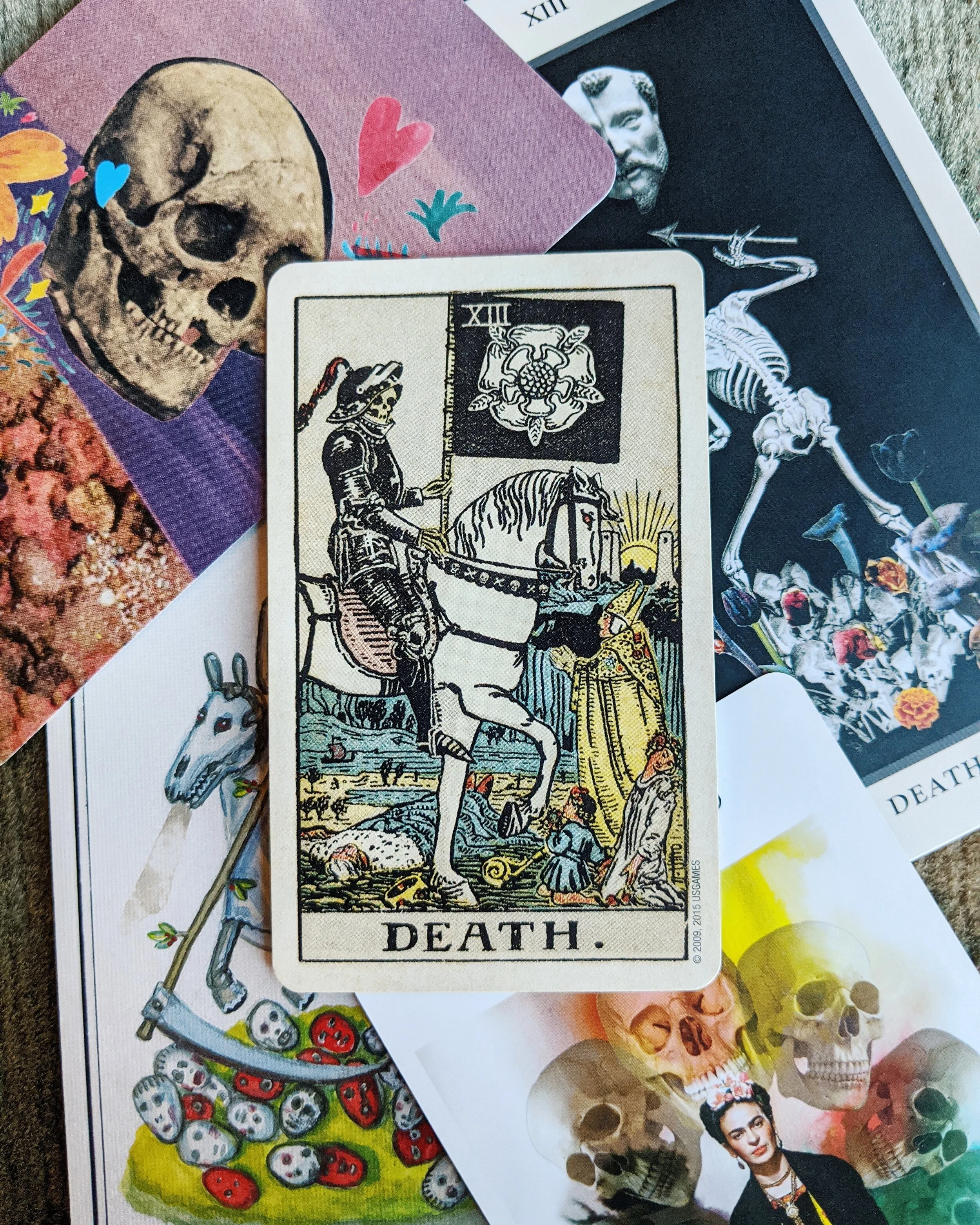
The most dominant cards in the tarot are called the Major Arcana, arcana being the Latin word for mystery or secret. There are 22 cards in the Major Arcana, and they depict the Fool’s Journey. It’s the tale of a young, naive protagonist who meets mentors, makes choices, encounters difficulty, and is transformed. Each step in the journey is portrayed in a numbered card, and in card 13, The Fool comes face-to-face with Death.
But Death is not the end. Death is not a disappearance or a finality. Death, in the tarot, comes just over halfway in the Fool’s Journey, and it is the gateway through which The Fool learns the most perilous, ephemeral, and changing lessons of all.
Tarot has been reimagined and reinterpreted by countless artists. Given our home in an art museum this evening, I want to spotlight just the tiniest handful of Death cards from various decks and see what they reveal about this archetypal energy.
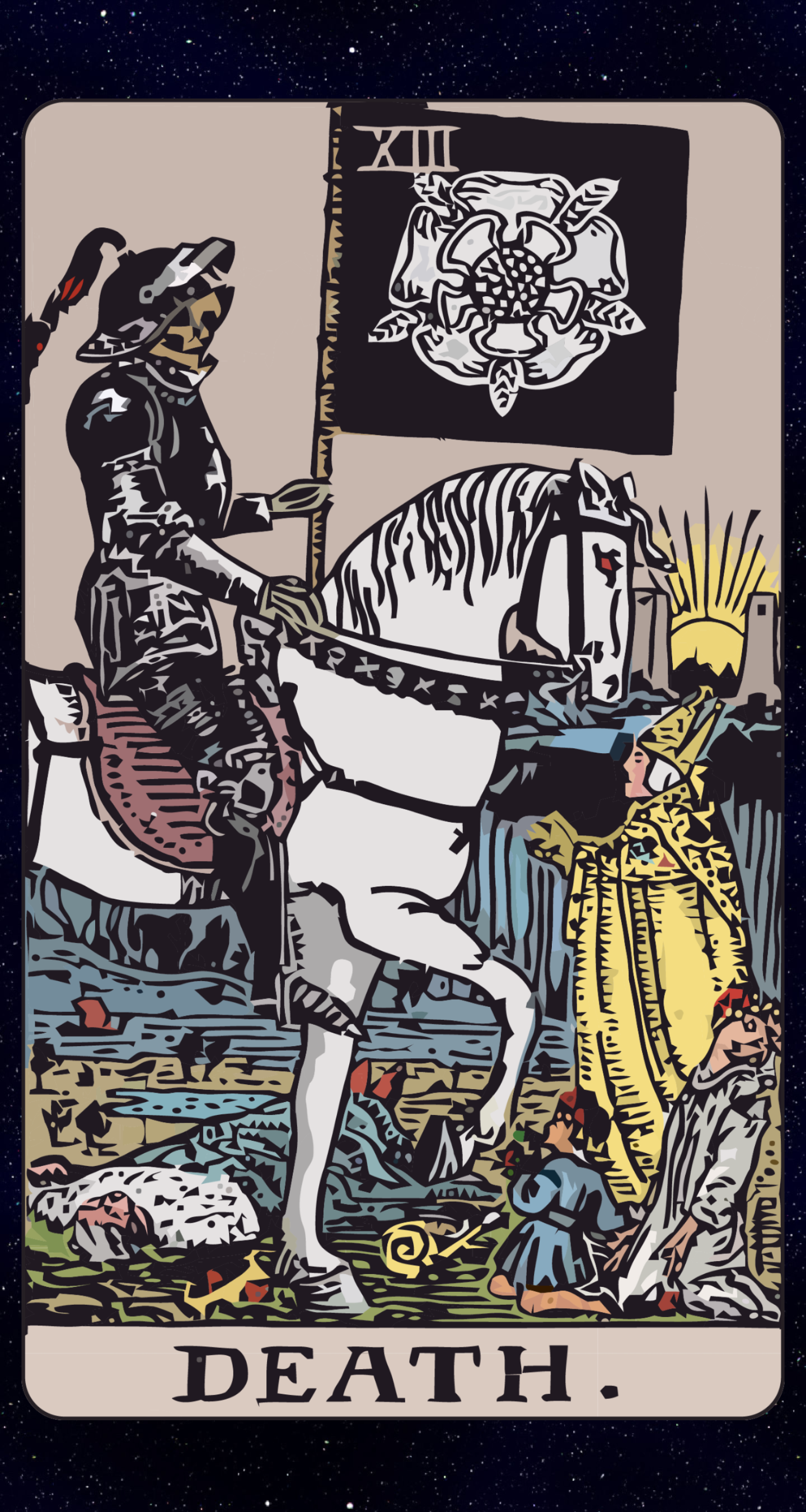
The most influential Death card in the world comes from the iconic Smith-Rider-Waite deck. Envisioned by academic and mystic A.E. Waite and published by the Rider company, all 78 cards in the deck were conceptualized and drawn by Pamela Colman Smith. The Death card features a skeleton in a suit of armor riding a white horse and carrying a black and white banner. Four other figures appear on the card -- a king, a church elder, a young woman, and a child. Each respond differently to Death’s arrival. The king is already overcome; his crown is on the ground, symbolizing how even powerful institutions are subject to death’s cycles. The church elder stands with his hands up, perhaps saying a prayer or performing a ritual to stop death’s advances. The young woman turns her head away to avoid seeing the truth right in front of her. The child kneels on the ground and looks up openly, offering a flower, welcoming this strange soldier. The Smith-Rider-Waite deck predates the theory of the Stages of Grief by many decades, but in these figures, I feel some commonalities: the king shows shock, the church elder shows bargaining, the young woman shows denial and depression, and the child, finally, shows acceptance.
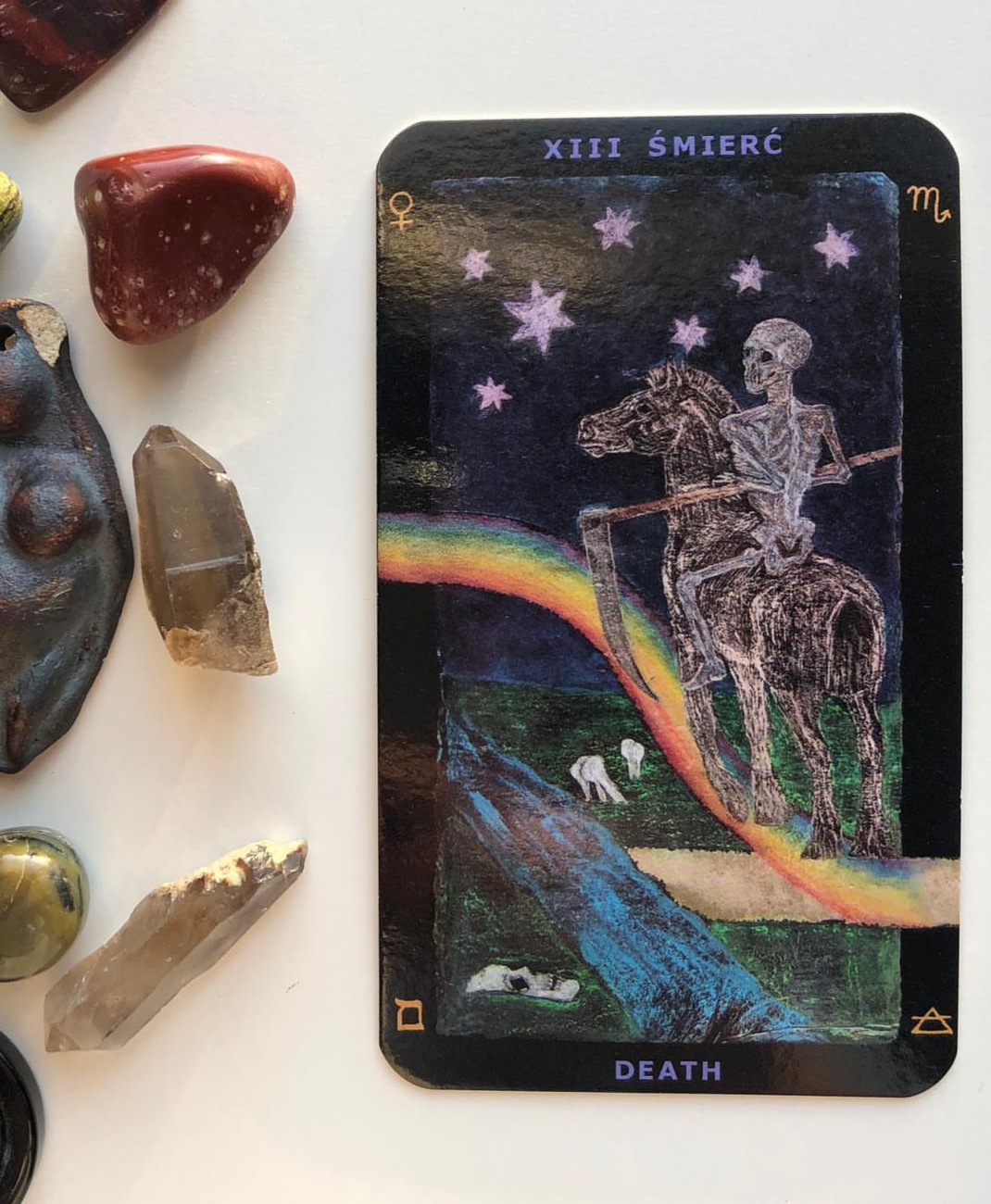
The rare Tarot Droga deck comes from Poland, and it too shows a skeleton on horseback, though this one rides an ascending rainbow with no one around to see. This horse and rider seem more humble than the ones on the Smith-Rider-Waite card -- no triumphant banner, no suit of armor, just the indication of a quiet journey to unseen realms.
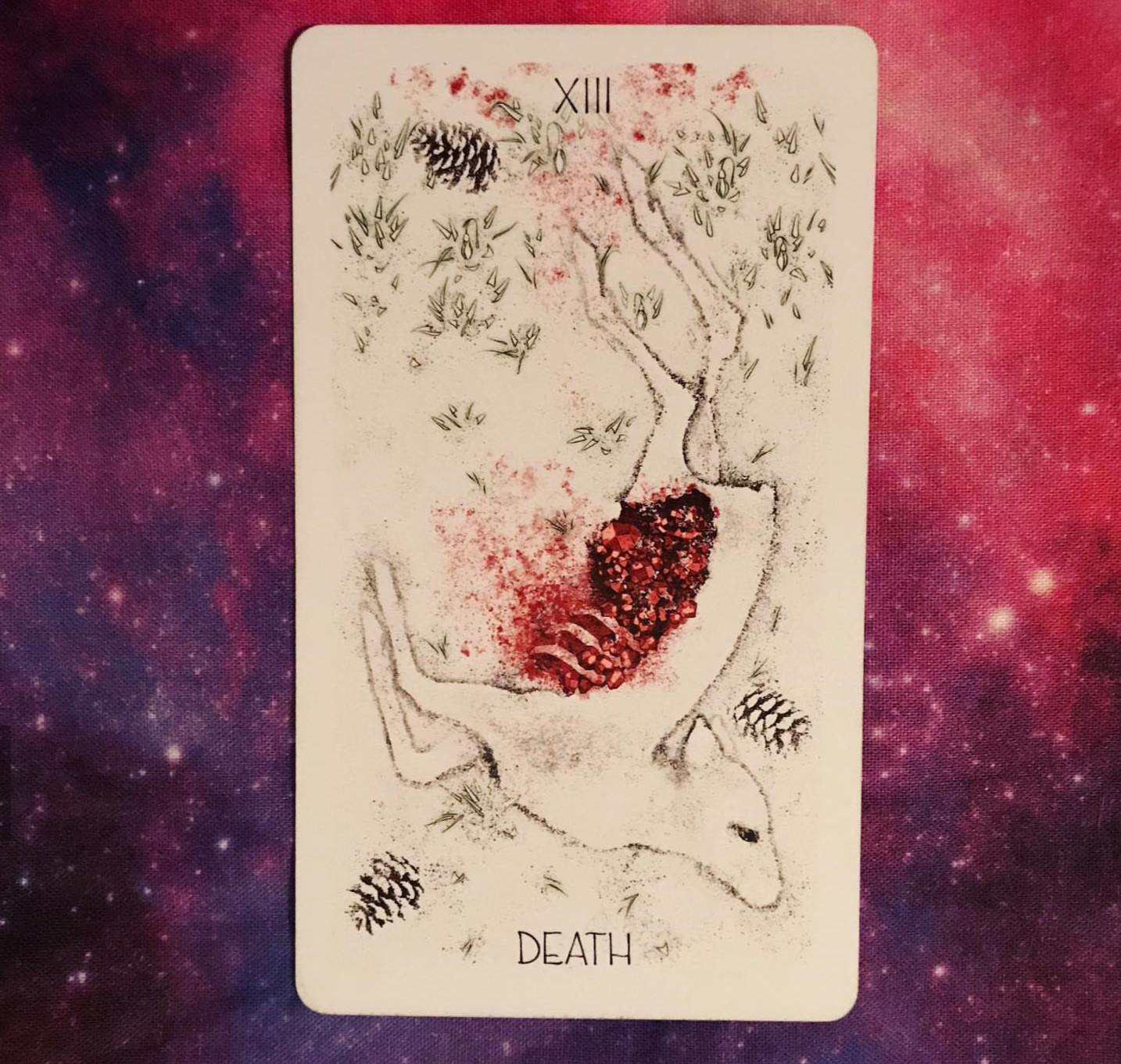
In The Wayhome Tarot, we see a fallen deer on a snowy forest floor, its bloody hoofprints showing up in stark red contrast. The animal’s belly is ripped open, but amidst the ribcage and intestines, we see glowing jewels as well. Decomposition is a major theme of the Death card. What dies can be broken down to such a level that it feeds the soil and enriches new life. This is just as true in our lives as it is in nature, and when the Death card appears in a reading, it can be an invitation to think about what is dying within us and how it might become fertile soil for something else to grow.
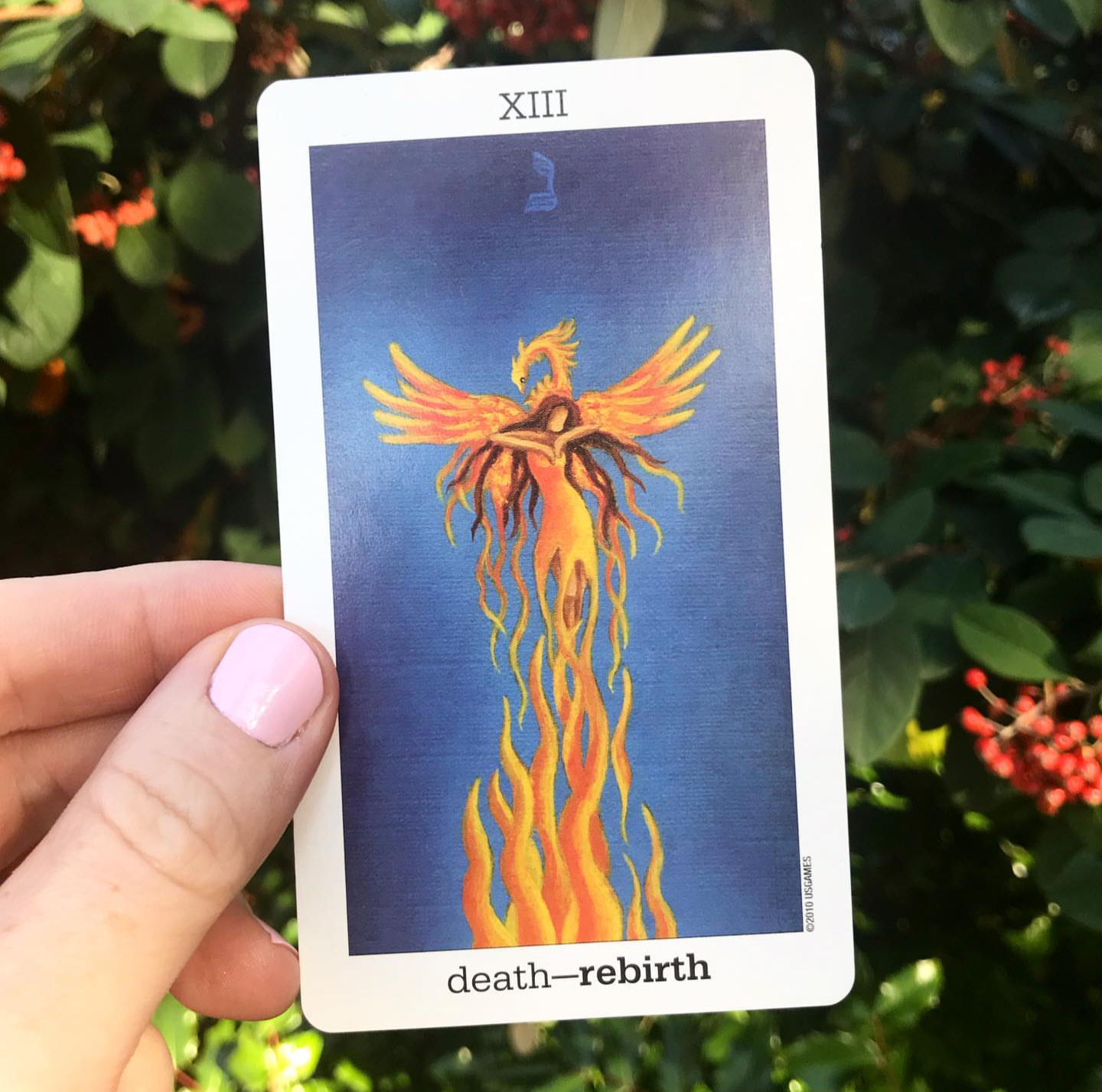
Here we have the Death card from the Sun and Moon Tarot deck, and it bucks the trend we’ve seen so far -- no bones in sight! Instead, this card is renamed Death/Rebirth, and it shows a creature who is both woman and phoenix rising from the flames. The myth of the phoenix is a beautiful parallel to the Death card, reminding us again of renewal.
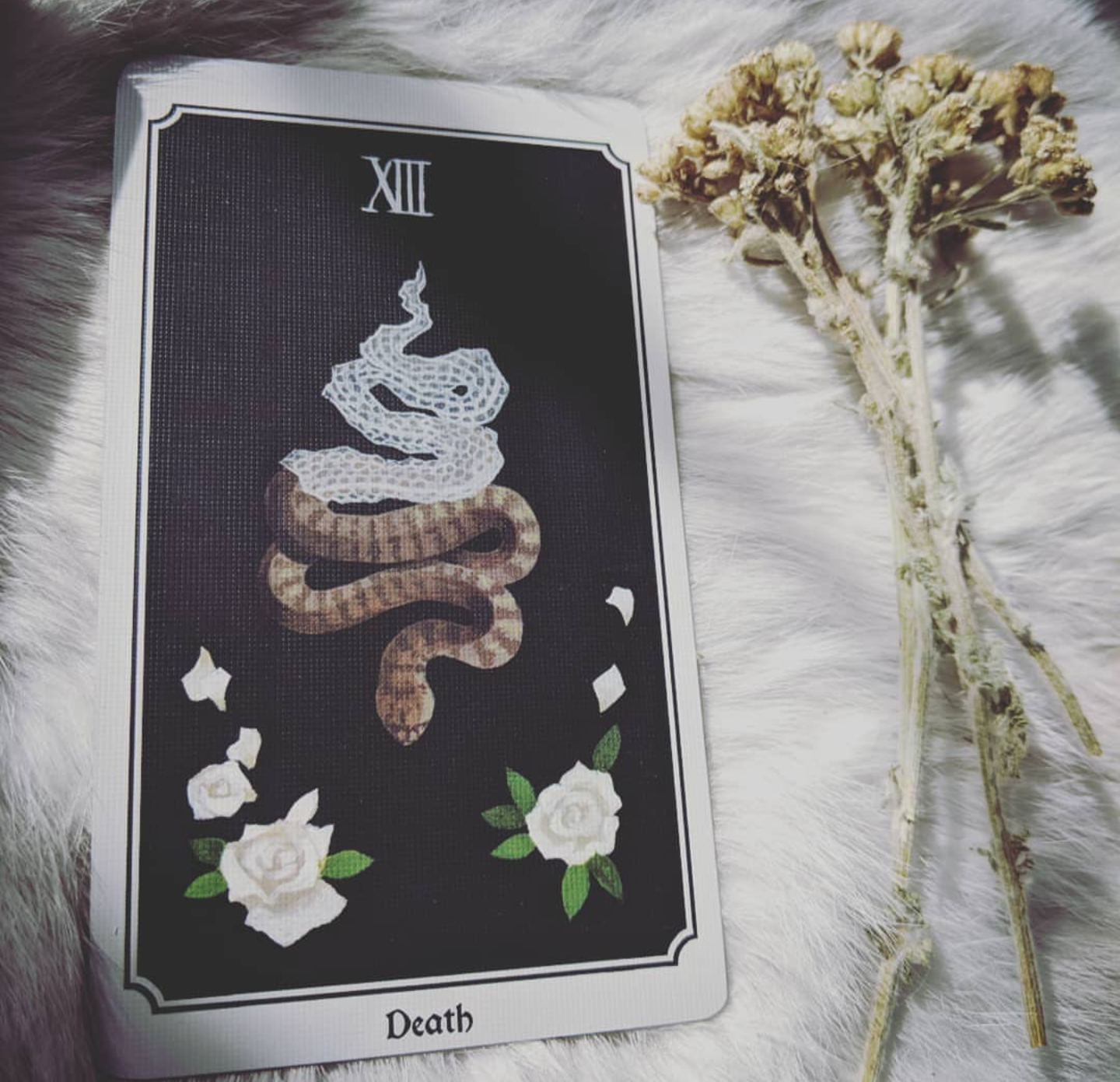
The Anima Mundi deck uses the metaphor of a snake shedding its skin to illustrate Death. Snakes are such feared and mysterious animals; you find them in some of the most compelling myths in every cultural tradition. The snake’s ability to shed what it outgrows is perfectly tied to the spirit of the Death card. So often, what we shed is ego, the little structures we build up all around us to say, “This is what I am, this is what I’m about.” The snake knows when those structures become too small and itchy and confining, and it works to slough off what has outlived its usefulness. Death, then, is a way of breaking free.
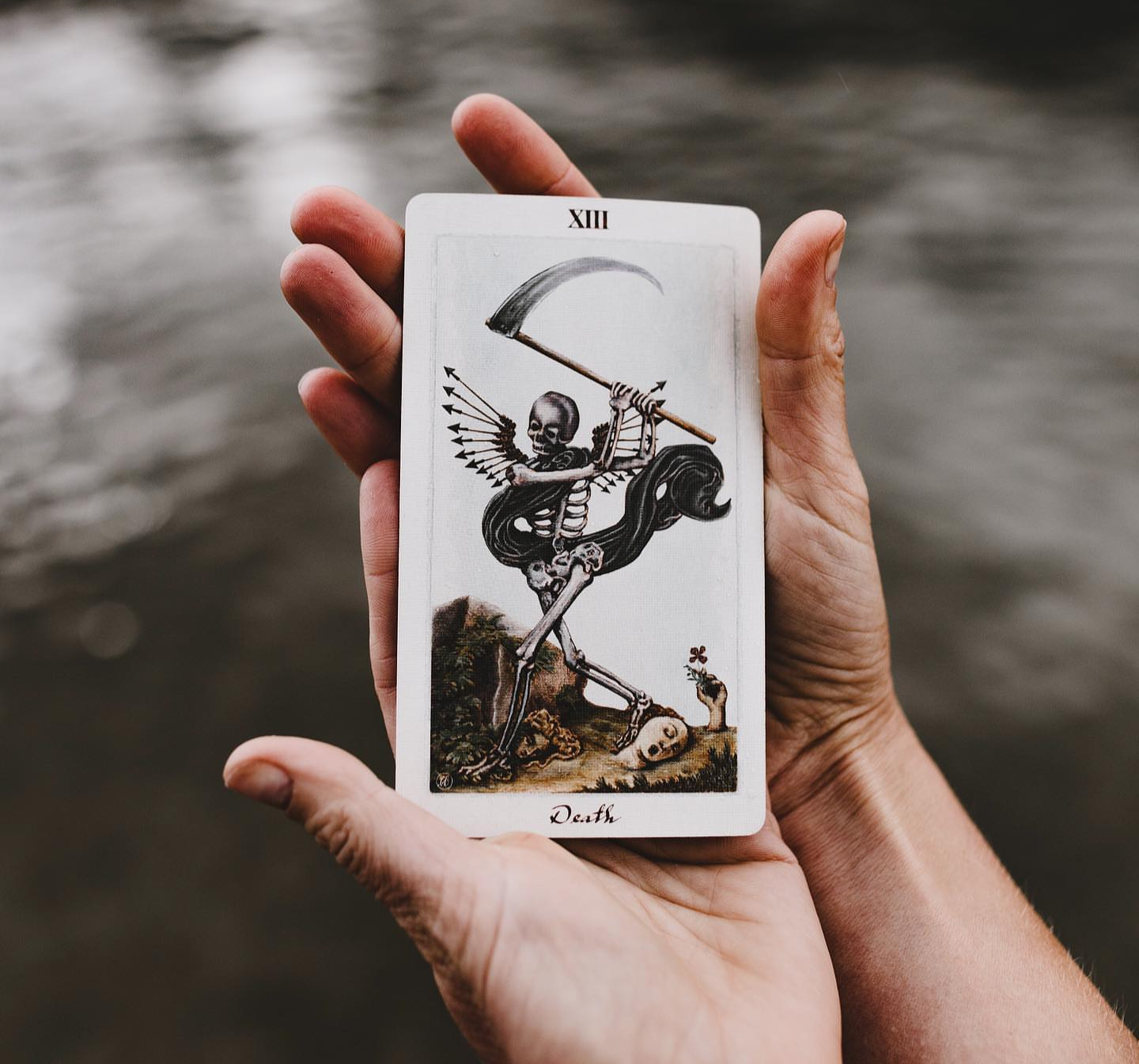
In the Pagan Otherworlds deck, Death shows up as a marauding skeleton with wings made of arrows, black scarf billowing, scythe swinging, bodies on the ground. This guy looks like he’s having a blast. A disembodied hand behind the skeleton holds up a four-leaf clover; my imagination fills in the pieces to say there’s a recently-deceased man somewhere saying, “But I thought today was my lucky day!” There’s a flavor of gallows humor in this version of the Death card. Death comes for all of us -- who says we can’t have a bit of fun with it?
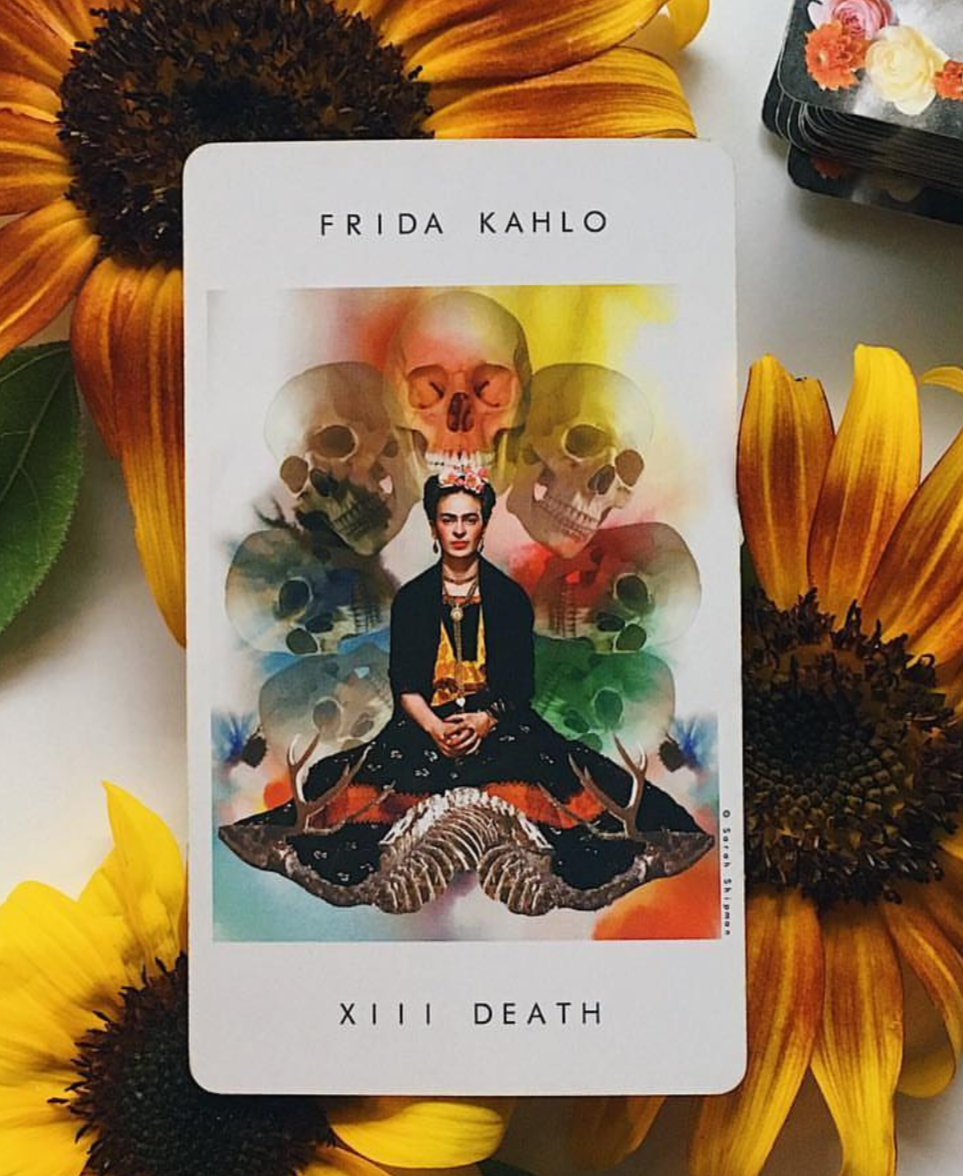
The Our Tarot deck connects each card with a notable woman from history. Death is embodied in Mexican artist Frida Kahlo, sitting serenely on a throne of deer skeletons, backdropped by a wreath of colorful skulls. This view of death is more psychedelic and even whimsical, in my opinion. The presence of a celebrated, innovative, revolutionary artist on the card brings out themes of creativity in Death.
And speaking of Frida, her words illuminate the ultimate meaning of Death in the tarot:
“Nothing is absolute. Everything changes, everything moves, everything revolves, everything flies and goes away.”
Death in the tarot is rarely indicative of a physical death, the moment your heart stops beating and whatever it is that made you human leaves your body for the next chapter of its journey. Death in the tarot is all the ways we shift and change and metaphorically die and are reborn a million times. It is change, transition, transformation, allowing something new to grow. It’s the way that old saying “This too shall pass” applies to every part of us, every part of everything.
The Death card isn’t a bad omen, it isn’t anything terrible, but I also have to admit it isn’t easy. We call it DEATH for a reason; the card isn’t called CHANGE, even though that’s the most neutral term for what it is when you get right down to it. We call this card DEATH because death, as natural and universal as it is, is scary as hell. People we love go away from us, and we don’t know where, and we can’t predict when, and we know it will happen to us too. It’s the great mystery, the one we can’t escape and so often do our best to ignore. Death taps into our deepest feelings of fear and loneliness.
In her book “The Bright Hour,” written when she was facing imminent death, Nina Riggs wrote this about her two young sons: “Their very existence is the one dark piece I cannot get right with in all this. I can let go of a lot of things: plans, friends, career goals, places in the world I want to see, maybe even the love of my life. But I cannot figure out how to let go of mothering them.” I read that in my kitchen while I made dinner one night, and tears came to my eyes immediately. I kissed my kids on the tops of their heads while they played around me, and I had to concur. I can’t imagine how to let go of mothering them.
Death forces us to let go of things we can’t imagine letting go of. And that’s necessary, it’s even beautiful sometimes, but it’s also very, very hard.
Clarissa Pinkola Estes wrote these words about death in her life-changing book, “Women Who Run With the Wolves”:
“We have been taught that death is always followed by more death. It is simply not so, death is always in the process of incubating new life, even when one’s existence has been cut down to the bones. Rather than seeing the archetypes of Death and Life as opposites, they must be held together as the left and right side of a single thought … While one side of the heart empties, the other fills. When one breath runs out, another begins.”
I hold these puzzling truths in balance whenever I see the Death card: that Death is okay, and that it’s also the least okay thing in the world. That it’s nothing to fear, and that fear is a completely reasonable response. That death allows for life, and life allows for death, and death allows for life, and life allows for death.