2020 Collective Reading
On the morning of December 31, 2019 (New Year’s Eve), I did a live collective tarot reading on my Instagram account. These are the cards and messages that I shared during that reading.
We’re going into 2020. It feels significant, to say the least. Anytime you’re stepping over a threshold into something new, it’s something to be thoughtful about, but with this year being a move into a new decade, along with the energy we’re all in, the enormity of it just feels heightened over any ordinary new year.
Today’s reading will be with the Modern Witch Tarot Deck by Lisa Sterle. I’ll be pulling 8 cards. We’ll look at the lessons of 2019 and also what’s coming up in 2020. When I do tarot readings, I tend to think of them as a way to connect with your intuitive self moreso than a way to predict the future, and at the same time, sometimes your intuition has a really good sense of what’s ahead. As we go through these cards and talk about the year ahead, I’ll try to be very thoughtful with my language around how the future is always being made. We don’t know what’s going to happen, but we can know what our souls are reaching for on the eve of this change.
Starting with an examination of 2019:
What was last year’s major lesson? Page of Cups
What was last year’s biggest achievement? Knight of Swords
What did we let go of last year? Six of Swords
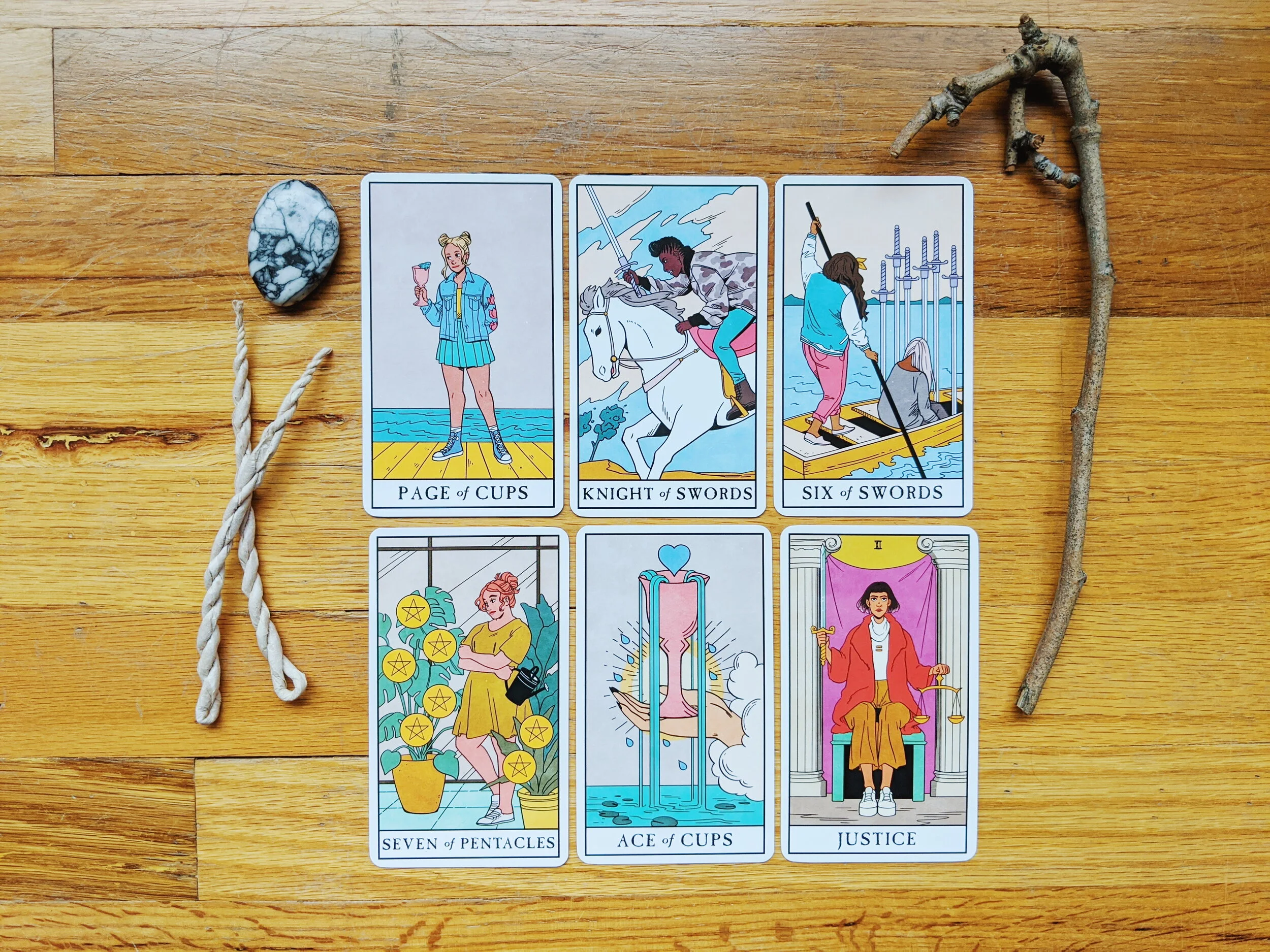
Beginning with last year’s major lesson, the Page of Cups. This is a card of such tenderness and inner child strength. All the Pages in the tarot remind me of students and of kids, how they learn by trying and doing and failing. My kids, for example, so frequently try to say a new word and get it completely wrong. They string a bunch of syllables together and just give it a shot. They don’t get it right on the first try, but they don’t seem to have that fear yet of being wrong or looking stupid. They learn by trying. The Pages are the same. Pages are associated with the element of Earth; they’re very connected to the planet, to the material realm, and to the body. Cups, on the other hand, are associated with the element of Water, and they speak to the heart, feelings, and emotions. In their highest form, Cups are all about recognizing the truths in your feelings and welcoming them. As last year’s major lesson, this card suggests that we were really learning how to be in this zone, how to be our most openhearted, student-like self.
Numerologically, 2019 has been a year of The Hanged Man (2+0+1+9=12, the number of The Hanged Man), and Hanged Man energy is about forced discomfort for your own growth. It can feel incredibly confronting; you’re completely changing your perspective and being forced to let go of things that are keeping you locked away in a cozy prison. A process like that requires you to shed a lot of layers and get down to a more elemental version of yourself, something pure and open like the Page of Cups. That’s what we were really getting in touch with during 2019.
As for the biggest achievement of 2019? Our card here is the Knight of Swords, which is very different from the Page of Cups on an elemental level; where the Page of Cups is blending earth and water, the Knight of Swords is blending fire and air. This card is all about learning how to move. The Knight of Swords is the fastest mover in the deck, someone who rushes headlong into battles and quests. She does so with determination, vision, and total confidence. For some of us, being able to move at this speed and get through SO MUCH inner work, so much processing and growth in just one year, has been an achievement of monumental proportions. This horse has been galloping for all it’s worth and covering a lot of ground, propelling us forward at a fast clip. That’s one kind of achievement, being able to move with that much speed, and another version is learning to work with Knight of Swords energy and speed in a way that’s more moderate and doesn’t leave you exhausted. For some of us, the achievement is learning to hold back the reins. Living in Knight of Swords all the time is wearing. The achievement might have been befriending the Knight of Swords without getting swept away. Some of us needed to slow down, and some of us needed to speed up, but either way, 2019 was a year of learning how to use fast movement and accelerated growth to our advantage. The Knight of Swords is dead-set on her goal, and she doesn’t see any use in putting it off. She’s ready, and she’s moving. And so were we in the previous year. The Hanged Man energy of 2019 probably felt really uncomfortable and possibly even like we were stuck at some points, like “What am I even doing here?” But I think the message here is that we were doing a lot more work than we may have realized in the moment.
What did we let go of last year? Six of Swords. I love the way this card is depicted in this deck. You have all the traditional hallmarks of the card: people in a boat with six swords, one person sitting, one person rowing. What I love here is that the person who’s rowing is a young person, and the person sitting is older, crone-like figure. I see them as a young person helping her elder or even possibly an older version of herself. There’s something here about caretaking the different versions of yourself, serving Future You. Sometimes the most loving thing we can do is care about our future selves and what’s going to be best for them, even if it’s not what we’d prefer for our present selves.
The Six of Swords is also about moving away from something reluctantly, but doing it because you know you need to, often for external reasons. The evidence becomes clear that it’s not safe or okay to stay where you are, and when you make the decision to move on, there’s definitely some sadness there. The destination is unknown, and the departure is discouraging. It feels a little like defeat, like you’re being forced to surrender even though you want to keep fighting. This card is showing up as a symbol of what we let go of in 2019, and I can definitely see that in my own life. In 2019, I let go of a friendship. It was very hard to do. Maybe you can relate with something you let go of in 2019, possibly due to forces beyond your control. There was probably a part of you that fought it kicking and screaming. But I can tell you one thing for sure: what we left behind in 2019 is not meant to come with us. This isn’t a situation where you let go for a while and will eventually resume; instead, it’s an irrevocable shedding.
If there’s anything you faced in 2019 where you reached the absolute end, it means that you’re really truly done with it for good. Let that be burned into your psyche and soul. It’s done. Don’t pick it up again. Don’t second-guess your choice. Don’t second-guess what you know you had to do. And at the close of this year, we’re letting go of the sadness and defeat over this letting go. We don’t have to feel like it was a loss anymore. We don’t have to feel conflicted anymore. We get to let go of that last shred of doubt. We’re not in a place of wondering if we did the right thing; now, we get to know for sure that it was right and good and needed. In hindsight, what looked like defeat was actually victory in a weird package.
Into this coming year …
What to expect this year? Seven of Pentacles
This year’s biggest challenge? Ace of Cups
This year’s theme? Justice
Let’s talk Seven of Pentacles. This lady’s waiting. She’s ready for her plant to be ripe, but it’s not time yet, and I think you can see a sense of loving impatience. We can get so impatient for things (and people) to be where we want them to be, but how can we fault them? They’re not ready because they’re just not ready. The fruit is giving everything it has to growing, and if it’s not ready, we have to accept that.
In 2020, we’ll need to be super aware of timing. Just because something is good and desirable doesn’t mean the time is right. Readiness is key. If you pluck the fruit off the vine too quickly, in your eagerness, you’re not accepting the gifts of the waiting or experiencing the ultimate sweetness of the fruit, so you’re ultimately hurting yourself. Waiting is a bridge. When you’re in that inbetween place of knowing what you want but needing more preparation time, that’s a liminal space. You’re on your way to something, but you’re not fully there. The archetypal magic of the bridge is that it is in two places at once and yet also in neither place. That’s the space you get to inahbit while waiting.
This card doesn’t feel to me like it’s suggesting a year of total waiting, but it seems that waiting will be an important factor in many things we do. 2020 is the year of the Emperor (2+0+2+0=4, the number of The Emperor card), and the Emperor is about sturdy structure, finite boundaries, and maintaining one’s own space. In order to do that, there does need to be precision around timing.
For this year’s biggest challenge, we have the Ace of Cups. In this deck and many others like it, the Aces are shown with the suit front and center, and here we have a cup, overflowing and abundant and drenched. It’s gorgeously giving. It’s being offered on a hand that emerges from a cloud, suggesting a heavenly gift. This is something that’s being offered as if from nowhere. All the Ace cards are the very beginnings of something; you don’t know where it’s gonna go, but you feel something stirring. Again, we’re looking at that sense of waiting.
With an Ace card, the question is always, “Are you going to accept the gift?” It’s being offered freely, and it’s truly up to you. No judgment. The challenge of this year: will we welcome in our heart’s truth? For some of us, that’s no problem. We live in Cups energy all the time, and we’re comfortable there. For others of us, being this vulnerable and stripped down to the heart, and loving and honoring our emotions, is not easy. We’d prefer some distance. We like to minimize or discount our feelings so we can stay where things make sense.
The Ace of Cups is an invitation to go within. 2020, like every year, will have a lot of activity; we’ll be in the midst of things like politics and social change and environmental change, and we’ll be navigating it all. There’s no avoiding that. But the Ace of Cups asks, “Can you feel it? Can you not just register facts, but also feel emotion? Can you allow joy and sorrow and peace and turmoil to coexist and really feel them? Can you let your feelings be welcome?” Our feelings are incredibly wise. Intuition understands things that the conscious mind cannot. It’s deeply logical. The book “The Gift of Fear” by Gavin deBecker talks about intuition prior to violent attacks, and in the moments before an attack, people often have an intuitive sense that something’s wrong and they need to protect themselves. They don’t have time to parse it out logically, to say “Wait a minute, X, Y, and Z are a little off, so therefore, I know I need to get out of here immediately,” but the intuition takes all that information and synthesizes it at lightning speed in a way the mind can’t keep up with. It tells us everything we need to know.
The Ace of Cups in 2020 asks, “Will we accept the gift of our own overflowing intuition and our own deep knowing? Will we trust it? Will we let it become part of us?” Intuition has been working overtime for you since the moment you were born. The gift we’re being offered is to more fully honor and acknowledge it, to work with it so we can recognize that intuitive whisper when it comes.
This year’s theme card is Justice. This is a card where the name can be a little deceptive. We think of the justice system, which can be so slanted and biased and home to profound injustice. The word “justice” can put us on edge because of the way it shows up in the overculture or in religion, where the idea of God’s justice can be wielded like a threat. The true soul of Justice, though, isn’t about an external force dealing out punishments left and right. To me, Justice is about true sight. The woman on the Justice card is holding her sword stock straight. She’s strong. In her other hand, she’s holding scales in perfect balance, with delicacy and also firmness. She’s sitting with strong posture. She sees her own authority. Her eyes are up and open.
There’s a sense with Justice of seeing things for what they truly are, without regard to how they could or should have been. We have a lot of stories around what happens to us and to the world. We have stories about how what happens is not okay, and that can be 100% true. However, in Justice, we have the opportunity to contextualize things in a different way for a clear purpose. Regardless of whether something is okay, Justice allows you to process and accept that it’s happening, then figure out what to do with that information. Justice is not interested in excuses or anything that will distract, minimize, or misrepresent reality. Justice only cares about relevant pieces of truth.
In 2020, with Justice and the Ace of Cups in our corner, we get to integrate intuitive knowing and then use that knowing to act from a basis of truth. So many times, we can get caught up in sadness around things we’re not okay with, and that’s a perfectly human response. Justice, however, invites you into a space of objectivity in order to find solutions. It’s such a powerful energy to channel because it lets you get shit done. When you know the truth, you can actually make a change. You can make things better in the future because you fully understand how they are right now.
Wrapping up with our final two cards …
Advice for this year? The High Priestess
How to approach the transition between 2019 and 2020? Seven of Wands
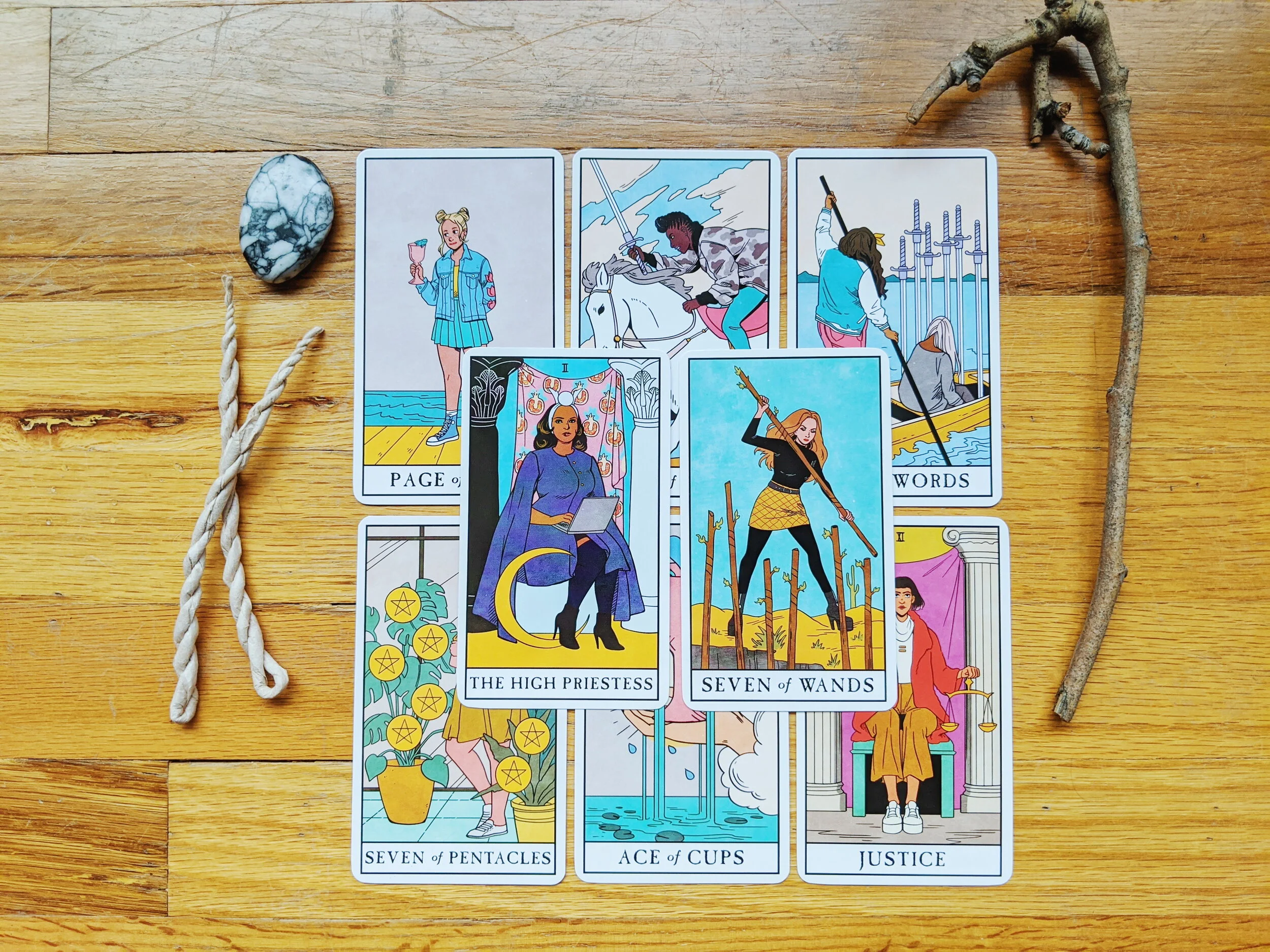
Anytime the High Priestess shows up, it’s a cause for celebration. To me, the High Priestess puts an exclamation point on the Page of Cups and the Ace of Cups that we saw earlier in the reading, both of which return us to intuition. She is the deepest listener. She is all about receiving internally. She tells us to stay close to our divine channel, to tend it and honor it. Your intuition is always gonna be there for you, it’s not going anywhere, but you can strengthen your connection with it by paying attention to it and and honoring it. Any love you give yourself is love you’re giving your intuition, by default, because it is a part of you. The High Priestess advises you to congratulate yourself for being the wise person you are. She says, “Go within. Be willing to clear out distraction. Be willing to fly with your own wings. Be willing to rely on your own channel. Be willing to trust.”
High Priestess doesn’t need external validation or praise; she cares only about her own connection with the divine, not about preaching or convert. We can look at 2020 as a year to be fully invested in the personal experience of spirituality and personal connection to the divine. What other people think is literally irrelevant to this area of life, so don’t feel like your wisdom is up for anyone else’s vote. It doesn’t matter whether anyone else sees or believes it. The High Priestess is fully sovereign and self-contained.
Going into an Emperor year, it can seem like the Emperor and the High Priestess are very much at odds as these archetypal masculine and feminine figures, but in actuality, they’re wonderful complements. There’s a deep, profound respect between these two energies for doing work that the other is incapable of, and it’s wonderful to think of how we might integrate both sides of the spectrum in the year ahead.
Finally: the Seven of Wands for how to approach the transition between years. This is a card of defense, for better or for worse. Sometimes defense is overzealous or ill-placed, and sometimes, it’s exactly right. As we go into 2020 and settle into what it’s creating in us and in the world, I think the Seven of Wands advises that we claim space claim the right to say “no.”
The woman on the card has the high ground, and the other wands in front, we can imagine, are being held by people who want to be where she is. Maybe their motivations are destructive, meaning they want to invade and kick her out, or maybe they simply want to join her on the plateau. Either way, the Seven of Wands woman says, “No. You don’t get to come in without my permission.” Understand that it’s totally fine to claim space that’s just for you, even if it means turning people away. No one has automatic access to your time, talents, body, or creative fire.
This transition between years is momentous, and each of us will be stepping into something very important for our own development. If anyone comes along in that process to demand something of you, or if anyone is expecting to be where you are, you get to say no. You get to have room to go through whatever you’re going through. No one is entitled to come in just because they show up. Other people are not entitled to your work. Their desire can be totally pure and genuine, but your fire is your own. Wands as a suit speak to spirit and creative forces, and creation is such a taxing process; other people don’t just get to show up to the party without an invite. Your fire is not theirs for the taking. The Seven of Wands says, “This is my space. I have a right to be here and to decide who is welcome to join me.” Everyone has to do their own work, and no one is entitled to capitalize on yours. Keep that in mind during this initial entry into 2020.
There you have it! Looking at these cards as a group, that theme of intuition is very strong. There’s gonna be a lot of people and things competing for our attention in 2020, and a lot of it will be very worthwhile. How will we discern where to place our attention? How will we know when the time is right to make an important move or seize an opportunity? If we strengthen that bond between conscious self and intuitive knowing, we’ll detect the way forward.
We are right here on the cusp. It’s a big time. I wish you well. Stay safe. Be protective of your energy. Listen to that intuitive whisper.